Plus: Fortastra raises $30 million
By Jeff Foust
In this today's edition: FCC to free up more spectrum for D2D services, Fortastra raised $30 million for highly maneuverable spacecraft, NASA releases Artemis 2 science data, and more.
If someone forwarded you this edition, sign up to receive it directly in your inbox every weekday. Have thoughts or feedback? You can hit reply to let me know directly.
|
|
|
|
FROM SPACENEWS |
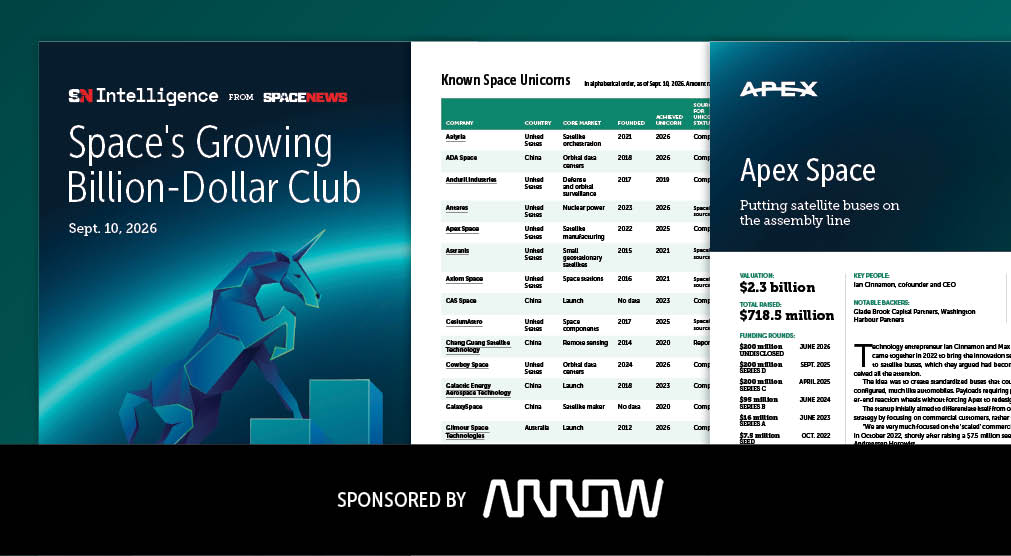 |
Explore the themes connecting space unicorns: The number of private companies valued at $1 billion or more has rocketed as the maturing space industry draws deeper pools of capital from asset managers, sovereign wealth funds and other institutional investors. Read the latest SpaceNews Intelligence report to track where investors see the biggest opportunities. Download now. |
|
|
|
|
|
Top Stories
The FCC plans to make more spectrum available for satellite direct-to-device services. The FCC said Wednesday it will vote Oct. 29 on a proposal to make an additional 482 megahertz of licensed spectrum available for what it calls Supplemental Coverage from Space (SCS). That spectrum would come from low- and mid-band frequencies already licensed for cellular or flexible use, a senior FCC official said, building on SCS rules that have enabled Starlink Mobile to connect smartphones and other devices in the United States via T-Mobile's spectrum. The announcement came a day after the FCC authorized SpaceX to deploy 15,000 next-gen direct-to-device satellites for its Starlink Mobile constellation. The upgraded satellites are authorized to operate in shells between 326 and 335 kilometers above Earth to reduce latency, compared with as low as 340 kilometers for existing Starlink Mobile spacecraft. [SpaceNews]
Fortastra, a startup developing maneuverable spacecraft for on-orbit security, raised $30 million in a Series A investment round. The company announced the round Thursday led by First In, with participation from several other funds. The funding also will allow Fortastra to expand its engineering and operations workforce, extend its manufacturing infrastructure and enhance the agentic and collaborative autonomy of its satellites. Fortastra seeks to establish a large constellation of highly maneuverable spacecraft to guard critical assets, evaluating surrounding activity and responding to potential threats. [SpaceNews]
An ESA study concluded it is feasible for Europe to pursue a heavy-lift reusable launch vehicle. In a presentation at the International Astronautical Congress (IAC) on Wednesday, an ESA official said the agency study found that it is technically feasible for Europe to build a vehicle that would be partially or fully reusable and place at least 30 tons into low Earth orbit. The business case for such a vehicle also closes, the study found, assuming a flight rate of 24 launches a year. ESA officials have expressed interest in pursuing such a vehicle, which could be one of the topics of an ESA intermediate ministerial meeting in December. [SpaceNews]
Colorado-based York Space Systems is expanding its presence in Austin, Texas. The company announced Thursday it will open a new office for software development there, joining an existing office from the company's 2023 acquisition of Emergent Space Technologies. The company's Texas workforce is expected to grow by 10% to 15% in the next year. [SpaceNews]
Some U.S. military aircraft and ground vehicles may not be fully equipped with modernized navigation systems until mid-century. That conclusion came from a GAO report Wednesday on modernization of the GPS system, including new receivers that are more resilient to disruptions of space-based systems. The Army does not expect to complete fielding of its EAGLE-M secure GPS navigation system across its aviation fleet until 2049, while full deployment of the next generation of its MAPS navigation system for ground combat vehicles is projected for 2050 or later, the report stated. One challenge has been a limited supply of chips for receivers that can use the more secure GPS M-code signals. [SpaceNews]
NASA is providing more incentives for countries that sign the Artemis Accords. NASA Deputy Administrator Matt Anderson, who co-chaired a meeting of Artemis Accords countries at IAC this week, said that the proposed U.S. Space Academy could be open to students from countries who sign the accords, similar to military academies that enroll a small number of international cadets. That is in addition to offers by NASA to allow Artemis Accords countries to participate in the agency's lunar base effort. The IAC meeting included representatives of 44 of the 76 signatory countries. [SpaceNews]
|
|
|
|
|
Other News
SpaceNews has published the finalists for this year's SpaceNews Icon awards. The finalists are in categories ranging from civil and military space achievements to international collaboration, innovative technology and the deal of the year. The winners will be announced at the 2026 SpaceNews Icon Awards on Dec. 1 in Washington D.C. [SpaceNews]
NASA released Wednesday the full science dataset from the Artemis 2 mission. The data, released at an event during IAC, includes 12,000 photos as well as hours of crew audio records and handwritten annotations the astronauts made as they observed the moon during the April mission. Scientists said the data show the value of human observations in addition to cameras and other instruments. [SpaceNews]
Elon Musk claimed that "certain oligarchs" are blocking SpaceX from offering Starlink in India. In a social media post, Musk claimed those individuals, whom he did not name, are keeping Starlink from offering service in India "to maintain their monopolistic chokehold on the Indian people." Indian officials pushed back on the claims, with India's Ministry of Communications stating that Musk's claims are "baseless and misconceived" and that every operator must comply with laws and regulations, including security rules. The ministry said that Starlink, along with OneWeb and India's Jio Satellite Communications Ltd., are all at roughly the same stage of the licensing process. [The Statesman]
Virgin Galactic performed a glide test of its old suborbital vehicle as part of training for its new one. The company said Wednesday it flew its VSS Unity vehicle on a glide flight from Spaceport America in New Mexico, dropping it from its carrier aircraft to glide back to the spaceport's runway. The flight was part of pilot training ahead of test flights for its first Delta-class suborbital spaceplane in the coming months. [X @virgingalactic]
A Canadian government minister said the country will consider recruiting a new astronaut class in the near future. Minister of Industry Mélanie Joly, whose portfolio includes space, said in an interview that the government would consider selecting more astronauts once one of its current astronauts, Jenni Gibbons, is assigned to a spaceflight. With the retirement earlier this year of Jeremy Hansen after Artemis 2, Canada has three active astronauts, including Josh Kutryk, who launched to the ISS last week on his first flight. Joly did not give a schedule for starting an astronaut selection but said she hoped to see measurable progress on a selection process as well as a flight assignment for Gibbons in the next year. [SpaceQ]
The woman who programmed the computers used on Apollo 11 has died. Margaret Hamilton died Sept. 30 at the age of 90. She worked as a computer programmer in the MIT Instrumentation Laboratory in the 1960s, developing software for the computers guiding Apollo 11. Those computers, state of the art at the time, had just 72 kilobytes of memory. A famous photo shows Hamilton standing next to a printout of the code for the Apollo computers; the stack of paper was as tall as her. Hamilton also popularized the term "software engineering" to describe the complexity of computer programming. [New York Times]
|
|
|
|
|
|
|
|
Totally Fictitious Orb
|
"This is the most ridiculous thing I've ever seen in my entire life. Dude, it looks like a totally fictitious orb."
|
– NASA astronaut Reid Wiseman, describing his view of the moon during the eclipse portion of Artemis 2's lunar flyby in audio NASA released Wednesday as part of the mission's science data.
|
|
|
|
|
|
|
FROM SPACENEWS |
 |
Unlike traditional press wires, Stellar Dispatch ensures your message gets in front of industry leaders and decision-makers. Reach thousands of professionals directly, get enhanced search visibility and maximize your distribution. Make your first post today for $899, or save with our plans that include multiple posts. |
|
|
|
|









No comments:
Post a Comment