Wednesday, October 7, 2026

Editor's Choice: When the industry needs more ... or less


Plus: Graveyard orbits and dead satellites
 ‌ ‌ ‌ ‌ ‌ ‌ ‌ ‌ ‌ ‌ ‌ ‌ ‌ ‌ ‌ ‌ ‌ ‌ ‌ ‌ ‌ ‌ ‌ ‌ ‌ ‌ ‌ ‌ ‌ ‌ ‌ ‌ ‌ ‌ ‌ ‌ ‌ ‌ ‌ ‌ ‌ ‌ ‌ ‌ ‌ ‌ ‌ ‌ ‌ ‌ ‌ ‌ ‌ ‌ ‌ ‌ ‌ ‌ ‌ ‌ ‌ ‌ ‌ ‌ ‌ ‌ ‌ ‌ ‌ ‌ ‌ ‌ ‌ ‌ ‌ ‌ ‌ ‌ ‌ ‌ ‌ ‌ ‌ ‌ ‌ ‌ ‌ ‌ ‌ ‌ ‌ ‌ ‌ ‌ ‌ ‌ ‌ ‌ ‌ ‌ ‌ ‌ ‌ ‌ ‌ ‌ ‌ ‌ ‌ ‌ ‌ ‌ ‌ ‌ ‌ ‌ ‌ ‌ ‌ ‌ ‌ ‌ ‌ ‌ ‌ ‌

10/07/2026

READ IN BROWSER

SpaceNews logo
Space News Editor's Choice newsletter logo

The updates your team needs to make smart decisions: Set up SpaceNews access for five or more readers and save more than 25%. Learn more.

By Mike Gruss


More.


That one word can sum up much of what’s happening in the space industry and for evidence look at this week’s headlines. 


More, more, more.


This news is the result of a booming space economy. And that economy is built on the assumption that you can’t have more space services without more launches, and you can’t have more launches without more satellites needing to go to space and you can’t have more satellites without a robust supply chain. 


In this new era of megaconstellations, Hope Hodge Seck examined how, when the industry is full of giant numbers, this complicated puzzle fits together. 


The unprecedented rush to put satellites into low Earth orbit is colliding with shortages of specialized components and materials, suppliers struggling to keep up and competition from the booming artificial intelligence industry. The squeeze is forcing satellite companies to rethink designs, accept delays and confront a more fundamental question about the timelines for what’s possible.


Competition for scarce resources and supplies amid surging demand is forcing tradeoffs in industry that threaten to delay launches and may push companies out of the market or trigger greater consolidation.


There’s also this:


According to some estimates, the next few years could mean the nearly 19,000 satellites now in LEO will be joined by 70,000 more. And while analysts who spoke with SpaceNews were, across the board, unwilling to speak to companies’ plans and challenges on the record, they agreed that the coming demand signal will only exacerbate already-felt bottlenecks around limited and necessary resources.


It all requires a significant amount of foresight and for each step of the way to go as planned.


There’s also a flip side to all of this abundance. Less. What happens when an organization is done with its spacecraft? More trips to the graveyard.


The Space Development Agency is moving from studies toward flight demonstrations and operational missions.


Its latest initiative is Deorbit-as-a-Service, a program jointly funded with the Defense Innovation Unit, a Pentagon organization that works to bring commercial technology into military programs. Firefly Aerospace, D-Orbit Space and Katalyst Space are competing in an initial phase worth a combined $8.4 million to develop mission designs.


Preliminary design reviews are expected by the end of the year, according to SDA officials. The broader goal is to put a prototype in orbit by mid-2028. The three companies are competing for a follow-on phase in which one would be selected for the flight mission.


📲  Download the SpaceNews mobile app


FROM SPACENEWS

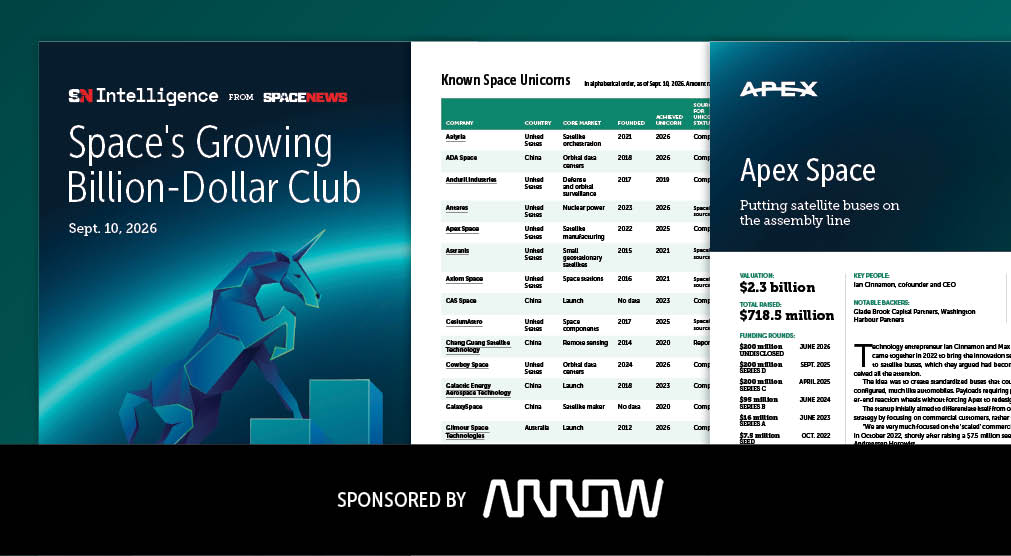
Download the latest SpaceNews Intelligence report,

Explore the themes connecting space unicorns: The number of private companies valued at $1 billion or more has rocketed as the maturing space industry draws deeper pools of capital from asset managers, sovereign wealth funds and other institutional investors. Read the latest SpaceNews Intelligence report to track where investors see the biggest opportunities. Download now.

SIGNIFICANT DIGIT


26

The number of Starlink V3 satellites the Starship Flight 14 mission launched Sept. 28 despite some initial concerns about the early shutdown of one of six engines in the upper stage.

An artist's rendering of a DSP satellite. Credit: U.S. Space Force Illustration by John Ayre.

AN UNUSUAL FINAL ASSIGNMENT


I know it’s October but we really didn’t plan for this (spooky?) edition to be about end of life and graveyard orbits. 


Nonetheless, it’s worth noting the U.S. Space Force has retired its Defense Support Program missile-warning constellation, ending more than five decades of operations for a satellite family that provided some of the Pentagon’s earliest space-based warning of missile attacks.


The Pentagon launched 23 DSP satellites between 1970 and 2007, with the final two spacecraft launched in 2004 and 2007. The last batch of satellites each had a price tag of about $400 million, which means the constellation cost more than $8 billion. 


Developed during the Cold War to provide warning of Soviet and Chinese ballistic missile launches, the constellation later detected Iraqi Scud launches during Operation Desert Storm and continued operating alongside the newer Space Based Infrared System, or SBIRS. 


The service disclosed Oct. 1 that the two final DSP satellites took part in U.S. Space Command’s Apollo Maneuvers exercise in September, where crews repositioned the aging spacecraft before sending them to supersynchronous disposal orbits.

Trending This Week


Varda Space Industries, a company that operates reentry spacecraft for pharmaceutical and hypersonics research applications, has raised $251 million as it prepares to launch three missions in the next month.


Two small satellites York Space Systems built for the U.S. Space Force will be used to detect, track and maneuver near other objects in geosynchronous orbit. The Space Force had described it as a “two-for-one” purchase.


Thomas Zurbuchen, a former NASA associate administrator for science, is joining Blue Origin as senior vice president of advanced concepts.


Space Force Lt. Gen. David Miller Jr. is expected to be nominated to become the next head of U.S. Space Command.


FROM SPACENEWS

Learn more about our Stellar Dispatch press release distribution service

Unlike traditional press wires, Stellar Dispatch ensures your message gets in front of industry leaders and decision-makers. Reach thousands of professionals directly, get enhanced search visibility and maximize your distribution. Make your first post today for $899, or save with our plans that include multiple posts. 

Subscribe to SpaceNews


No comments:

Post a Comment

Editor's Choice: When the industry needs more ... or less

Plus: Graveyard orbits and dead satellites  ‌ ‌ ‌ ‌ ‌ ‌ ‌ ‌ ‌ ‌ ‌ ‌ ‌ ‌ ‌ ‌ ‌ ‌ ‌ ‌ ‌ ‌ ‌ ‌ ‌ ‌ ‌ ‌ ‌ ‌ ‌ ‌ ‌ ‌ ‌ ‌ ‌ ‌ ‌ ‌ ‌ ‌ ‌ ‌...