By Jeff Foust
In today's edition: the final O3b mPower satellites are ready for launch, NASA adjusts Artemis spacesuit requirements, a new office plans to consolidate NASA launch activities and more.
If someone forwarded you this edition, sign up to receive it in your inbox every weekday. Have thoughts or feedback? You can hit reply to let me know.
|
|
|
|
|
|
SPONSORED |
 |
As constellations scale, regulatory approvals are stuck in a massive queue. More launches are delayed by paperwork than by hardware. Invariant AI closes that gap: what takes eight months the traditional way, we do in five. We handle FCC, ITU and NOAA authorizations, alongside ITAR, EAR and FAA compliance, for satellite operators and launch providers who can't afford to wait in a queue. Every filing is built and reviewed by a lawyer working alongside our AI platform, which identifies the right approvals, drafts the documents and submits them directly to the regulator, at a fraction of the usual cost. You build. You fly. We own the filings, end to end. |
|
|
|
|
Top Stories
Boeing has completed the final three O3b mPower satellites for SES. The companies said Wednesday that the three satellites, designated F11, F12 and F13, have arrived at Cape Canaveral for launch on a Falcon 9 later this month. The delivery marks one of the final milestones for a contract that began with an order for an initial seven satellites in 2017. Launches got underway about five years later. The first six satellites suffered electrical issues, one factor in the SES decision to expand the constellation to 13 satellites. While SES prepares to add the final pieces to its O3b mPower network, the company has already begun laying the groundwork for a follow-on generation it calls meoSphere, using satellites built by K2 Space. [SpaceNews]
NASA is adjusting requirements for a lunar spacesuit to ensure it is ready in time for a 2028 landing. At a meeting this week of NASA's Aerospace Safety Advisory Panel, committee members said that NASA is shortening duration requirements for Axiom Space's AxEMU suit for the first Artemis landing missions, noting the original longer-duration requirements would not be needed on those first missions. The change is part of efforts to keep development of the suit on schedule for Artemis 4, planned for 2028. The panel said NASA has increased insight into suit development and holds meetings with Axiom six days a week. Suit development was also a factor in NASA's decision to obtain a Boeing 737 for use in reduced-gravity flight testing, as the plane will be able to briefly simulate lunar gravity to test spacesuit mobility. [SpaceNews]
Satellite antenna manufacturer All.Space has signed an agreement with the Pentagon’s Defense Innovation Unit to demonstrate high-rate production. All.Space said this week it received an Other Transaction Agreement from the Defense Innovation Unit under a program aimed at bringing high-volume commercial manufacturing practices into the national security space supply chain. The value and duration of the agreement were not disclosed. DIU is paying All.Space to demonstrate that the terminals can be integrated, tested and qualified at substantially higher production rates. All.Space was acquired by satellite manufacturer York Space Systems in July. [SpaceNews]
A new NASA office plans to consolidate launch procurements, which could lead to bulk buys of rockets. The Commercial Access to Space, or CAtS, office was created as part of an agency-wide reorganization earlier this year as part of the new Human Spaceflight Mission Directorate. The office will be responsible for all launch activities outside of human spaceflight, an official said at a recent conference. While plans are still in development, CAtS may oversee block buys of five to 20 rockets at a time, a change from NASA's traditional approach for procuring launches for individual missions. CAtS will also oversee agency rideshare launch opportunities. [SpaceNews]
Samara Aerospace received an award from the National Science Foundation to improve attitude-control technologies. The $1.22 million SBIR Phase 2 contract will allow the company to subject its Multifunctional Structures for Attitude Control (MSAC) technology, which uses piezoelectric actuators in the hinges of deployable panels, to extensive ground tests. Next year, Samara plans to launch Hummingbird, a small satellite based on MSAC technology that the company is developing with funding from the Space Force's SpaceWERX innovation unit. [SpaceNews]
|
|
|
|
|
Other News
Rocket Lab launched another satellite for Japanese radar-imaging company Synspective on Wednesday. An Electron rocket lifted off from the company's Launch Complex 1 in New Zealand at 8:01 a.m. Eastern, after a delay of nearly an hour because of high winds. The rocket successfully deployed into low Earth orbit the latest StriX satellite for Synspective. This was the 11th launch of a Synspective satellite on Electron while another Japanese radar-imaging company, iQPS, has launched nine satellites on Electron. The two companies have a combined 25 additional Electron launches under contract. [SpaceNews]
The White House has reportedly been pressuring American companies not to attend the International Space Summit in France next week. An official with the White House's Office of Science and Technology Policy told representatives of several companies, including SpaceX, in a private call last week to skip the summit, reportedly because of Chinese participation in the event and a lack of coordination between France and the United States. U.S. government officials are still expected to attend, though, and the schedule shows that executives of several American companies will appear on panels or other conference events. [Politico]
Russia's answer to Starlink is struggling. A recent analysis showed that the second set of 16 satellites for the Rassvet constellation, launched in July, have stopped raising their orbits and are well below their expected orbit of 550 kilometers. It's not clear why the satellites have not reached their operational orbits. Twelve of the first set of 16 launched in March are in that orbit, while the other four apparently failed in orbit. [Kyiv Post]
Two space science instruments on NASA's New Horizons spacecraft could shut down next month because of a lack of funding. The instruments, which measure the solar wind in the distant reaches of the solar system, are supposed to be funded by NASA's heliophysics division, but the division has withheld the expected $2 million needed for operating the instruments for the last two fiscal years without explanation. That has prompted plans to shut the instruments down unless the funding is restored. NASA Administrator Jared Isaacman said he was aware of the issue and that he was "generally supportive of generating high-quality scientific returns for low-dollar spend," but stopped short of stating the funding would be restored. [Science]
Astronomers are excited about the potential discovery of a hypothesized dark matter particle. Scientists announced at a conference this week that an experiment called LUX-ZEPLIN detected a particle consistent with a class of dark matter called weakly interacting massive particles, or WIMPs. The composition of dark matter remains one of the biggest mysteries in astronomy, although its existence is inferred from its gravitational effects. Researchers said they were excited about the detection but cautioned it was only a single event and not conclusive evidence that WIMPs exist. [Science News]
|
|
|
|
|
|
|
|
Never Too Old for Your First Launch
|
"This is the first rocket launch I've been to, and I'm 62. It's been very inspirational for me."
|
– David Weinberg, a professor of astronomy at Ohio State University, after attending the launch of the Roman Space Telescope. [Columbus Dispatch]
|
|
|
|
|
|
|
FROM SPACENEWS |
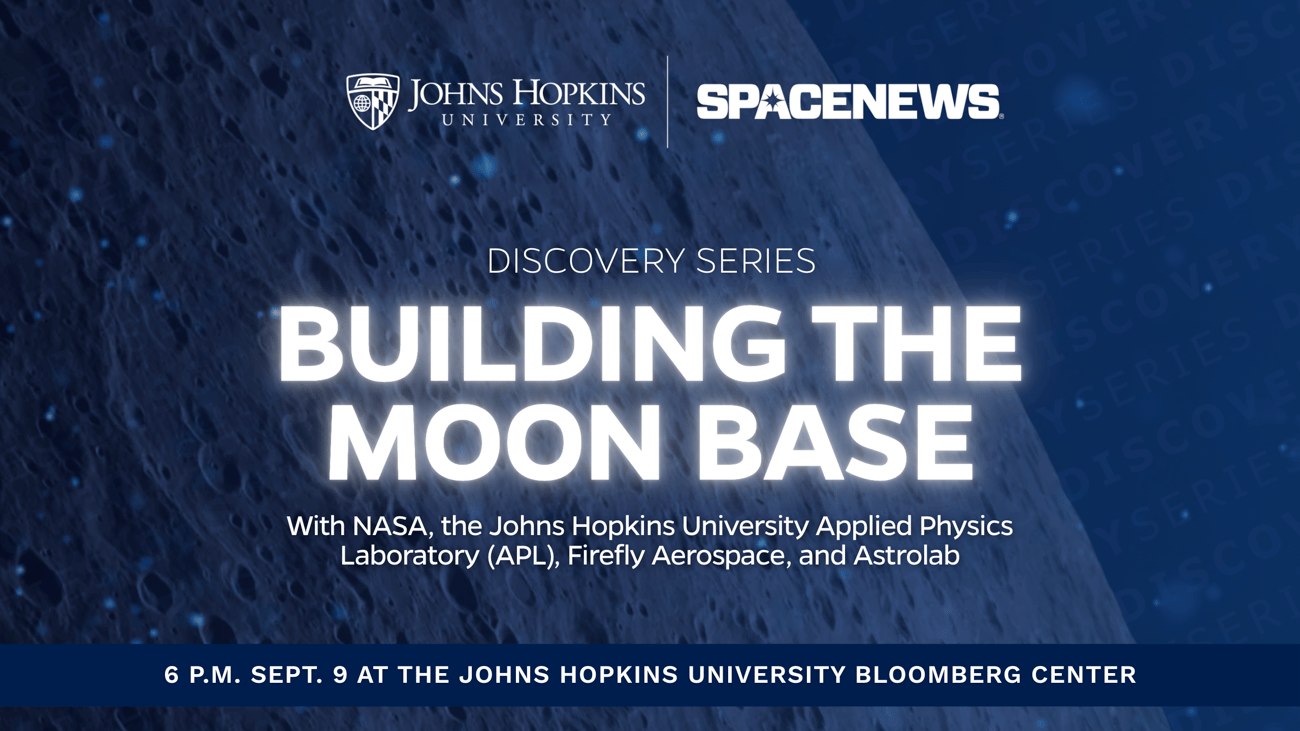 |
Join us in Washington D.C. on Sept. 9 for our next Discovery Series conversation at the Johns Hopkins Bloomberg Center. This in-person event will explore the latest plans for NASA's Moon to Mars architecture alongside the commercial opportunities, investments, and policies needed to build and support work on the lunar surface for months and eventually years at a time. We'll be joined by leaders from NASA, Firefly Aerospace, Astrolab and the Johns Hopkins University Applied Physics Laboratory. Register now. |
|
|
|
|










No comments:
Post a Comment