Plus: Two companies added to Space Force launch contract
By Jeff Foust
In today's edition: Venus Aerospace raises $91 million, two more companies added to a Space Force launch contract, Skyroot and RFA prepare for their first launches and more.
If someone forwarded you this edition, sign up to receive it in your inbox every weekday. Have thoughts or feedback? You can hit reply to let me know.
|
|
|
|
|
|
SPONSORED |
 |
Powering Golden Dome for America with mission-proven advanced avionics for missile warning and tracking space sensors, space-based interceptors, and traditional interceptors. Innoflight delivers affordable, mature, low-size, weight, and power solutions, including high-assurance encryption (point-to-point and mesh network HAIPE®), communications, networking, high-performance processing, and precision timing. Our technologies help prime contractors reduce costs, accelerate integration and deployment, and enable the resilient mesh network architecture central to Golden Dome. Partner with Innoflight to help shape the future of missile defense. |
|
|
|
|
Top Stories
Hypersonic propulsion startup Venus Aerospace has raised $91 million. The company announced a Series B round Wednesday led by by Houston-based venture capital firm Mercury Fund. The company said the new capital will fund engine development and manufacturing as it seeks to scale production of its rotating detonation rocket engine (RDRE) from flight testing toward operational deployment. The reusable, throttleable engine is intended for a range of missions, including munitions, space launch vehicles, orbital transfer vehicles and lunar landers. [SpaceNews]
The Space Force added Relativity Space and Impulse Space to a launch contract program. The companies were admitted to the National Security Space Launch (NSSL) Phase 3 Lane 1 contract vehicle, making them eligible to compete for future task orders under the program, the Space Force announced Tuesday. The two newcomers represent different approaches to the market, with Relativity Space developing a medium-lift reusable launcher while Impulse Space develops orbital transfer vehicles. The latter's selection reflects an evolution in how the Space Force is defining launch services, going beyond just buying rockets to include integrated transportation services in which one company provides the launch vehicle while another performs the final orbital delivery. [SpaceNews]
Indian launch startup Skyroot Aerospace is preparing for its first orbital launch attempt. The company says the first flight of its Vikram-1 rocket could take place as soon as Sunday, at the start of a launch period that runs through early August. Vikram-1 is a four-stage rocket designed to place up to 350 kilograms into low Earth orbit. A company executive said at the Spacetide conference Tuesday that the company wants to perform up to two more launches this year and has the capacity to produce about a rocket a month. It has been helped by Indian's commercial space reforms, including a new policy that will partially subsidize costs to encourage companies to launch satellites on Indian vehicles. [SpaceNews]
Italian space logistics specialist D-Orbit will provide a series of launches aboard its ION Satellite Carrier for Japanese startup ArkEdge Space. D-Orbit will send ArkEdge satellites to sun-synchronous orbit in 2027 and 2028 on an undisclosed number of missions, the companies announced Tuesday. D-Orbit's ION has completed 23 missions with the most recent ION launched on a SpaceX rideshare mission Tuesday. [SpaceNews]
Industry officials are offering a range of options to deal with strained launch sites. The concepts range from additional funding for spaceport infrastructure improvements to more cooperation among government agencies in dealing with launch site upgrades. The ideas are, in many cases, not new but are getting more attention after the Blue Origin New Glenn pad explosion in May. [SpaceNews]
|
|
|
|
|
|
Other News
SpaceX launched another rideshare mission amid concerns about that program's long-term future. A Falcon 9 lifted off Tuesday at 3:12 a.m. Eastern on The Transporter-17 mission, carrying 81 payloads to sun-synchronous orbit. While the Transporter series of rideshare missions remains popular with spacecraft developers, many are concerned that SpaceX may phase out the program in the next few years. Rocket Lab CFO Adam Spice said at the Spacetide conference Tuesday that there "seems to be a panic setting in" about the availability of the Falcon 9 in general as SpaceX seeks to shift launches to its Starship vehicle while increasingly reserving Falcon 9 launches for its own Starlink and other internal payloads. [SpaceNews]
Among the payloads on Transporter-17 was the first satellite for data-relay startup Apolink. The 3U cubesat will test intersatellite links in S-band using a novel experimental license from the FCC. That license allows Apolink's cubesat to receive S-band signals from designated partner satellites on an unprotected and non-interference basis, before storing and forwarding them to approved ground stations. The IPoS-TDsM, or Interoperability Protocol over Satellite – Technology Demonstration Mission, is designed to close low-power links at distances of up to about 150 kilometers during line-of-sight passes. [SpaceNews]
Arianespace signed a memorandum of understanding with satellite servicing startup Infinite Orbits to study potential future GEO rideshare missions using the Ariane 6. Depending on demand, the companies could pursue full Ariane 64 rideshare launches or as piggyback opportunities around larger satellites. Arianespace first mentioned the possibility of rideshare services to geostationary orbit in 2019. But amid growing concerns over potential bottlenecks in the rideshare market after 2028, it is now revisiting the possibility of GEO rideshare services for commercial customers in more concrete terms. Arianespace says it is also interested in potential LEO rideshare missions. [SpaceNews]
Satellite refueling company Orbit Fab has a new CEO and additional funding as it moves from technology development to commercial operations. The company announced Tuesday it hired Peter Shaper, a former CEO of satellite services companies CapRock Communications and Speedcast, while lead investor Stride Capital is providing more than $25 million in interim financing as it works closing a Series B round. Shaper said he is tasked with taking Orbit Fab's technology to refuel satellites in orbit, with three demo missions planned in the next 18 to 24 months, and turning it into a commercial service with the U.S. government as a likely initial customer. [SpaceNews]
German launch startup Rocket Factory Augsburg (RFA) could attempt its first orbital launch as soon as next month. A five-week launch period for the first RFA ONE rocket opens Aug. 10 from SaxaVord Spaceport in the Shetland islands, the spaceport's operator said this week. Launch windows open three days a week in that span for four hours each day. RFA ONE is a small launch vehicle designed to place about a ton into low Earth orbit. The company had been working toward a first launch in 2024 from SaxaVord when the rocket's first stage exploded in a static-fire test on the pad there. [European Spaceflight]
Firefly Aerospace won a contract to develop part of a mission to deploy helicopters in the Martian atmosphere. The company said Tuesday it was selected by JPL to develop the aeroshell for the SkyFall mission, which will deploy three helicopters at Mars. SkyFall will hitch a ride to Mars on SR-1 Freedom, a nuclear propulsion demonstration mission scheduled to launch as soon as late 2028. The aeroshell contract is worth $13 million. [Firefly Aerospace]
|
|
|
|
|
|
FROM SPACENEWS |
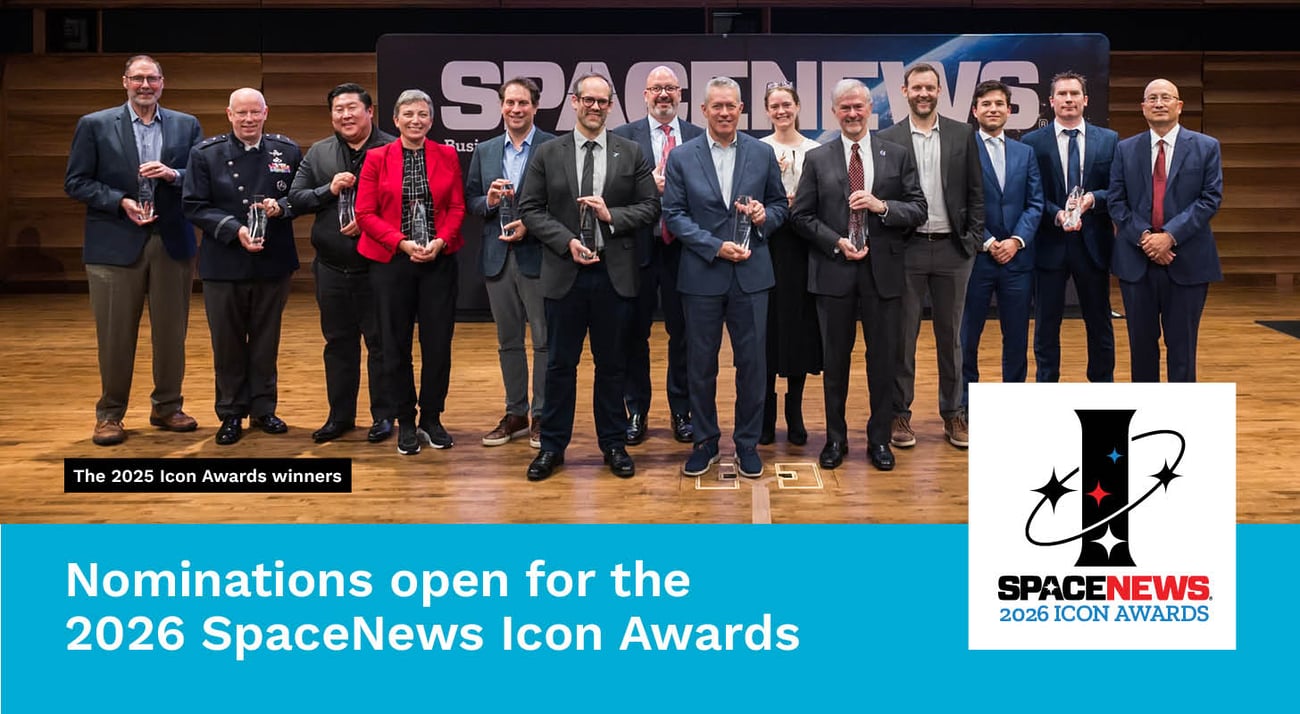 |
Honor the icons shaping space: Since 2017, the SpaceNews Icon Awards have celebrated the companies, teams and individuals driving breakthroughs across civil, commercial and military space. Nominate the innovators, collaborators and leaders whose work over the past year — or an entire career — has left a lasting mark on the industry. Submit your nomination today. |
|
|
|
|
|
Outlier View
|
"All things considered, this is what qualifies as an outlier view on SpaceX right now: being unsold on the company's grand bullish vision right now, but perhaps being open to it in the future."
|
– From a Business Insider article about a report on SpaceX from MoffettNathanson, the only analyst firm of 19 so far not to give SpaceX stock a "buy" rating.
|
|
|
|
|
|
|









No comments:
Post a Comment