Plus: The Swift reboost mission is en route
By Dan Robitzski
A good scientific experiment begins with a question or assumption about some aspect of how the universe works, and then tests as many explanations for the phenomenon as possible. And then, only by trying and failing to disprove their assumptions can scientists say that they’ve made a new finding — for example, vaccines work because clinical trials have such tightly controlled variables, and we’ve learned a great deal about how the universe behaves thanks to instruments that can repeatedly take extremely sensitive measurements.
But those assumptions are always subject to change once new data emerge, which is all to highlight just how impressive and surprising it is that one grainy photo that China’s Tianwen-2 mission took of the asteroid Kamoʻoalewa has already updated our understanding of it.
|
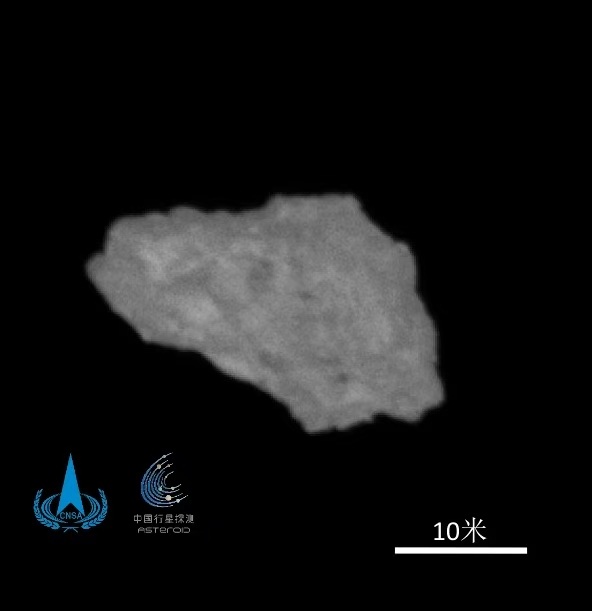 |
Near-Earth asteroid Kamo'oalewa imaged from a distance of 20 km by Tianwen-2, July 2, 2026. Credit: CNSA |
The China National Space Administration announced July 6 that the Tianwen-2 spacecraft had recently completed a 400-day journey of roughly 1 billion kilometers that brought it within 20 kilometers of Kamoʻoalewa, where it snapped a comparatively close-up image. Tianwen-2, which carries 11 scientific payloads, will later attempt to gather samples to ship back to Earth. Those samples and other data gathered will tell scientists more about the asteroid and its origins, but the image itself has already taught us quite a lot. Namely:
How big Kamoʻoalewa is. Ground-based observations suggested that the asteroid was anywhere from 40 to 100 meters across, though James Webb Space Telescope observations suggested an 18-meter diameter. Based on the photo, the asteroid is just over 20 meters across. New data; one of two hypotheses disproven. What Kamoʻoalewa is made of. Some scientists suspected that Kamoʻoalewa began as a chunk of the far side of the moon that was knocked into orbit from a significant impact. But the image revealed that it has a high geometric albedo, meaning its surface is particularly reflective. The moon, by contrast, has a lower geometric albedo — a mismatch that suggests Kamoʻoalewa is asteroidal in origin. |
|
|
|
|
|
SPONSORED |
 |
The Clouds Above the Clouds – 40 Years of Collaboration
The 40th Annual Small Satellite Conference will spotlight the technologies driving constellation success and celebrate the thousands of people whose vision and collaboration have propelled the industry forward over the past four decades. Join us as we celebrate the past, examine the present, and shape the future of small satellites.
|
|
|
|
|
|
SIGNIFICANT DIGIT
|
3 |
The number of European companies that NASA added to its Commercial Satellite Data Acquisition program, which provides a commercial procurement framework through which NASA can acquire commercial datasets to complement its own Earth science missions and research activities. Kuva Space (Finland), OroraTech (Germany) and Satlantis (Spain) were added alongside five American companies, bringing the total tally to 25 private firms. |
|
|
|
|
|
THE SWIFT REBOOST MISSION BEGINS
|
A few editions of this newsletter ago, I described how the attempt to boost the orbit of the Neil Gehrels Swift Observatory and prevent the 22-year-old space telescope from breaking up during reentry could herald a new era of spacecraft servicing. Now, it’s time to see how things pan out. On July 3, a Northrop Grumman Pegasus XL — the final mission for the air-launched rocket — ferried Katalyst Space’s Link spacecraft into orbit, where it will approach Swift and attempt to tow it farther from Earth.
For now, Katalyst will spend two weeks conducting checks on the Link spacecraft while they use it to survey Swift, searching for possible locations to grapple onto and begin the three-month reboosting process.
|
|
|
|
|
|
|
|
|
|
| SpaceX launched the latest in its Transporter series of rideshare missions July 7 as industry concerns about the program’s future reached what one rival company executive called a panic.
|
|
|
| Iridium Communications has completed its takeover of Aireon, bringing the aircraft-tracking venture fully in-house ahead of the satellite operator’s planned $8 billion sale to Rocket Lab.
|
|
|
|
| Blue Origin is continuing to develop its Blue Moon lunar landers, with seven vehicles in production, while recovering from the New Glenn pad explosion more than a month ago.
|
|
|
| Hongqing Technology, the satellite manufacturing affiliate of launch firm Landspace, closed a fundraising round of more than 1.3 billion yuan ($191 million), one of the largest single raises for a Chinese commercial satellite maker.
|
|
|
|
|








No comments:
Post a Comment