Plus: A big price tag for NASA's nuclear propulsion demo
By Jeff Foust
In today's edition: Relativity to build rockets in Florida, satellite life extension mission launches, a billion-dollar price tag for a NASA nuclear propulsion demo mission and more.
If someone forwarded you this edition, sign up to receive it in your inbox every weekday. Have thoughts or feedback? You can hit reply to let me know.
|
|
|
|
FROM SPACENEWS |
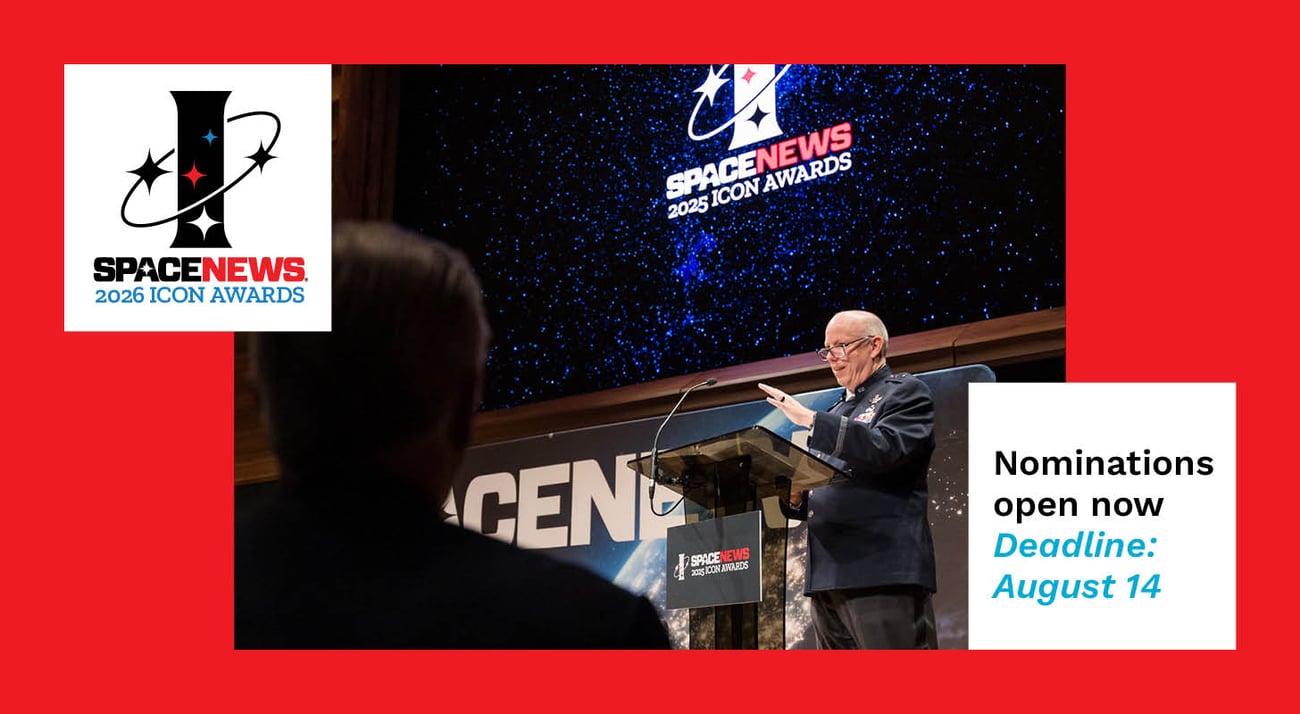 |
Someone you know belongs on this list: Whatever category fits — technology, sustainability, defense, advocacy or an entire career's worth of impact — the Icon Awards are built to recognize achievements across the industry. Tell us about the innovators, collaborators and change-makers whose contributions have left a lasting mark. Nominations for this year's awards are open now through Aug. 14, and we want to hear from you. Submit your picks. |
|
|
|
|
|
Top Stories
Relativity Space will expand production of its Terran R rocket in Florida. The company and Space Florida announced a deal Tuesday where the state will help finance development of a new rocket production facility in Florida along with upgrades to test and launch infrastructure at Cape Canaveral. The state will provide up to $134 million toward those projects. Relativity said the Florida factory would be in addition to its existing facility in Long Beach, California. The medium-lift rocket remains in development and the company has not announced a date for its first launch from Cape Canaveral. [SpaceNews]
Northrop Grumman is taking another charge related to the redesign of the solid rocket motor it produces for United Launch Alliance's Vulcan Centaur. The company said Tuesday as part of its second quarter financial results that it took a $91 million unfavorable adjustment to its earnings at completion on its GEM 63XL motor program, after reporting a $71 million unfavorable adjustment in the first quarter. The motor suffered what ULA called a "significant performance anomaly" on a February launch, leading to changes in the design of the booster. Northrop said it expects to begin delivering the redesigned motors by the end of the year. Vulcan has not launched since that February mission, although the Space Force said this spring it was considering revamping its launch manifest to bring forward missions that could use Vulcan without any solid rocket boosters. [SpaceNews]
A long-awaited satellite servicing mission launched Tuesday. A Falcon 9 lifted off from Cape Canaveral Space Force Station in Florida at 5:15 p.m. Eastern carrying the Mission Robotic Vehicle (MRV) for SpaceLogistics, a subsidiary of Northrop Grumman, along with three Mission Extension Pods. The MRV will use robotic arms to install the pods on commercial communications satellites in geostationary orbit, extending those satellites' lives. The robotic system originated under the Defense Advanced Research Projects Agency's Robotic Servicing of Geosynchronous Satellites program, known as RSGS, in 2016. Because of the performance requirements for the mission the Falcon 9 booster was expended after 32 launches. [SpaceNews]
An Artemis 2 astronaut says NASA should reconsider plans to immediately go to the south polar region of the moon on the first crewed Artemis landings. Speaking at a conference Tuesday, Victor Glover said the first landings should target more familiar regions of the moon, like those closer to the equator used on the Apollo missions, citing safety concerns and less challenging terrain and lighting conditions there. Landing in equatorial regions, he said, could allow NASA to gain experience with landers and "work our way to the south pole" on later missions. NASA officials said at the meeting that they continue to target the south polar regions for the Artemis 4 and 5 missions, scheduled for 2028, but added that exact landing sites would be determined only after better understanding the capabilities of the landers under development. [SpaceNews]
Zenno Astronautics, a startup developing superconducting magnets for spacecraft attitude control, is moving from New Zealand to the United States. The company plans to set up offices in Los Angeles, citing the high density of space companies in the region along with better access to venture capitalists. Zenno's impending relocation comes on the heels of a June demonstration of its Z01 Supertorquer, a superconducting magnetic actuator, aboard Impulse Space's Mira satellite. [SpaceNews]
|
|
|
|
|
|
|
Other News
A Chinese commercial rocket placed nine satellites in orbit after launching from a ship. Orienspace's Gravity-1 rocket lifted off at 10:54 p.m. Eastern Tuesday from a ship offshore from Shanghai. The launch carried nine payloads including six Dongpo satellites for the Huantian optical and radar imaging constellation. This was the third launch of the solid-fuel Gravity-1 rocket as Orienspace works on Gravity-2, a liquid-fuel reusable rocket set to make its debut late this year. [SpaceNews]
SpaceX launched more Starlink satellites a day after a last-second abort. A Falcon 9 lifted off from Vandenberg Space Force Base in California at 10:49 a.m. Eastern, putting 24 satellites into orbit. The launch came 24 hours after the vehicle aborted a liftoff immediately after igniting its Merlin engines. SpaceX did not disclose the issue that caused the scrub. [Spaceflight Now]
NASA's SR-1 Freedom nuclear propulsion demonstration mission will cost more than $2 billion. The agency said Tuesday that it set a preliminary cost estimate of $2.1 billion for the mission, scheduled to launch in late 2028 and demonstrate nuclear electric propulsion technologies on a trip to Mars. The agency has resisted offering a cost estimate for the mission, announced at the Ignition event in March and not included in NASA's fiscal year 2027 budget proposal. That cost estimate includes $640 million allocated for fiscal year 2026 to exploration accounts and last year's budget reconciliation bill. [Politico]
The Space Force may have to consider limiting the number of launches at Cape Canaveral and Vandenberg as growing activity strains those sites. Gen. Chance Saltzman, the outgoing chief of space operations for the Space Force, said at a conference last week that while he does not want to put a cap on the number of launches from those sites, "we have to consider that our existing resources will fail if we don't consider a cap." A sharp increase in launches at both sites has strained infrastructure like roads and consumables. Space Force officials are working to determine when those spaceports might reach their limits. [Air and Space Forces Magazine]
South Korean launch startup Innospace expects to make another orbital launch attempt in November. The company said Wednesday it expects to fly its Hanbit-Nano rocket from the Alcântara Space Center in Brazil in November, 11 months after the rocket's inaugural flight there failed shortly after liftoff. That will come after the launch of a suborbital rocket, Sebit, from Alcântara on Aug. 19. Innospace developed Sebit to provide testing and technology demonstration services. [Innospace]
|
|
|
|
|
|
|
|
Dress for Success
|
"You know, April 1 came around. Some of us were not expecting to go that day. I was like, I'm not going to wear my launch shirt. And then I quickly ran back and put it on because holy cow, we are going to the moon."
|
– Marie Henderson, a member of the Artemis 2 science team, discussing the mission during a talk Tuesday at the NASA Exploration Science Forum.
|
|
|
|
|
|
|









No comments:
Post a Comment