Plus: An Artemis astronaut has notes on moon landing plans
By Dan Robitzski
In 2022, NASA awarded Draper a $73 million task order through its Commercial Lunar Payload Services program (CLPS) for an uncrewed lunar landing mission to the far side of the moon. Now, almost exactly four years later, NASA and Draper have pulled the plug.
NASA said that the termination stems from years of delays with the lunar lander design (the mission was originally supposed to launch last year but had slipped to 2030 before getting canceled.) The problems stem from multiple lander redesigns in 2023, 2025 and earlier this year by ispace, the subcontractor developing the lander on Draper’s behalf.
Now, that decision leaves multiple scientific objectives stranded without a guaranteed ride to the moon. The purpose of CLPS is to make it easier for commercial companies to launch scientific missions, technology demos and other missions to and around the moon quickly for relatively low cost. That’s resulted in successful and “partially successful” (read: unsuccessful) moon landings by private firms, which in turn are accelerating lunar exploration and research. CP-12, the name given to the 2022 task order, is the first CLPS mission to be canceled in four years, preceded by Masten Mission One after the contractor went bankrupt.
Three scientific experiments had been slated for CP-12. The Farside Seismic Suite, or FSS, features seismometers to measure seismic activity in the moon’s Schrödinger Basin. The Lunar Interior Temperature and Materials Suite would measure heat flow and electrical conductivity below the surface. And the Lunar Surface Electromagnetics Experiment-Lite, or LuSEE-Lite, would measure electrical and magnetic fields.
So far, there’s no word on when or if these payloads will find their way to the moon — NASA has said that it “remains committed to the science objectives of the CP-12 science payloads and will work to deliver these already-developed instruments to the moon at the earliest opportunity through future CLPS landings as part of the increased tempo of lunar activity by our Moon Base and Artemis programs.” And while there does seem to be room for some of these payloads on future CLPS missions, there’s not yet word on any specific plans to do so.
|
|
|
|
SIGNIFICANT DIGIT
|
$400,000
|
The amount that the British government and the Space Florida aerospace finance and development authority have jointly committed ($200,000 each) to support joint research, innovation and commercialization projects.
|
|
|
|
|
|
AN EASIER PATH TO THE MOON
|
Victor Glover, the pilot for the Artemis 2 lunar flyby mission that brought humans farther away from Earth than ever before, has some notes on the rest of NASA’s Artemis plans. Namely, he’s urging NASA Administrator Jared Isaacman to pursue a simpler path to a crewed moon landing that would target the equatorial region instead of the particularly harsh lunar south pole.
“If you want to go fast, go familiar,” Glover said at the NASA Exploration Science Forum at Ames Research Center on July 21. “We want to get to the surface. If we want to land soon, familiar, daylight, equator.”
Part of Glover’s concerns about starting with a south pole mission, aside from the added difficulty of targeting and operating in the permanently-shadowed craters there, is crewmember safety and the ability to evacuate in case of an emergency or medical issue. The orbit required for a south pole landing may leave crewmembers without an exit plan for up to a week at a time, whereas they could make a speedier exit from the equatorial region.
“We need to be realistic and work our way to the south pole, and maybe not try to go there first,” Glover said.
|
|
|
|
|
|
|
|
|
|
| Commercial space station and spacecraft developer Vast has established a new division intended to support work in national security space.
|
|
|
The island nation of Mauritius signed the Artemis Accords July 17, becoming the 70th nation to do so in less than six years.
|
|
|
|
|
FROM SPACENEWS |
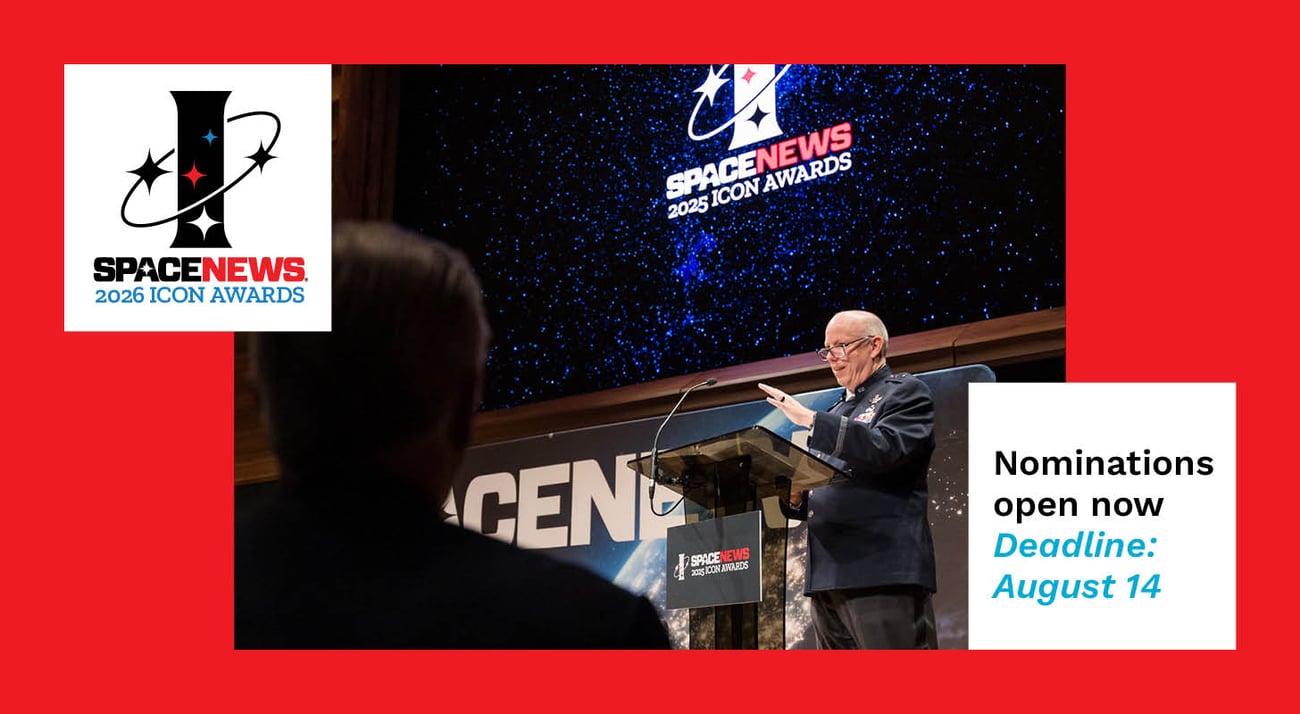 |
Someone you know belongs on this list: Whatever category fits — technology, sustainability, defense, advocacy or an entire career's worth of impact — the Icon Awards are built to recognize achievements across the industry. Tell us about the innovators, collaborators and change-makers whose contributions have left a lasting mark. Nominations for this year's awards are open now through Aug. 14, and we want to hear from you. Submit your picks. |
|
|
|
|









No comments:
Post a Comment