Friday, September 4, 2026

The Space Force has a new commanding general

Plus: ISRO's first launch since January
 ‌ ‌ ‌ ‌ ‌ ‌ ‌ ‌ ‌ ‌ ‌ ‌ ‌ ‌ ‌ ‌ ‌ ‌ ‌ ‌ ‌ ‌ ‌ ‌ ‌ ‌ ‌ ‌ ‌ ‌ ‌ ‌ ‌ ‌ ‌ ‌ ‌ ‌ ‌ ‌ ‌ ‌ ‌ ‌ ‌ ‌ ‌ ‌ ‌ ‌ ‌ ‌ ‌ ‌ ‌ ‌ ‌ ‌ ‌ ‌ ‌ ‌ ‌ ‌ ‌ ‌ ‌ ‌ ‌ ‌ ‌ ‌ ‌ ‌ ‌ ‌ ‌ ‌ ‌ ‌ ‌ ‌ ‌ ‌ ‌ ‌ ‌ ‌ ‌ ‌ ‌ ‌ ‌ ‌ ‌ ‌ ‌ ‌ ‌ ‌ ‌ ‌ ‌ ‌ ‌ ‌ ‌ ‌ ‌ ‌ ‌ ‌ ‌ ‌ ‌ ‌ ‌ ‌ ‌ ‌ ‌ ‌ ‌ ‌ ‌ ‌

09/04/2026

READ IN BROWSER

SpaceNews logo
SpaceNext First Up newsletter logo

Didn't make it to SmallSat this year? Catch up on all the headlines and watch or listen to our conversations with leaders from Frontgrade, Icarus Robotics, Morpheus Space and Innoflight recorded in Salt Lake City last week.

By Jeff Foust


In today's edition: the Space Force has a new commanding general, ISRO launches its first mission since a January failure, U.S. companies drop out of a French space conference and more. 


If someone forwarded you this edition, sign up to receive it in your inbox every weekday. Have thoughts or feedback? You can hit reply to let me know.


📲  Download the SpaceNews mobile app


SPONSORED

Power Built for Where You're Going. Why choose between flight heritage and manufacturing scale? DragonSCALES™ delivers both: flight-proven silicon solar that scales with your program, from LEO constellations to lunar surface power. Resilient. Reliable. Ready to manufacture at volume. As mPower builds the future of space-grade silicon solar, we're proud to power the missions defining the next era of spaceflight. See why leading programs choose DragonSCALES™.

Top Stories


The U.S. Space Force has a new commanding general. In a ceremony Thursday at Joint Base Andrews in Maryland, Gen. Douglas Schiess took over as the U.S. Space Force's third chief of space operations, succeeding Gen. Chance Saltzman. In his first message to the force, Schiess portrayed his tenure as the next stage in the development of the Space Force, which was established in 2019 and has been moving from its initial focus on building a new military service toward preparing forces for combat. This phase, Schiess said, will require the Space Force to expand while improving how it develops, tests and operates new systems. His comments at the change-of-command ceremony signaled continuity with Saltzman, who during his tenure put greater emphasis on preparing guardians for warfare in space and on developing capabilities to protect U.S. satellites and counter adversaries' use of space systems. [SpaceNews]


The Space Force is using its latest round of small-business research contracts to pursue technologies that are closer to operational use. The service's newest Small Business Innovation Research solicitations, released this week, cover on-orbit logistics, satellite self-protection, cyber defense and artificial intelligence for missile warning and tracking. Three of the four are Direct-to-Phase 2 opportunities, which allow companies with sufficiently mature technology to bypass the initial feasibility-study phase of the SBIR process. This approach reflects a shift from the open-ended research projects that have sometimes fueled industry skepticism of the Pentagon's SBIR program. [SpaceNews]


German launch company HyImpulse has raised additional funding ahead of a suborbital launch. HyImpulse announced Wednesday it raised more than 50 million euros ($58 million) in an extension of a Series A round from last October. The company said the additional funding will accelerate work on its SR75 suborbital rocket, slated to make its second launch later this year from SaxaVord Spaceport, and its SL1 small orbital launch vehicle under development. Both use hybrid propulsion with liquid oxygen and solid paraffin as propellants. HyImpulse is part of a tier of European launch companies continuing work on vehicles despite missing out on the European Launcher Challenge. [SpaceNews]


Earth observation company Satellogic is partnering with SynMax to provide maritime intelligence. Under the agreement announced Thursday, Satellogic will provide data from its new Merlin constellation for maritime intelligence exclusively through SynMax's Theia platform. In June, the companies announced plans to develop AI-powered intelligence products for the Merlin constellation. Satellogic's Merlin constellation will acquire daily global imagery with a resolution of one meter along with Automatic Identification System (AIS) information. The first Merlin satellite is scheduled to launch in October with additional satellites reaching orbit in February and July.  [SpaceNews]


A NASA astrophysics smallsat has started science operations. NASA announced recently that the Pandora spacecraft, launched on a SpaceX rideshare mission into sun-synchronous orbit in January, had completed commissioning and started collected science data. Pandora will observe exoplanets as they pass in front of their stars, enabling astronomers to better understand those planets' atmospheres. Pandora is also the first spacecraft mission in NASA's Astrophysics Pioneers program of low-cost missions, with a cost cap of $20 million. A project official said at last week's Small Satellite Conference that they have collected lessons learned during the development and operations of Pandora, such as how to manage risk, to help future Pioneers missions. [SpaceNews]


Other News


The Indian space agency ISRO successfully launched an Earth imaging satellite in its first mission since a January failure. A GSLV Mark 2 rocket lifted off from the Satish Dhawan Space Centre at 5:25 p.m. Eastern Thursday, deploying the EOS-05 satellite into a transfer orbit nearly 20 minutes later. EOS-05 will operate from geostationary orbit, providing continuous but low-resolution imaging of India using multispectral and hyperspectral instruments. The launch was the first by ISRO since a January failure of the PSLV rocket. After the launch, ISRO said it plans six more launches through the end of the fiscal year in March 2027, including the first uncrewed test flight of the Gaganyaan human spaceflight vehicle. [SpaceNews]


The French government said four American companies have pulled out of next week's International Space Summit, reportedly at the urging of the U.S. government. A spokesperson for France's ministry for higher education, research and space said that Blue Origin, SpaceX, Starcloud and Stoke Space no longer plan to attend the two-day event in Paris next week. The announcement came after reports that White House officials had recommended American companies not participate, arguing that doing so might endorse European space policy positions. The spokesperson said of the companies' withdrawals that it's "hard not to link it to the rumors of pressure." Philippe Baptiste, the French minister overseeing the conference, said on social media that American companies and government officials were more than welcome to attend: "we want you there." [Le Monde]


One Jeff Bezos company is luring satellite engineers away from another. Blue Origin has hired nearly 50 people who had been working on the Amazon Leo constellation. Many of those people are now working on TeraWave, Blue Origin's own constellation to provide broadband connectivity for enterprise users. Both companies are working on their constellations in the Seattle area, where there is high demand for engineers. [Bloomberg]


A private mission to Venus is waiting on a rocket. The Rocket Lab Mission to Venus is a private effort to send a small spacecraft into the atmosphere of Venus in an attempt to detect any organic molecules that may be present there. The mission was originally planned to launch on the company's Electron rocket, but a scientist involved with the mission said the company has moved it to its larger Neutron rocket. The company has not disclosed when it expects to launch the mission on Neutron, but scientists said while they wait they are planning potential follow-on missions. [Space.com]


A joint ESA-JAXA mission is approaching its destination, Mercury. The BepiColombo spacecraft separated from its transfer stage Thursday as they approached Mercury. The transfer stage had provided power and propulsion since the mission's launch in 2018 but is no longer needed. BepiColombo will enter orbit around Mercury in November and then split into two independent orbiters, one developed by ESA and the other by JAXA, to study the planet and its magnetosphere. [AP]


Depends on How It's Combusting


"I would text him and be, like, 'Why are you in the middle of nowhere?' And he would reply with, 'We're testing. A rocket just combusted.' And I would think to myself, 'Is that bad? Are you OK? What does that mean?'"


– Taylor Funari, describing conversations with her brother Chenzo when he was an intern at Masten Space Systems testing rocket engines. Chenzo later worked for Blue Origin and SpaceX but left the space industry, and is now on the coaching staff of the NFL's Minnesota Vikings. [The Athletic]


Subscribe to SpaceNews


Thursday, September 3, 2026

NASA adjusts the Artemis spacesuit requirements

Plus: The final O3b mPower satellites are ready to launch
 ‌ ‌ ‌ ‌ ‌ ‌ ‌ ‌ ‌ ‌ ‌ ‌ ‌ ‌ ‌ ‌ ‌ ‌ ‌ ‌ ‌ ‌ ‌ ‌ ‌ ‌ ‌ ‌ ‌ ‌ ‌ ‌ ‌ ‌ ‌ ‌ ‌ ‌ ‌ ‌ ‌ ‌ ‌ ‌ ‌ ‌ ‌ ‌ ‌ ‌ ‌ ‌ ‌ ‌ ‌ ‌ ‌ ‌ ‌ ‌ ‌ ‌ ‌ ‌ ‌ ‌ ‌ ‌ ‌ ‌ ‌ ‌ ‌ ‌ ‌ ‌ ‌ ‌ ‌ ‌ ‌ ‌ ‌ ‌ ‌ ‌ ‌ ‌ ‌ ‌ ‌ ‌ ‌ ‌ ‌ ‌ ‌ ‌ ‌ ‌ ‌ ‌ ‌ ‌ ‌ ‌ ‌ ‌ ‌ ‌ ‌ ‌ ‌ ‌ ‌ ‌ ‌ ‌ ‌ ‌ ‌ ‌ ‌ ‌ ‌ ‌

09/03/2026

READ IN BROWSER

SpaceNews logo
SpaceNext First Up newsletter logo

Didn't make it to SmallSat this year? Catch up on all the headlines and watch or listen to our conversations with leaders from Frontgrade, Icarus Robotics, Morpheus Space and Innoflight recorded in Salt Lake City last week.

SPONSORED BY

By Jeff Foust


In today's edition: the final O3b mPower satellites are ready for launch, NASA adjusts Artemis spacesuit requirements, a new office plans to consolidate NASA launch activities and more. 


If someone forwarded you this edition, sign up to receive it in your inbox every weekday. Have thoughts or feedback? You can hit reply to let me know.


📲  Download the SpaceNews mobile app


SPONSORED

As constellations scale, regulatory approvals are stuck in a massive queue. More launches are delayed by paperwork than by hardware. Invariant AI closes that gap: what takes eight months the traditional way, we do in five. We handle FCC, ITU and NOAA authorizations, alongside ITAR, EAR and FAA compliance, for satellite operators and launch providers who can't afford to wait in a queue. Every filing is built and reviewed by a lawyer working alongside our AI platform, which identifies the right approvals, drafts the documents and submits them directly to the regulator, at a fraction of the usual cost. You build. You fly. We own the filings, end to end.

Top Stories


Boeing has completed the final three O3b mPower satellites for SES. The companies said Wednesday that the three satellites, designated F11, F12 and F13, have arrived at Cape Canaveral for launch on a Falcon 9 later this month. The delivery marks one of the final milestones for a contract that began with an order for an initial seven satellites in 2017. Launches got underway about five years later. The first six satellites suffered electrical issues, one factor in the SES decision to expand the constellation to 13 satellites. While SES prepares to add the final pieces to its O3b mPower network, the company has already begun laying the groundwork for a follow-on generation it calls meoSphere, using satellites built by K2 Space. [SpaceNews]


NASA is adjusting requirements for a lunar spacesuit to ensure it is ready in time for a 2028 landing. At a meeting this week of NASA's Aerospace Safety Advisory Panel, committee members said that NASA is shortening duration requirements for Axiom Space's AxEMU suit for the first Artemis landing missions, noting the original longer-duration requirements would not be needed on those first missions. The change is part of efforts to keep development of the suit on schedule for Artemis 4, planned for 2028. The panel said NASA has increased insight into suit development and holds meetings with Axiom six days a week. Suit development was also a factor in NASA's decision to obtain a Boeing 737 for use in reduced-gravity flight testing, as the plane will be able to briefly simulate lunar gravity to test spacesuit mobility. [SpaceNews]


Satellite antenna manufacturer All.Space has signed an agreement with the Pentagon’s Defense Innovation Unit to demonstrate high-rate production. All.Space said this week it received an Other Transaction Agreement from the Defense Innovation Unit under a program aimed at bringing high-volume commercial manufacturing practices into the national security space supply chain. The value and duration of the agreement were not disclosed. DIU is paying All.Space to demonstrate that the terminals can be integrated, tested and qualified at substantially higher production rates. All.Space was acquired by satellite manufacturer York Space Systems in July. [SpaceNews]


A new NASA office plans to consolidate launch procurements, which could lead to bulk buys of rockets. The Commercial Access to Space, or CAtS, office was created as part of an agency-wide reorganization earlier this year as part of the new Human Spaceflight Mission Directorate. The office will be responsible for all launch activities outside of human spaceflight, an official said at a recent conference. While plans are still in development, CAtS may oversee block buys of five to 20 rockets at a time, a change from NASA's traditional approach for procuring launches for individual missions. CAtS will also oversee agency rideshare launch opportunities. [SpaceNews]


Samara Aerospace received an award from the National Science Foundation to improve attitude-control technologies. The $1.22 million SBIR Phase 2 contract will allow the company to subject its Multifunctional Structures for Attitude Control (MSAC) technology, which uses piezoelectric actuators in the hinges of deployable panels, to extensive ground tests. Next year, Samara plans to launch Hummingbird, a small satellite based on MSAC technology that the company is developing with funding from the Space Force's SpaceWERX innovation unit. [SpaceNews]


Other News


Rocket Lab launched another satellite for Japanese radar-imaging company Synspective on Wednesday. An Electron rocket lifted off from the company's Launch Complex 1 in New Zealand at 8:01 a.m. Eastern, after a delay of nearly an hour because of high winds. The rocket successfully deployed into low Earth orbit the latest StriX satellite for Synspective. This was the 11th launch of a Synspective satellite on Electron while another Japanese radar-imaging company, iQPS, has launched nine satellites on Electron. The two companies have a combined 25 additional Electron launches under contract. [SpaceNews]


The White House has reportedly been pressuring American companies not to attend the International Space Summit in France next week. An official with the White House's Office of Science and Technology Policy told representatives of several companies, including SpaceX, in a private call last week to skip the summit, reportedly because of Chinese participation in the event and a lack of coordination between France and the United States. U.S. government officials are still expected to attend, though, and the schedule shows that executives of several American companies will appear on panels or other conference events. [Politico]


Russia's answer to Starlink is struggling. A recent analysis showed that the second set of 16 satellites for the Rassvet constellation, launched in July, have stopped raising their orbits and are well below their expected orbit of 550 kilometers. It's not clear why the satellites have not reached their operational orbits. Twelve of the first set of 16 launched in March are in that orbit, while the other four apparently failed in orbit. [Kyiv Post]


Two space science instruments on NASA's New Horizons spacecraft could shut down next month because of a lack of funding. The instruments, which measure the solar wind in the distant reaches of the solar system, are supposed to be funded by NASA's heliophysics division, but the division has withheld the expected $2 million needed for operating the instruments for the last two fiscal years without explanation. That has prompted plans to shut the instruments down unless the funding is restored. NASA Administrator Jared Isaacman said he was aware of the issue and that he was "generally supportive of generating high-quality scientific returns for low-dollar spend," but stopped short of stating the funding would be restored. [Science]


Astronomers are excited about the potential discovery of a hypothesized dark matter particle. Scientists announced at a conference this week that an experiment called LUX-ZEPLIN detected a particle consistent with a class of dark matter called weakly interacting massive particles, or WIMPs. The composition of dark matter remains one of the biggest mysteries in astronomy, although its existence is inferred from its gravitational effects. Researchers said they were excited about the detection but cautioned it was only a single event and not conclusive evidence that WIMPs exist. [Science News]


Never Too Old for Your First Launch


"This is the first rocket launch I've been to, and I'm 62. It's been very inspirational for me."


– David Weinberg, a professor of astronomy at Ohio State University, after attending the launch of the Roman Space Telescope. [Columbus Dispatch]


FROM SPACENEWS

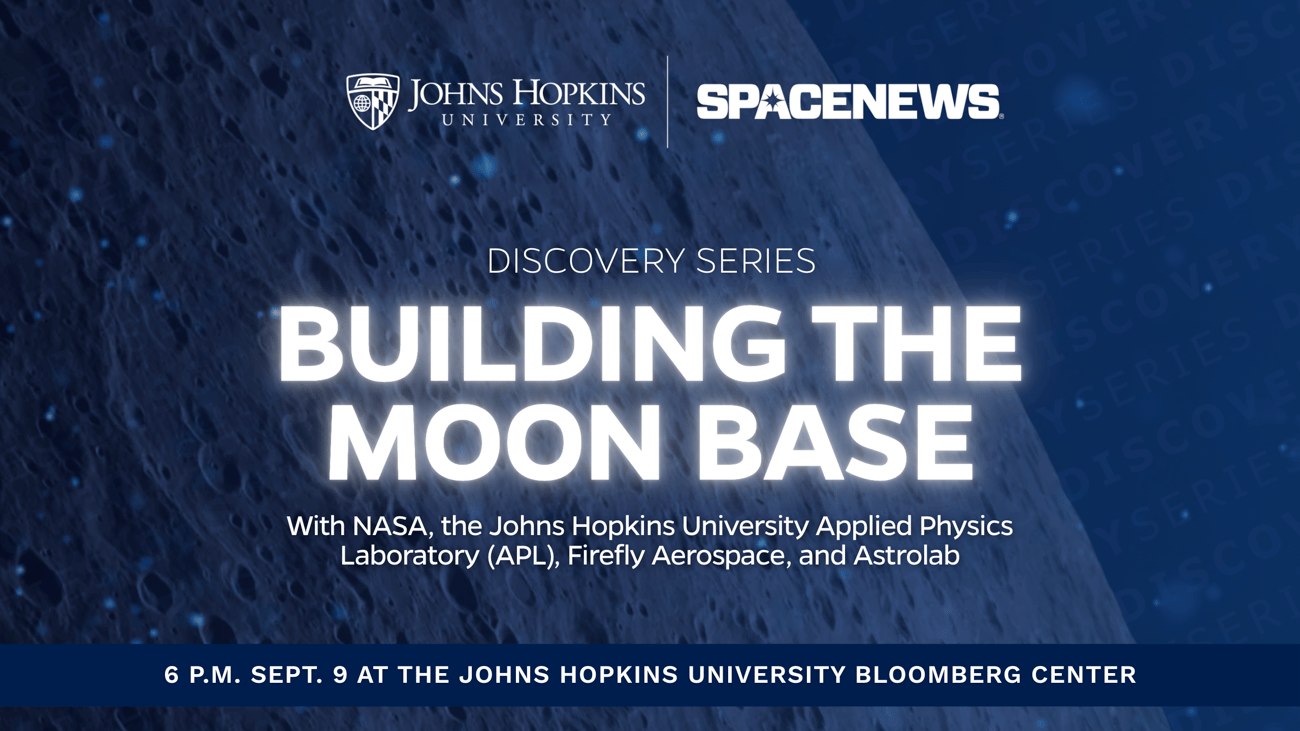
Join us on Sept. 9 for Building the Moon Base in Washington, D.C.

Join us in Washington D.C. on Sept. 9 for our next Discovery Series conversation at the Johns Hopkins Bloomberg Center. This in-person event will explore the latest plans for NASA's Moon to Mars architecture alongside the commercial opportunities, investments, and policies needed to build and support work on the lunar surface for months and eventually years at a time. We'll be joined by leaders from NASA, Firefly Aerospace, Astrolab and the Johns Hopkins University Applied Physics Laboratory. Register now.

Subscribe to SpaceNews


Opinions: Hubble deserves a plan, not a Hail Mary

Plus: America needs a Space Academy that invests in people, not buildings  ‌ ‌ ‌ ‌ ‌ ‌ ‌ ‌ ‌ ‌ ‌ ‌ ‌ ‌ ‌ ‌ ‌ ‌ ‌ ‌ ‌ ‌ ‌ ‌ ‌ ‌ ‌ ‌ ‌ ...