Friday, May 2, 2025

Lockheed Martin delivers Orion - SpaceNews This Week

Top stories of the week from SpaceNews
 ‌ ‌ ‌ ‌ ‌ ‌ ‌ ‌ ‌ ‌ ‌ ‌ ‌ ‌ ‌ ‌ ‌ ‌ ‌ ‌ ‌ ‌ ‌ ‌ ‌ ‌ ‌ ‌ ‌ ‌ ‌ ‌ ‌ ‌ ‌ ‌ ‌ ‌ ‌ ‌ ‌ ‌ ‌ ‌ ‌ ‌ ‌ ‌ ‌ ‌ ‌ ‌ ‌ ‌ ‌ ‌ ‌ ‌ ‌ ‌ ‌ ‌ ‌ ‌ ‌ ‌ ‌ ‌ ‌ ‌ ‌ ‌ ‌ ‌ ‌ ‌ ‌ ‌ ‌ ‌ ‌ ‌ ‌ ‌ ‌ ‌ ‌ ‌ ‌ ‌ ‌ ‌ ‌ ‌ ‌ ‌ ‌ ‌ ‌ ‌ ‌ ‌ ‌ ‌ ‌ ‌ ‌ ‌ ‌ ‌ ‌ ‌ ‌ ‌ ‌ ‌ ‌ ‌ ‌ ‌ ‌ ‌ ‌ ‌ ‌ ‌

View in Browser

05/02/2025

Welcome to our roundup of top SpaceNews stories, delivered every Friday! This week, Lockheed Martin delivered Orion to NASA, Isaacman's NASA administrator nomination moved forward, the first Kuiper satellites reached orbit and more.

Our Top Story

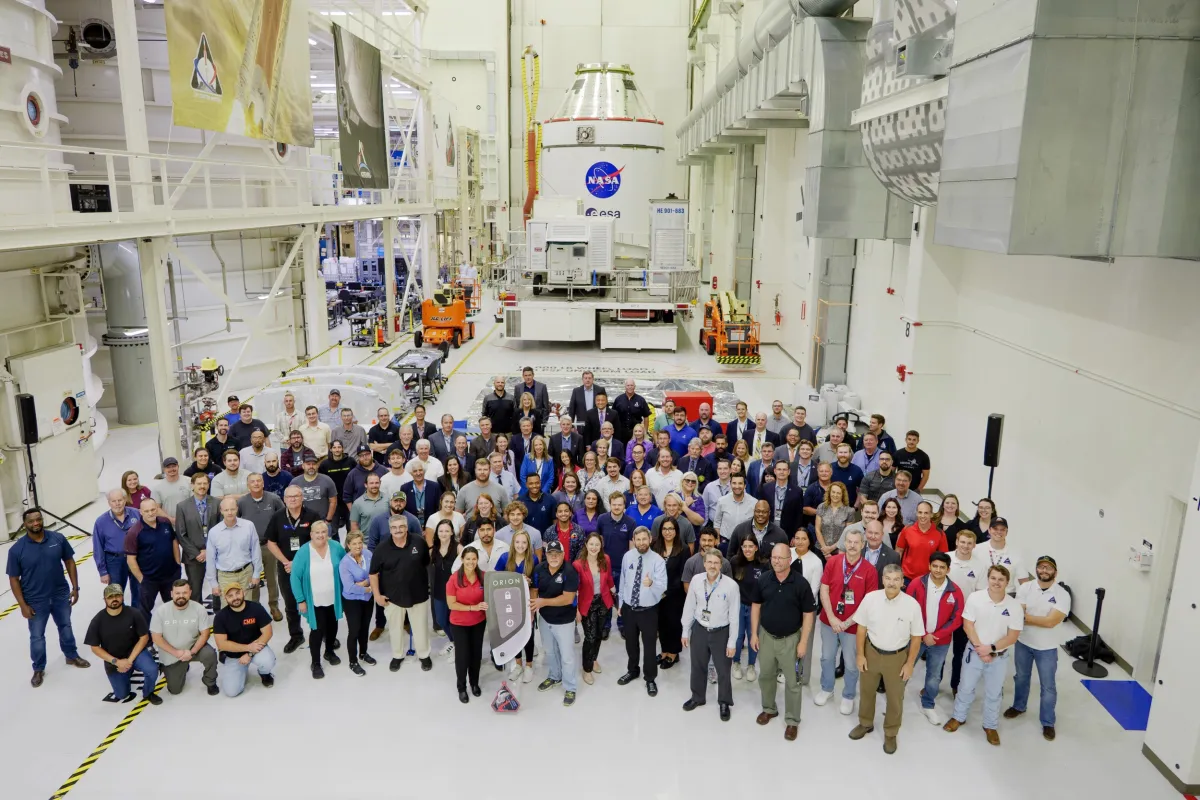
Lockheed Martin delivers completed Orion to NASA for Artemis 2

Orion

By Jeff Foust, May 2, 2025


Lockheed Martin formally delivered to NASA May 1 the Orion spacecraft for Artemis 2, keeping that mission on track for a launch in early 2026.


NASA took acceptance of the Orion spacecraft at the Kennedy Space Center, signing paperwork marking completion of Lockheed's work to assemble the spacecraft. The spacecraft is now the responsibility of the Exploration Ground Systems (EGS) program.


EGS will now take Orion to processing facilities at the center to load consumables such as propellant, water and oxygen, followed by installation of its launch abort system. Orion will then go to the Vehicle Assembly Building to be integrated with the Space Launch System rocket currently being assembled there. Read More

Other News From the Week

POLICY & POLITICS

Senate Commerce Committee advances Isaacman nomination to lead NASA

The Senate Commerce Committee voted 19 to 9 to advance Jared Isaacman's nomination to be NASA administrator to the full Senate on April 30, bringing him one step from confirmation. The vote happened three weeks after he testified before the committee, and allows the nomination to now go to the full Senate for a confirmation vote, yet to be scheduled. Read More


FCC opens new battlefront in satellite power struggle

The Federal Communications Commission unanimously voted April 28 to review its satellite spectrum sharing rules, opening a new front in the power struggle between legacy operators in geosynchronous orbit (GSO) and non-GSO (NGSO) upstarts. The agency adopted a Notice of Proposed Rulemaking to explore updating Equivalent Power Flux Density limits, set up more than 30 years ago to regulate how strong NGSO signals can be to avoid disrupting GSO satellites flying overhead. Read More


China and Malaysia to study international equatorial spaceport project

China is exploring establishing its first overseas launch site with a proposed equatorial spaceport in Malaysia, carrying strategic, economic, and geopolitical implications. The China Great Wall Industry Corporation signed a letter of intent with Pahang State Development Corporation and Lestari Angkasa Sdn Bhd, a Malaysian private company actively involved in the development of the country's space sector, April 15. Read More

Loving SpaceNews This Week? Check out SpaceNext: AI, where we look at how artificial intelligence is becoming integral to the space industry, and how companies and agencies are using it for their missions.

MILITARY

Ursa Major wins $28.5 million Air Force contract to flight-test Draper engine for hypersonic use

The contract, announced May 1, covers both the first flight demonstration and integration of the Draper engine, a storable, high-performance propulsion system tailored for hypersonic missile applications, into a test vehicle, with work scheduled through early 2027. The project aims to advance U.S. capabilities in hypersonic weapons, a category of defense systems that has become a top Pentagon priority amid competition with China and Russia. Read More


U.S. Space Force taps 12 firms for $237 million small-satellite procurement

The U.S. Space Force has selected 12 companies for a 10-year, $237 million contract to develop and deploy small satellites under a new procurement initiative aimed at advancing military space technology through commercial innovation. The agreement, known as the Space Test Experiments Platform 2.0, is part of the Department of Defense's broader Space Test Program. Read More

LAUNCH

Alpha launch of Lockheed tech demo satellite fails

A Firefly Alpha rocket malfunctioned during an April 29 launch, preventing a Lockheed Martin technology demonstration satellite on board from reaching orbit. The launch of the FLTA0006 mission appeared to go as planned until stage separation about 2 minutes and 35 seconds after liftoff. A cloud suddenly formed between the two stages, and video showed what appeared to be debris falling away as the upper stage continued its ascent. Read More


Atlas launches first operational Project Kuiper satellites

An Atlas 5 successfully launched April 28 the long-delayed first set of operational Project Kuiper broadband satellites for Amazon. United Launch Alliance reported a little more than 90 minutes later that the 27 Kuiper satellites on board had deployed from the Centaur upper stage into low Earth orbit. Read More

OPINION

Building the space workforce — how to compete for top talent in a new frontier


Galileo

By Mark Sasson, May 2, 2025


The space industry is entering a new era. No longer defined solely by national agencies and defense contractors, it now includes a fast-growing field of private innovators, venture-backed startups and visionary founders. In 2024 alone, startups in the sector brought in $8.6 billion in funding — a clear sign that investors are putting serious money behind commercial space companies and the people building them.


But there's a gap between potential and reality. Without a steady pipeline of talent, even the most well-funded or well-engineered ideas risk stalling. Building the next generation of the space workforce is now mission-critical. Read More


Expanding the human presence in orbit faces growing risk from space debris

By Siamak Hesar


If European leaders want to beef up defense in space, they should look to the Space Development Agency

By Jean-Francois Morizur and François Alter


Data architecture is paramount for Golden Dome success — and the Department of Defense is not ready
By Rob Goron and Damon Feltman


SpaceNews is committed to publishing our community's diverse perspectives. Whether you're an academic, executive, engineer or even just a concerned citizen of the cosmos, send your arguments and viewpoints to opinion@spacenews.com to be considered for publication online or in our next magazine. The perspectives shared in these op-eds are solely those of the authors.

Stellar Dispatch logo

Publish your press release with SpaceNews' premier press release service and start seeing results today.


Latest Press Releases

Inside the $320B Opportunity to Connect the Unconnected

EBAD's Spacecraft Dispensing Mechanisms Propel Amazon's Project Kuiper into Orbit

Novaspace Forecasts Global Space Exploration Investment to Reach $31 Billion by 2034

Sponsored Post

L3Harris

Why Resilient GPS (R-GPS) Matters for US Military Superiority: We Must Address GPS Vulnerabilities

By L3Harris


GPS is not only a cornerstone to our military superiority, it is foundational to our national and global economic stability. In fact, analysts warn that GPS outages could cost our economy $1 billion per day. Once the world's sole global navigation satellite system, GPS now competes with international alternatives. While the U.S. continues investing in GPS modernization, other nations have been more aggressive in adopting new technologies and expanding their satellite networks.


Recently, our adversaries have deployed sophisticated efforts to disrupt, deny and degrade U.S. Precision, Navigation and Timing (PNT) advantages. The conflict in Ukraine offers a sobering wake-up call where advanced electronic warfare capabilities have effectively degraded or denied GPS-guided weapons and unmanned vehicles. This isn't a theoretical threat – it's happening today, and if we want to dominate on the battlefield, we will need to have a PNT solution that is seamless and adaptive. Read More


What's New With SpaceNews?

Don't forget to sign up for our next webinar!

Webinar registration

Join us May 6 as we sit down with Novaspace to dig into their in-depth analysis of SpaceX's financial health, strategic evolution and key business segments.

YouTube
Linkedin
Facebook
Instagram

Space Force takes a STEP on small sat testing

Plus: The latest on the Orion spacecraft for Artemis 2
 ‌ ‌ ‌ ‌ ‌ ‌ ‌ ‌ ‌ ‌ ‌ ‌ ‌ ‌ ‌ ‌ ‌ ‌ ‌ ‌ ‌ ‌ ‌ ‌ ‌ ‌ ‌ ‌ ‌ ‌ ‌ ‌ ‌ ‌ ‌ ‌ ‌ ‌ ‌ ‌ ‌ ‌ ‌ ‌ ‌ ‌ ‌ ‌ ‌ ‌ ‌ ‌ ‌ ‌ ‌ ‌ ‌ ‌ ‌ ‌ ‌ ‌ ‌ ‌ ‌ ‌ ‌ ‌ ‌ ‌ ‌ ‌ ‌ ‌ ‌ ‌ ‌ ‌ ‌ ‌ ‌ ‌ ‌ ‌ ‌ ‌ ‌ ‌ ‌ ‌ ‌ ‌ ‌ ‌ ‌ ‌ ‌ ‌ ‌ ‌ ‌ ‌ ‌ ‌ ‌ ‌ ‌ ‌ ‌ ‌ ‌ ‌ ‌ ‌ ‌ ‌ ‌ ‌ ‌ ‌ ‌ ‌ ‌ ‌ ‌ ‌

View in Browser

A SpaceNews daily newsletter

05/02/2025

Top Stories

Twelve companies won Space Force contracts to develop and deploy smallsats. The awards are part of the Space Test Experiments Platform (STEP) 2.0 program, a 10-year effort worth $237 million that allows the companies to compete for a series of task orders to build satellite buses carrying experimental payloads. STEP 2.0 is designed to modernize the government's ability to test and evaluate new space-based systems by tapping into the commercial small satellite market. The 12 companies range from major contractors General Atomics and Lockheed Martin to smaller providers such as Loft Orbital, Spire and York Space Systems. [SpaceNews]


Lockheed Martin formally delivered to NASA the Orion spacecraft for Artemis 2 Thursday. The handover marks the completion of the assembly of Orion by Lockheed and start of final preparations by NASA's Exploration Ground Systems program for the spacecraft's launch in early 2026. Lockheed said it is working to accelerate production of future Orion spacecraft, ultimately reaching one per year. The company said it supports the current Artemis architecture that uses SLS to launch Orion as the fastest way to return humans to the moon, but that it would be open, if requested, to consider alternative vehicles. [SpaceNews]


A former Space Force officer nominated to be undersecretary of the Air Force faced tough questions at his confirmation hearing Thursday. Matthew Lohmeier is a former Space Force lieutenant colonel who was removed from command in 2021 after publicly criticizing diversity, equity, and inclusion initiatives in the military. Some Democratic senators read aloud Lohmeier's previous public comments that suggested he might seek retribution against officers who supported DEI programs if confirmed to the position. Lohmeier during the hearing sought to distance his nomination from those past statements and told senators he would push for a politically neutral military. [SpaceNews]


Ursa Major won an Air Force Research Lab contract to conduct flight testing of its Draper engine. The $28.5 million contract, announced Thursday, covers the flight demonstration and integration of the engine into a test vehicle, with work scheduled through early 2027. The engine produces 4,000 pounds-force of thrust and uses storable propellants that make it suitable for use in missiles. Ursa Major completed ground tests of Draper in 2024. [SpaceNews]

Other News

Two NASA astronauts successfully completed a spacewalk outside the International Space Station Thursday. Anne McClain and Nichole Ayers wrapped up the spacewalk, lasting five hours and 44 minutes, at 2:49 p.m. Eastern. The two completed their primary tasks of relocating a communications antenna and installing a mounting bracket for a new solar array. They also completed some additional "get-ahead" tasks while outside the station. The spacewalk was McClain's third and the first for Ayers. [AP]


SpaceX launched more Starlink satellites Thursday night. A Falcon 9 lifted off from Cape Canaveral, Florida, at 9:51 p.m. Eastern, placing 28 Starlink satellites into orbit. The Falcon 9 booster for this launch completed its 18th flight with a droneship landing. [Florida Today]


Radian Aerospace announced plans this week to develop a reentry vehicle for hypersonic testing. The company said it decided to pursue the Radian Reusable Reentry Vehicle (R3V) to test technologies it needs for its future Radian One spaceplane. The vehicle, though, can also be used for hypersonic testing and flying experiments in orbit to be returned. The company said R3V could be ready for its first flight, launching on a small or medium-class rocket, as soon as 2026. [SpaceNews]


NASA's SPHEREx space observatory has started observations. The spacecraft, launched into Earth orbit in early March, completed six weeks of checkouts and has started its mission to map the entire sky at 102 distinct infrared wavelengths. It will create four such maps over its two-year primary mission. SPHEREx, or Spectro-Photometer for the History of the Universe, Epoch of Reionization and Ices Explorer, will provide data for astronomers probing the origins of the universe and presence of water in the Milky Way, among other objectives. [NASA/JPL]


They're Saying It's Not Aliens


"If the ultimate result of this story is that the public is more circumspect about future claims of life detection, that's not a terrible thing."


– Eddie Schwieterman, an assistant professor of astrobiology at the University of California, Riverside, on followup studies that raised doubts about the discovery of a potential biosignature on the exoplanet K2-18b. [Space.com]


What's New With SpaceNews?

Why Space Needs Nuclear Now

Check out the latest episode of our new podcast, Space Minds. Join David Ariosto, Mike Gruss and journalists from the SpaceNews team for compelling interviews with scientists, founders and experts who love to talk about space, and their takes on the week's biggest news.


New episodes come out every Thursday on SpaceNews.com, YouTube and wherever you listen to your favorite podcasts.


Manage Preferences


Thursday, May 1, 2025

Golden Dome: fantasy or essential?

Plus: True Anomaly's new funding and NASA is a step closer to an administrator
 ‌ ‌ ‌ ‌ ‌ ‌ ‌ ‌ ‌ ‌ ‌ ‌ ‌ ‌ ‌ ‌ ‌ ‌ ‌ ‌ ‌ ‌ ‌ ‌ ‌ ‌ ‌ ‌ ‌ ‌ ‌ ‌ ‌ ‌ ‌ ‌ ‌ ‌ ‌ ‌ ‌ ‌ ‌ ‌ ‌ ‌ ‌ ‌ ‌ ‌ ‌ ‌ ‌ ‌ ‌ ‌ ‌ ‌ ‌ ‌ ‌ ‌ ‌ ‌ ‌ ‌ ‌ ‌ ‌ ‌ ‌ ‌ ‌ ‌ ‌ ‌ ‌ ‌ ‌ ‌ ‌ ‌ ‌ ‌ ‌ ‌ ‌ ‌ ‌ ‌ ‌ ‌ ‌ ‌ ‌ ‌ ‌ ‌ ‌ ‌ ‌ ‌ ‌ ‌ ‌ ‌ ‌ ‌ ‌ ‌ ‌ ‌ ‌ ‌ ‌ ‌ ‌ ‌ ‌ ‌ ‌ ‌ ‌ ‌ ‌ ‌

View in Browser

A SpaceNews daily newsletter

05/01/2025

Top Stories

True Anomaly, a defense-focused aerospace startup developing spacecraft and software for U.S. national security missions, has raised $260 million. The company announced the Series C funding round Wednesday led by venture firm firm Accel. The round is a mix of equity and debt, with Stifel Bank providing the debt portion of the raise. The company designs spacecraft that can maneuver near other satellites in orbit, technology that aligns with U.S. efforts to bolster space domain awareness and respond to potential threats in orbit. The company said the funding will support work on four missions over the next 18 months as well as development of new products and growth of the company from 170 to 250 employees. [SpaceNews]


Jared Isaacman is a step closer to becoming NASA's next administrator after a committee vote Wednesday. The Senate Commerce Committee voted 19-9 to advance Isaacman's nomination to the full Senate for a final confirmation vote. The committee's chairman, Sen. Ted Cruz (R-Texas), and ranking member Sen. Maria Cantwell (D-Wash.) said they both supported the nomination based on Isaacman's commitment to continue the Artemis lunar exploration effort. The full Senate has not yet scheduled a vote on the nomination. [SpaceNews]


Mike Waltz, the president's national security adviser, defended the Golden Dome missile defense initiative amid congressional debates. Speaking at The Hill & Valley Forum Wednesday, Waltz drew parallels between Golden Dome and Trump's push to establish the Space Force during his first term, an effort ridiculed by some but which Waltz said with hindsight is now "prescient." His comments came the same day that the strategic forces subcommittee of the House Armed Services Committee debated the program, with subcommittee chairman Rep. Scott DesJarlais (R-Tenn.) calling it essential for defending from missile attacks. By contrast, ranking member Rep. Seth Moulton (D-Mass.) called Golden Dome a "fantasy" that could trigger an arms race. [SpaceNews]


NASA is delaying a call for proposals for an astrophysics mission by at least a year. NASA said this week that the announcement of opportunity for the next Small Explorer, or SMEX, mission that was to be released in April had been delayed to at least April 2026. NASA did not disclose the reason for the delay, but at a committee meeting last month an agency official said the release of the call for proposals would be linked to budgets the agency expected for 2026 and beyond. The administration is reportedly proposing to cut NASA science programs by nearly 50%, with even steeper cuts to astrophysics. A top-level "skinny" budget proposal for 2026 could be released as soon as Friday, with the more detailed budget to come in late May. [SpaceNews]


NASA is investigating a problem with the electric thrusters on its Psyche. NASA said the spacecraft turned off its Hall effect thrusters in early April after a drop in pressure in a line that feeds xenon propellant to them. Options to fix the problem include switching to a backup propellant line. The agency said it has until mid-June to implement a solution before the spacecraft's trajectory is significantly affected. Psyche uses electric propulsion along with a Mars flyby next year to reach the main belt asteroid Psyche in 2029. [SpaceNews]


Other News

Two NASA astronauts are gearing up for a spacewalk outside the International Space Station this morning. Anne McClain and Nichole Ayers were scheduled to start a spacewalk around 8:15 a.m. Eastern but preparations were running behind schedule. The two are scheduled to spend six and a half hours outside the station to relocate a communications antenna and install a bracket for mounting a new set of solar arrays that will be sent to the station later this year. [NASA]


The ISS performed a maneuver Wednesday to avoid a piece of Chinese space debris. A Progress spacecraft docked to the station fired its thrusters for three and a half minutes to adjust the station's orbit and provide more clearance from a piece of debris from a 2005 launch. Without the maneuver the debris would have passed about two-thirds of a kilometer from the station. [NASA]


NASA swapped a shuttle-era main engine on the Space Launch System rocket being prepared for the Artemis 2 mission. The agency said that one of the four RS-25 engines has a hydraulic leak and the program decided to replace the entire engine. SLS uses engines originally built for the shuttle program for its first four launches, with later launches using new engines. The engine swap won't delay the schedule for the Artemis 2 mission, scheduled for early 2026. [Ars Technica]


Canada needs to develop domestic launch capabilities to join the "club" of respected space powers. That was the message from a session of the Canadian Space Launch Conference this week. Industry and government panelists argued that Canada needs to invest in key strategic capabilities, like launch, to gain access to key programs by U.S. and NATO allies. Doing so, they said, will also give Canada "agency over our own decisions" in space and related areas. [SpaceQ]


An English spaceport has lost funding from a local government because of conflict-of-interest concerns. The Cornwall Council awarded £200,000 ($265,000) to Spaceport Cornwall earlier this year. Days later, a councilor, Louis Gardner, announced plans to step down and take a job with the spaceport. Gardner had not disclosed plans to go work for the spaceport when the council considered the funding. The council has since revoked the funding after concluding it did not offer "best value for money for the taxpayer." [Falmouth Packet]


Times Have Changed


"'But whatever you do, don't go into space because nothing interesting is happening there and there's not much innovation.' I was excited about space so I thankfully ignored him, and the rest is history."


– Rep. George Whitesides (D-Calif.), recalling during a panel discussion at The Hill & Valley Forum Wednesday advice he received from a family friend early in his career.


What's New With SpaceNews?

SpaceNews Job Board

The SpaceNews Job Exchange is your go-to hub for space industry careers. Whether you're looking to hire, get hired, or stay connected to top talent, this is your launchpad to success.


Manage Preferences


Top Stories: A Russian military satellite approached an Iceye spacecraft

Plus: JAXA launched a Phobos sample return mission  ‌ ‌ ‌ ‌ ‌ ‌ ‌ ‌ ‌ ‌ ‌ ‌ ‌ ‌ ‌ ‌ ‌ ‌ ‌ ‌ ‌ ‌ ‌ ‌ ‌ ‌ ‌ ‌ ‌ ‌ ‌ ‌ ‌ ‌ ‌ ‌ ‌ ‌ ‌ ‌...