Thursday, November 5, 2026

What the midterms mean for space

Plus: Regulators limit the size of the Open Cosmos constellation
 ‌ ‌ ‌ ‌ ‌ ‌ ‌ ‌ ‌ ‌ ‌ ‌ ‌ ‌ ‌ ‌ ‌ ‌ ‌ ‌ ‌ ‌ ‌ ‌ ‌ ‌ ‌ ‌ ‌ ‌ ‌ ‌ ‌ ‌ ‌ ‌ ‌ ‌ ‌ ‌ ‌ ‌ ‌ ‌ ‌ ‌ ‌ ‌ ‌ ‌ ‌ ‌ ‌ ‌ ‌ ‌ ‌ ‌ ‌ ‌ ‌ ‌ ‌ ‌ ‌ ‌ ‌ ‌ ‌ ‌ ‌ ‌ ‌ ‌ ‌ ‌ ‌ ‌ ‌ ‌ ‌ ‌ ‌ ‌ ‌ ‌ ‌ ‌ ‌ ‌ ‌ ‌ ‌ ‌ ‌ ‌ ‌ ‌ ‌ ‌ ‌ ‌ ‌ ‌ ‌ ‌ ‌ ‌ ‌ ‌ ‌ ‌ ‌ ‌ ‌ ‌ ‌ ‌ ‌ ‌ ‌ ‌ ‌ ‌ ‌ ‌

11/05/2026

READ IN BROWSER

SpaceNews logo
SpaceNext First Up newsletter logo

Get your tickets to the 2026 Icon Awards. Early bird rate extended through Nov. 6. Join us in D.C. on Dec. 1 to celebrate this year's winners. Secure your spot.

By Jeff Foust


In today's edition: how the midterm elections affect the Space Force and NASA, regulators limit the size of an Open Cosmos satellite constellation, astronauts start a spacewalk to install a space station solar array and more. 


If someone forwarded you this edition, sign up to receive it in your inbox every weekday. Have thoughts or feedback? You can hit reply to let me know.


📲  Download the SpaceNews mobile app


FROM SPACENEWS

Register to join our

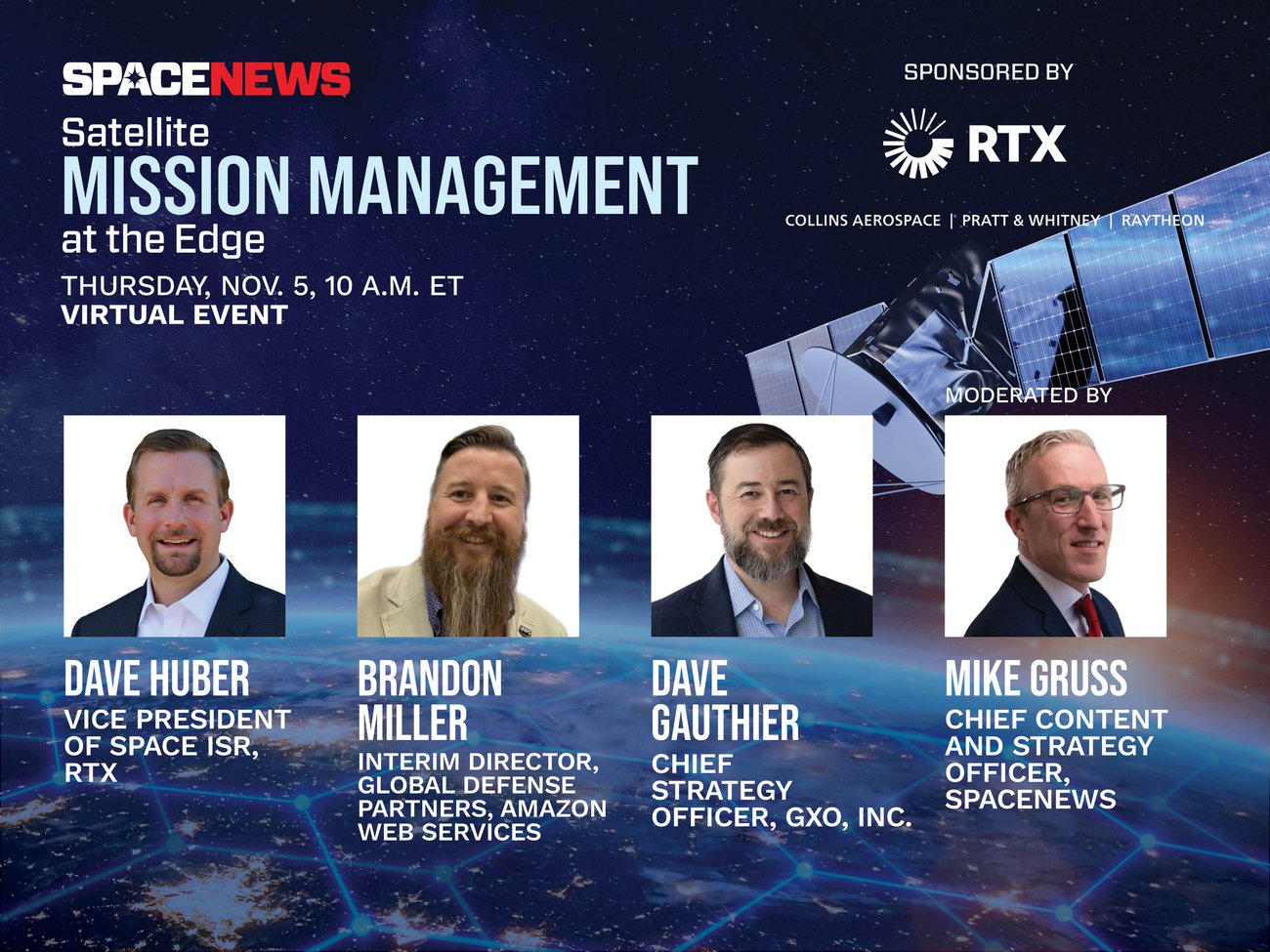
Today at 10 a.m. – register now: Satellite operations are growing more complex. For national security missions, that means faster decisionmaking, greater resilience and the ability to adapt on orbit is needed. Join us for a conversation exploring how emerging technologies and commercial capabilities are transforming satellite operations and enabling more dynamic, resilient and affordable national security space missions. Register now.

Top Stories


The Space Force's top general says he is counting on continued bipartisan support amid a shift in control of Congress but warned of near-term budget issues. Gen. Douglas Schiess, chief of space operations, said lawmakers have supported the military's growing space requirements, even as questions remain about how much Congress will spend and which programs will receive funding. The administration requested $71 billion for the Space Force in fiscal year 2027, $12 billion of which would come through a reconciliation package whose future is in doubt. Schiess said that because the Space Force is funded through a continuing resolution (CR) that runs to Dec. 11, it cannot start new programs. The longer the CR remains in effect, he said, the harder it becomes to carry out the service's plans. [SpaceNews]


A new Congress could affect NASA's plans as well. With Democrats taking control of Congress, some observers note that new leadership could scrutinize agency budgets, schedules for Artemis and the agency's work with SpaceX. Others, though, note both space exploration and space science have strong, bipartisan public support, although there are budget uncertainties as a CR funding the agency is likely to be extended into next year. On Wednesday, Rep. Zoe Lofgren (D-Calif.), the ranking member of the House Science Committee, announced she will seek to become the chair of the committee in the next Congress. She said she would work to rebuild science programs across the federal government but did not explicitly discuss plans for NASA. [SpaceNews]


The Pentagon is backing a $150 million loan to LeoLabs to help that company expand its space-tracking radar network. The financing from the Office of Strategic Capital would be matched by private co-investment, resulting in a $300 million capital infusion if the transaction closes. The money would be used to increase production and deployment of LeoLabs' multi-mission phased-array radars, including its transportable Scout systems, and expand its global sensing infrastructure. [SpaceNews]


The ITU has limited the size of a constellation being developed by Open Cosmos after the company missed deployment deadlines. The company had Ka-band spectrum filings for up to 576 satellites, and planned to deploy a constellation of 192 satellites for broadband and narrowband services. The ITU agreed this week to extend the deadlines for one of the filings, covering 288 satellites, but reduced the number of satellites authorized to 52. It declined to extend a separate filing for another 288 satellites. Open Cosmos said the ruling still enables the company to press forward with deployment of its ConnectedCosmos constellation, but did not comment on how the filing cap would impact planned services. It said it has access to other spectrum filings that would allow it to expand the constellation to the 192 needed for global services. [SpaceNews]


Redwire won a $20 million contract from DARPA for another test of very low Earth orbit (VLEO) satellites. The new award will fund testing and experimentation involving a scaled-down version of Redwire's SabreSat spacecraft ahead of a full-scale mission intended to demonstrate an air-breathing electric propulsion system. The new contract adds a second flight mission to the program, bringing the value of two announced DARPA awards to $64 million. [SpaceNews]


A former NASA official is the new head of the Canadian Space Agency. The Canadian government announced late Wednesday it appointed Alex MacDonald as president of the agency. MacDonald worked for NASA for more than 15 years, including five as NASA's first chief economist, before leaving at the end of 2024. At a Canadian space conference earlier this year, MacDonald said NASA's plans to halt work on the lunar Gateway, for which Canada was to develop a robotic arm, provided an opportunity for Canada to pivot to lunar surface systems to support NASA's planned lunar base, which could open the door for Canadian astronauts to walk on the moon. [SpaceNews]


Other News


Two astronauts have started another International Space Station spacewalk to deploy a solar array. NASA's Anil Menon and CSA's Joshua Kutryk started their spacewalk at 8:36 a.m. Eastern. The two will install the eighth and final IROSA solar array on the ISS that will augment the station's power systems. The two astronauts installed a similar array during a spacewalk last week. [NASA]


A sounding rocket developed by ArianeGroup performed its first operational launch. The SyLEx rocket launched Wednesday on a suborbital flight for the French defense procurement agency, testing technologies being developed for a new French ballistic missile. The single-stage solid-fuel rocket can carry up to 300 kilograms of payload on suborbital trajectories, and ArianeGroup is working on a two-stage version that can carry up to 600 kilograms to altitudes of 200 to 400 kilometers. [SpaceNews]


Individual stock traders will have access to satellite imagery through a new partnership. The trading platform Robinhood announced Wednesday it is working with SkyFi to give Robinhood customers the ability to access satellite images of facilities associated with 10 companies, from Amazon and Google parent company Alphabet to Tesla and SpaceX. The $10 monthly subscription uses imagery collected by BlackSky satellites and artificial intelligence software developed by SkyFi to count vehicles, track construction projects and measure activity at facilities operated by major corporations. The data could offer investors clues about manufacturing activity, logistics demand and the pace of artificial intelligence infrastructure expansion before those trends become apparent in quarterly corporate earnings. [SpaceNews]


An Indian navigation satellite has reached its final orbit. The Indian space agency ISRO said Wednesday that the NVS-03 satellite, launched Friday, performed four orbit-raising maneuvers to reach its planned inclined geosynchronous orbit. Problems with the propulsion system on a predecessor satellite, NVS-02, stranded it in a low transfer orbit. NVS-03 will join three other satellites in providing navigation services for India and the surrounding region. [ISRO]


NASA's Swift gamma-ray observatory reentered Wednesday. The spacecraft reentered at 7:39 a.m. Eastern over northern Sumatra. There were no reports of debris reaching the ground. Swift launched in 2004 on an original two-year mission to spot gamma-ray bursts and quickly relay information about them to astronomers for follow-up observations. NASA attempted to raise Swift's orbit earlier this year to prevent a reentry, but the commercial servicing mission funded by the agency to reboost it suffered problems after launch that prevented the spacecraft from docking with Swift. [Space.com]


The newest space unicorn in Silicon Valley is… a baseball team. The San Jose Giants, a minor-league affiliate of the San Francisco Giants, announced this week it will play several games next season under an alternate name, the Silicon Valley Space Unicorns. The name is a nod to the startup culture of Silicon Valley along with the region's aerospace industry heritage. The term "unicorn" means, for a startup, a privately held company with a valuation of at least $1 billion. [San Jose Giants]


Both Involve Eccentricity


"So here's my congressional dynamics. It's like orbital dynamics, but sometimes doesn't make as much sense."


– Jack Kiraly, chief of advocacy for The Planetary Society, discussing the outcome of the midterm elections during a webinar Wednesday.


Subscribe to SpaceNews


No comments:

Post a Comment

What the midterms mean for space

Plus: Regulators limit the size of the Open Cosmos constellation  ‌ ‌ ‌ ‌ ‌ ‌ ‌ ‌ ‌ ‌ ‌ ‌ ‌ ‌ ‌ ‌ ‌ ‌ ‌ ‌ ‌ ‌ ‌ ‌ ‌ ‌ ‌ ‌ ‌ ‌ ‌ ‌ ‌ ‌ ‌ ‌...