By Jeff Foust
In today's edition: Northwood Space raises $375 million, China outlines its plans for landing astronauts on the moon, Google tests technologies for orbital data centers and more.
If someone forwarded you this edition, sign up to receive it in your inbox every weekday. Have thoughts or feedback? You can hit reply to let me know.
|
|
|
|
|
|
Top Stories
Northwood Space raised $375 million to advance development of ground systems for satellites. The company announced its Series C round Monday led by Andreessen Horowitz and DFJ Growth, with participation from several other investors. The round values the company at $2 billion. Northwood's network combines antennas with software that schedules satellite contacts and routes data, allowing commercial and government operators to buy access to shared ground capacity. The funding will allow the company to scale up that network. Northwood says it is seeing strong government and commercial interest in its ground station network, but did not disclose how its business is divided between the two markets. [SpaceNews]
China has provided more details about its plans to land astronauts on the moon by 2030. Wang Xiang, deputy chief designer of China's human spaceflight program and chief designer of the lunar exploration program, set out the latest sequence of missions for the country's crewed lunar plans in a keynote at the 7th Manned Space Symposium on Saturday. The single-stick Long March 10A rocket will first launch the Mengzhou crew spacecraft on cargo missions to the Tiangong space station to accumulate data and demonstrate reliability. The Lanyue lander will separately carry out a test flight on a tri-core, three-stage Long March 10 to land on and ascend from the lunar surface. Lanyue and Mengzhou will then launch on separate Long March 10 rockets and dock in lunar orbit in an uncrewed, full-system landing rehearsal mission. The outlined sequence appears to include no crewed lunar flyby or orbital test, suggesting the landing mission would be Mengzhou's first crewed flight beyond low Earth orbit. [SpaceNews]
The outcome of this week's midterm election could test bipartisan support for NASA in Congress. Democrats have a strong chance of winning a majority in either or both chambers in Tuesday's election, and a Democratic majority could take on issues ranging from proposed sharp cuts to NASA science to broader issues that have impacts on NASA, like investigations of Elon Musk. First, Congress will return next week for a lame-duck session that will include taking up fiscal year 2027 spending bills, with the possibility that it could instead pass a full-year continuing resolution. Work on those spending bills and other key legislation makes it less likely Congress will be able to take up smaller bills, like a new NASA authorization. [SpaceNews]
Companies are growing cautious about betting on the Pentagon's $185 billion Golden Dome missile defense initiative. Executives said at a conference last week that uncertainty over future congressional funding and unresolved acquisition challenges are making it difficult for companies to justify investments in manufacturing capacity and technologies. Golden Dome faces political risks because it has not secured broad bipartisan support and much of its initial funding came through budget reconciliation rather than the regular appropriations process. The comments highlight a challenge for Golden Dome as the Pentagon tries to turn a major national security initiative into a sustained industrial effort. [SpaceNews]
Canadian company MDA Space won a contract to provide antennas for some satellites in Europe's IRIS² constellation. The contract, worth more than 100 million Canadian dollars ($72 million), covers antennas for the first 66 low Earth orbit satellites Thales Alenia Space is helping develop for the constellation. The antennas and related subsystems would be based on MDA's new Aurora broadband platform also being used by Telesat's Lightspeed constellation. [SpaceNews]
Google has completed an early test of technologies it could use for future orbital data center satellites. The company said Friday it ran an artificial intelligence model on a data-center-class processor, known as a tensor processing unit, aboard a satellite built by Planet and launched last month. Google said this was the first AI response generated in orbit by one of its processors. The tests ranged from generating reports on the spacecraft's health based on telemetry to composing a haiku about space. The test is part of Google's Project Suncatcher, announced last year, which envisions networks of solar-powered satellites equipped with specialized AI processors and connected by optical links. [SpaceNews]
The Justice Department has asked a federal judge to throw out a $50 billion lawsuit filed by Ligado Networks. Ligado alleges in its suit that its efforts to deploy L-band satellite spectrum terrestrially were roadblocked because undisclosed military systems use or rely on the frequencies. In a motion filed last week, the Justice Department argued that the bankrupt satellite operator's L-band license does not come with protected property rights. It also noted that Ligado's license was awarded without an auction by the FCC and uses frequencies that are shared with federal users. Ligado countered that if the court allows the government to take its license without compensation, it "would unsettle the spectrum marketplace" and deter future investment. [SpaceNews]
|
|
|
|
|
Other News
India launched a navigation satellite Friday. A GSLV Mark 2 rocket lifted off at 2:21 p.m. Eastern from the Satish Dhawan Space Centre and successfully placed the NVS-03 spacecraft into a geostationary transfer orbit. That spacecraft will operate from GEO and broadcast navigation signals as part of India's NavIC system. NVS-03 would be the fourth satellite in that system, the minimum needed to provide services in India and the surrounding region. A previous satellite, NVS-02, launched in early 2025 but was stranded in a transfer orbit when a valve in its propulsion system failed to open. NVS-03 launched with the same valve already open, and since its launch has performed its first orbit-raising maneuver successfully. [SpaceNews]
SpaceX launched more Starlink satellites over the weekend. A Falcon 9 lifted off from Vandenberg Space Force Base in California at 12:04 a.m. Eastern Saturday, putting 27 Starlink satellites into orbit. The launch was the 700th flight of a Falcon 9 rocket since its introduction in 2010. [Spaceflight Now]
The Space Force is pushing ahead with upgrades to Cape Canaveral's launch facilities despite a near-term downturn in launches. The Eastern Range has hosted 60 orbital launch attempts so far this year, well off the pace of 2025 when it had a record 109 orbital launches. Speaking at a conference last week, Space Force Col. Brian Chatman said the spaceport was continuing upgrade efforts, citing projections of more than 600 launches annually there by 2035. That work includes new infrastructure for the spaceport, such as propellant pipelines and power systems, and finding sites for new launch vehicles. A chart he showed linked Blue Origin to Space Launch Complex 46, a site previously used by small launch vehicles and for missile testing. The Space Force put out a request for information about using that site for "super-heavy" launch vehicles but had not formally announced assigning the site to Blue Origin. [SpaceNews]
NASA is restarting a search for robotic servicing options for the Hubble Space Telescope. The agency released a request for information last week looking for concepts from industry for missions that could raise Hubble's orbit or also perform upgrades to the telescope. Hubble is in a slowly decaying orbit with a 50% chance of reentering by the end of 2033. The RFI also seeks input on missions that would perform a controlled reentry of Hubble. NASA sought concepts for robotic servicing missions in late 2022, around the same time it was also studying with SpaceX a servicing mission using a Crew Dragon spacecraft. NASA said in 2024, though, that it would not proceed with any of those plans, citing risks to the telescope. The agency said earlier this year it was open to a commercial Hubble reboost mission based on its work on a similar mission for the Swift space telescope. [SpaceNews]
Swift, meanwhile, is expected to reenter this week after its reboost mission failed. The spacecraft is projected to reenter early Wednesday according to predictions by the Space Force and The Aerospace Corporation. Most of the spacecraft should burn up on reentry but some components, including parts of its mirror, may survive and reach the ground. The reentry will take place between about 21 degrees north and south latitude. NASA had hoped to raise the spacecraft's orbit with a mission developed by Katalyst Space Technologies and launched in July, but that servicer spacecraft suffered technical problems that led NASA and the company to call off the reboost. [AP]
New British defense procurement rules could impact the ability of American companies to compete for military space projects. The policy, published by the Ministry of Defence Friday, identifies space technology among the government's strategic priorities and seeks to channel more foreign defense spending into British manufacturing, research, technology transfer and supply chains. It would require foreign contractors to generate domestic industrial and economic benefits worth up to 100% of major contract values for projects worth at least 50 million pounds ($67 million). The policy comes as Britain weighs a multibillion-pound procurement for its next generation of Skynet military communications satellites, a competition between Airbus and Lockheed Martin that has drawn attention to the future of Britain's sovereign satellite manufacturing capabilities. [SpaceNews]
Two Chinese commercial launch firms have passed key hardware milestones as they move toward inaugural flights of reusable launchers. Deep Blue Aerospace has finished manufacturing first-stage liquid oxygen and kerosene tanks five meters in diameter for its Nebula-2 rocket, scheduled to make its first flight in 2027. Nebula-2 will be capable of carrying a payload of greater than 25,000 kilograms to low Earth orbit. Another Chinese launch company, iSpace, has completed static load tests on two primary load-bearing sections of its Hyperbola-3 reusable rocket. The company describes the tests as groundwork for the rocket's first flight, which was once planned for this year. It did not disclose a new planned launch date. [SpaceNews]
Four people have just completed a simulated Mars mission lasting more than a year. The four members of the CHAPEA 2 crew exited their simulated Mars habitat at the Johnson Space Center on Saturday after 378 days inside the facility. The simulated Mars mission, the longest yet conducted by NASA, examined human factors issues and technologies needed for future human missions to Mars. "To my crewmates, it's been a hell of a year," said one of the CHAPEA crewmembers, Ellen Ellis. "Analog astronauts living in captivity of our own free will." [KHOU-TV Houston]
|
|
|
|
|
|
|
|
The Week Ahead
Monday:
Mahia Peninsula, New Zealand: Scheduled launch of an Electron carrying a iQPS radar imaging satellite at 11:30 a.m. Eastern Jiuquan, China: Projected launch of a Kinetica-2 rocket carrying Qianfan satellites at 7:13 p.m. Eastern. Monday-Thursday:
London: The Global Milsatcom conference covers military satellite communications topics. Reston/Chantilly, Va.: The Cybersat conference examines cybersecurity issues for space systems with both unclassified and classified sessions. Tuesday:
Online: Voyager Technologies holds an earnings call at 9 a.m. Eastern to discuss its third quarter financial results, which will be released after the markets close Monday. Vandenberg Space Force Base, Calif.: Scheduled launch of a Falcon 9 on the USSF-432 mission at 8:28 p.m. Eastern. Tuesday-Thursday:
Wednesday:
Wednesday-Thursday:
Wednesday-Friday:
Houston: SpaceVision 2026, the annual conference of Students for the Exploration and Development of Space, includes sessions on space exploration, science and policy. Thursday:
International Space Station: NASA astronaut Anil Menon and CSA astronaut Joshua Kutryk conduct a spacewalk to install a new solar array starting at 8:10 a.m. Eastern. Online: BlackSky releases its third quarter financial results and holds an earnings call at 8:30 a.m. Eastern. Online: MDA Space releases its third quarter financial results and holds an earnings call at 8:30 a.m. Eastern. Xichang, China: Scheduled launch of a Long March 2C with an undisclosed payload at 11 a.m. Eastern. Wenchang, China: Projected launch of a Long March 12 carrying Guowang satellites at 4:15 p.m. Eastern. Online: Viasat releases its second quarter fiscal 2027 financial results and holds an earnings call at 5:30 p.m. Eastern. Vandenberg Space Force Base, Calif.: Scheduled launch of a Falcon 9 carrying Starlink satellites at 9:21 p.m. Eastern. Friday:
Saturday-Sunday:
|
|
|
|
|
|
FROM SPACENEWS |
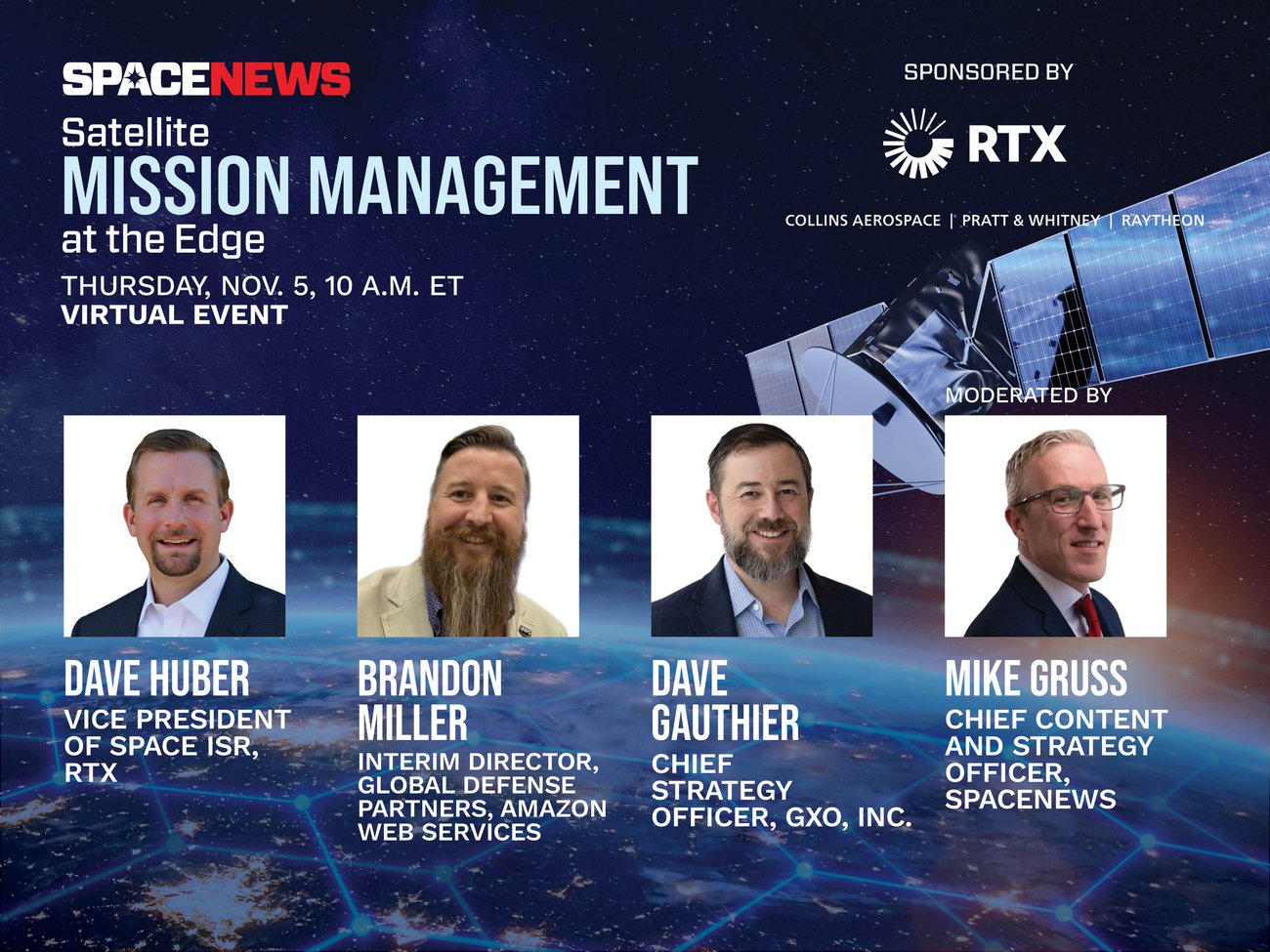 |
Register to join SpaceNews and RTX on Thursday: Satellite operations are growing more complex. For national security missions, that means faster decisionmaking, greater resilience and the ability to adapt on orbit is needed. Join us on Nov. 5 for a conversation exploring how emerging technologies and commercial capabilities are transforming satellite operations and enabling more dynamic, resilient and affordable national security space missions. Register now. |
|
|
|
|






No comments:
Post a Comment