Plus: Another way to address the launch capacity crunch
By Dan Robitzski
Welcome back to our weekly newsletter highlighting the opinions and perspectives of the SpaceNews community.
|
|
|
|
FROM SPACENEWS |
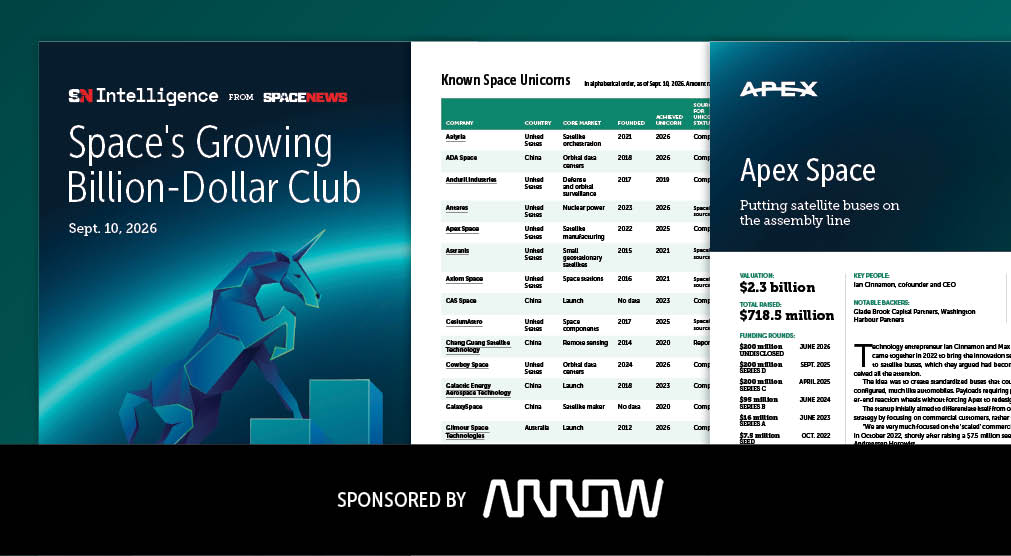 |
Explore the themes connecting space unicorns: The number of private companies valued at $1 billion or more has rocketed as the maturing space industry draws deeper pools of capital from asset managers, sovereign wealth funds and other institutional investors. Read the latest SpaceNews Intelligence report to track where investors see the biggest opportunities. Download now. |
|
|
|
|
|
The Office of Space Commerce’s new Space Commerce Certification (SCC) pilot program may determine whether space companies are able to operate cleanly under general guidelines or whether they need to navigate additional regulations every time they arrive at a novel technology or use for one in space, according to a commentary by Steven E. Bartz, who is a member of the International Institute of Space Law, and Jack Wright Nelson, a law professor at Thompson Rivers University.
"The United States is the world’s largest commercial space market," they wrote. "If Washington treats novelty as an 'authorization gap' requiring individualized clearance, other spacefaring states may follow. The result could be a nascent global industry organized around bureaucratic acceptance rather than technological achievement: higher compliance friction, slower development and an advantage for firms most able to navigate government bureaucracies."
Read the full SpaceNews article here. |
|
|
|
|
In a column for SpaceNews Magazine, Senior Staff Writer Jason Rainbow wrote about how a "worse-than-expected lack of launch capacity has blindsided an industry that had come to rely on growing access to space, not least the Falcon 9 launches and rideshares SpaceX is moving away from as it shifts focus to Starship.
"Coupled with launch failures and the struggles of nascent rocket alternatives to get off the ground, satellite makers and budding constellation operators have been left short of desperately needed near-term alternatives."
Aside from the push to bring more launchers online, companies are also working to make better use of each launch to which they get access, Jason wrote.
Read the rest of the SpaceNews article here
SpaceNews is committed to publishing our community’s diverse perspectives. Whether you’re an academic, executive, engineer or a concerned citizen, send your arguments and viewpoints to opinion (at) spacenews.com to be considered for publication online or in our next magazine. If you have something to submit, read some of our recent opinion articles and our submission guidelines to get a sense of what we’re looking for. The perspectives shared in these opinion articles are solely those of the authors and do not necessarily represent their employers or professional affiliations. |
|
|
|
|
|
|
|
FROM SPACENEWS |
 |
Unlike traditional press wires, Stellar Dispatch ensures your message gets in front of industry leaders and decision-makers. Reach thousands of professionals directly, get enhanced search visibility and maximize your distribution. Make your first post today for $899, or save with our plans that include multiple posts. |
|
|
|
|








No comments:
Post a Comment