Tuesday, October 6, 2026

Military Space: SDA tests the deorbiting market


Plus: The Army is expanding its space role
 ‌ ‌ ‌ ‌ ‌ ‌ ‌ ‌ ‌ ‌ ‌ ‌ ‌ ‌ ‌ ‌ ‌ ‌ ‌ ‌ ‌ ‌ ‌ ‌ ‌ ‌ ‌ ‌ ‌ ‌ ‌ ‌ ‌ ‌ ‌ ‌ ‌ ‌ ‌ ‌ ‌ ‌ ‌ ‌ ‌ ‌ ‌ ‌ ‌ ‌ ‌ ‌ ‌ ‌ ‌ ‌ ‌ ‌ ‌ ‌ ‌ ‌ ‌ ‌ ‌ ‌ ‌ ‌ ‌ ‌ ‌ ‌ ‌ ‌ ‌ ‌ ‌ ‌ ‌ ‌ ‌ ‌ ‌ ‌ ‌ ‌ ‌ ‌ ‌ ‌ ‌ ‌ ‌ ‌ ‌ ‌ ‌ ‌ ‌ ‌ ‌ ‌ ‌ ‌ ‌ ‌ ‌ ‌ ‌ ‌ ‌ ‌ ‌ ‌ ‌ ‌ ‌ ‌ ‌ ‌ ‌ ‌ ‌ ‌ ‌ ‌

10/06/2026

READ IN BROWSER

SpaceNews logo
Military Space newsletter logo

The updates your team needs to make smart decisions: Set up SpaceNews access for five or more readers and save more than 25%. Learn more.

SPONSORED BY

Terran Orbital logo

By Sandra Erwin


Welcome to SpaceNews' Military Space, your source for the latest developments at the intersection of space and national security. In this week's edition: SDA tests commercial services to deorbit satellites and the Army builds out its space force. Plus, military constellations generate more data than existing links can move.


If someone forwarded you this edition, sign up to receive it in your inbox every Tuesday. We welcome your feedback and suggestions. You can hit reply or DM me on Signal @SandraErwin.43.

📲  Download the new SpaceNews mobile app


The National Reconnaissance Office NROL-97 mission was the agency’s first launch aboard a SpaceX Falcon Heavy rocket. The classified payload launched from Launch Complex 39A at Kennedy Space Center Oct. 1. The Falcon Heavy’s two side boosters returned to SpaceX’s Landing Zones 1 and 2 at Cape Canaveral Space Force Station after delivering the payload to orbit. NROL-97 was also the first national security payload launched from an NSSL Phase 3 Lane 2 contract. Credit: SpaceX

Space Force is putting hundreds of satellites in orbit. It needs a way to bring them down


The Space Development Agency is putting money behind a field of companies developing servicing vehicles that could be used to deorbit dead satellites. 


SDA, part of the U.S. Space Force, is deploying the Proliferated Warfighter Space Architecture in low Earth orbit, a constellation projected to have hundreds of satellites. The agency began studying commercial disposal services in 2024 and is now moving toward flight demonstrations and operational missions.


The latest effort is Deorbit-as-a-Service, jointly funded by SDA and the Defense Innovation Unit. Firefly Aerospace, D-Orbit Space and Katalyst Space are splitting roughly $8.4 million for an initial phase focused on mission designs and technical risk reduction. Preliminary design reviews are expected by the end of the year, with SDA aiming to put a prototype in orbit by mid-2028.


The companies are taking different approaches. D-Orbit Space is proposing a reusable tug that would capture a satellite and attach a separate propulsion package, or “jetpack,” to carry out the deorbit. Katalyst is developing Nexus, a roughly 650-kilogram robotic spacecraft designed to grapple unprepared satellites, lower them into a rapidly decaying orbit and then move on to another mission. Firefly plans to adapt its Elytra orbital vehicle and a proprietary deorbit system that it says can accommodate satellites of different sizes and configurations.


SDA is also funding deorbit capabilities outside the DIU competition. Starfish Space has a separate contract worth up to $52.5 million to deorbit as many as seven PWSA spacecraft using its Otter servicing vehicle, with a first mission targeted for 2027. KMI Space is pursuing an SDA-backed STRATFI effort to demonstrate its Laelaps spacecraft and REACCH capture system in orbit. 


The acquisition question


The Space Force doesn't have a centralized office for buying deorbiting services. Space Systems Command has a Space Mobility and Logistics portfolio overseeing adjacent capabilities such as satellite refueling and augmented maneuver, but deorbiting isn't currently being procured through that office.


Organizations with a specific disposal need, including SDA, are instead working directly with industry.


That makes SDA's investments a test of more than spacecraft hardware. The agency is using several acquisition routes and backing different technical approaches while industry tries to show that satellite removal can become a repeatable service rather than a succession of one-off demonstrations.


“The government is clearly leading in this area, and it’s a good example of them doing the demand signaling,” Katalyst CEO Ghonhee Lee said.


Commercial customers are watching those government-funded missions, KMI CEO Troy Morris said, but want to see the technology demonstrated before committing their own money. “There is a waiting market for in-space mobility,” he said.


U.S. Army's space push gets real


The Army is putting personnel and money behind a larger role in military space, standing up its first permanent enlisted space workforce while awarding $66.6 million for technologies intended to counter enemy surveillance, including threats from orbit.


More than 600 soldiers officially became 40D Tactical Space Operations Specialists on Oct. 1, the first large enlisted cohort in the Army's new Space Operations Branch. Nearly 3,000 applied, with many of those selected coming from military intelligence, air defense artillery and the Signal Corps.


The personnel move is significant because the Army has relied on soldiers from those branches to temporarily fill space assignments. The new 40D specialty, which runs from specialist through sergeant major and is open to active-duty, National Guard and Reserve soldiers, creates a permanent enlisted career path alongside the Army's 40A Space Operations officers.


The reorganization comes as the Army takes on a more active role in countering the space capabilities that potential adversaries could use against forces on the ground.


‘Counter surveillance’ investments


A set of awards announced Sept. 30 provides a glimpse of the technology the Army wants for that mission.


The service awarded five standalone Other Transaction Authority agreements totaling $66.6 million to ICR, KBR-Kord, Northrop Grumman-Xetron, Raytheon and Systems & Technology Research to develop electromagnetic warfare prototypes over the next 18 to 20 months. KBR received the largest agreement at $22.4 million, followed by ICR at $18.8 million, STR at $10.9 million, Raytheon at $7.6 million and Northrop Grumman-Xetron at $6.9 million.


These technologies will support an Army program called Counter Surveillance and Reconnaissance, or CSR, aimed at protecting ground forces from intelligence, surveillance and reconnaissance threats. The Army has not disclosed what each contractor is building or which parts of an adversary's surveillance architecture the prototypes will target.


Electromagnetic warfare broadly involves using the electromagnetic spectrum to sense, protect against or interfere with an opponent's systems. Applied to counter-surveillance, these systems could potentially disrupt a sensor, communications link or another piece of the network that turns surveillance data into targeting information. 


Satellite buildup runs into a data bottleneck

A key challenge for the Space Force is not just putting more sensors in orbit but also building the infrastructure to move what they collect.


A Mitchell Institute for Aerospace Studies report released Oct. 1 warns that improvements in sensor resolution, persistence and revisit rates are causing data production to outpace the communications networks responsible for moving it. 


The report cites analysis showing a 200-fold increase in data output over the past 20 years. One advanced synthetic aperture radar satellite system cited in the study is projected to generate about 200,000 gigabytes a day, more than 18 times what a 1-gigabit-per-second communications link could transmit in the same period.


That mismatch is becoming more consequential as the Space Force shifts from small numbers of large satellites to proliferated constellations that continuously collect and exchange data. The report notes that the newest major ground station in the service's Satellite Control Network was completed in 1991.


The military needs hybrid networks that use high-capacity optical links to move large volumes of data while retaining RF for broad-area coverage and communications when weather or other conditions make optical links impractical, says the report. 


SpaceNews' latest national security coverage


FROM SPACENEWS

Download the latest SpaceNews Intelligence report,

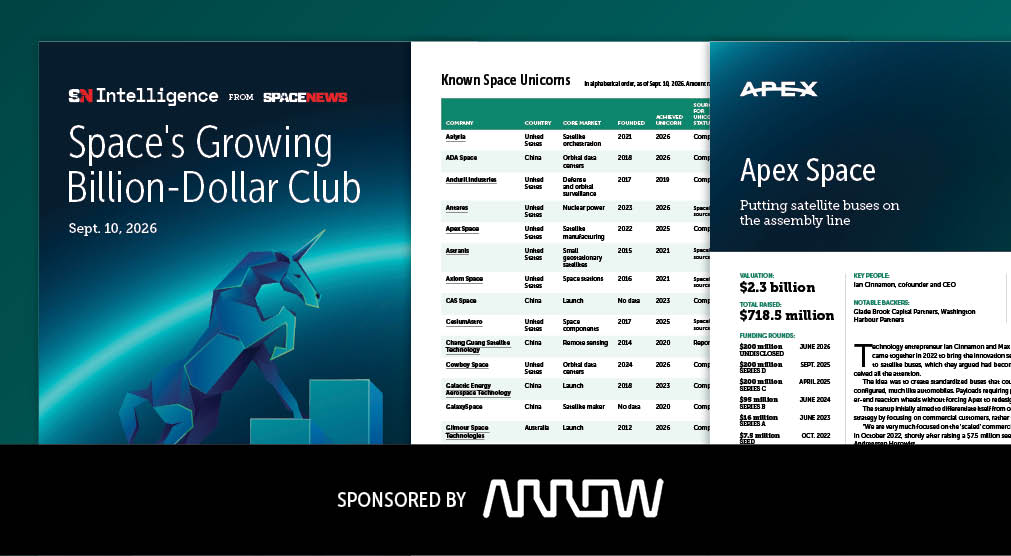
Explore the themes connecting space unicorns: The number of private companies valued at $1 billion or more has rocketed as the maturing space industry draws deeper pools of capital from asset managers, sovereign wealth funds and other institutional investors. Read the latest SpaceNews Intelligence report to track where investors see the biggest opportunities. Download now.

Subscribe to SpaceNews


No comments:

Post a Comment

Military Space: SDA tests the deorbiting market

Plus: The Army is expanding its space role  ‌ ‌ ‌ ‌ ‌ ‌ ‌ ‌ ‌ ‌ ‌ ‌ ‌ ‌ ‌ ‌ ‌ ‌ ‌ ‌ ‌ ‌ ‌ ‌ ‌ ‌ ‌ ‌ ‌ ‌ ‌ ‌ ‌ ‌ ‌ ‌ ‌ ‌ ‌ ‌ ‌ ‌ ‌ ‌...