By Jeff Foust
In today's edition: a Blue Ring for the Red Planet, Sierra Space identifies payloads for the first Dream Chaser flight, a new study raises space workforce concerns and more.
If someone forwarded you this edition, sign up to receive it directly in your inbox every weekday. Have thoughts or feedback? You can hit reply to let me know directly.
|
|
|
|
|
|
SPONSORED |
 |
As constellations scale, regulatory approvals are stuck in a massive queue. More launches are delayed by paperwork than by hardware. Invariant AI closes that gap: what takes eight months the traditional way, we do in five. We handle FCC, ITU and NOAA authorizations, alongside ITAR, EAR and FAA compliance, for satellite operators and launch providers who can't afford to wait in a queue. Every filing is built and reviewed by a lawyer working alongside our AI platform, which identifies the right approvals, drafts the documents and submits them directly to the regulator, at a fraction of the usual cost. You build. You fly. We own the filings, end to end. |
|
|
|
|
Top Stories
NASA selected Blue Origin to build a Mars telecommunications orbiter. The agency said Tuesday it awarded a contract to Blue Origin valued at about $700 million for the Mars Telecommunications Network (MTN), a spacecraft designed for launch in late 2028 that will serve as a communications relay in Mars orbit between other spacecraft there and Earth. NASA received funding for the mission in the budget reconciliation act last year, with restrictions on the companies that could bid on it. Blue Origin and Rocket Lab were the two companies most publicly interested in the mission. Blue Origin said its MTN orbiter will be based on its Blue Ring spacecraft. [SpaceNews]
Sierra Space said it has signed national security and commercial customers to fly payloads on the first orbital mission of its Dream Chaser spaceplane. The company announced Wednesday that the inaugural flight will carry a mix of national security, civil and commercial payloads, but did not identify the customers, disclose contract values or provide details about the payloads. Sierra Space originally developed Dream Chaser to deliver cargo to and from the International Space Station, but has pivoted to other government and commercial uses of the spaceplane. The company has targeted late this year for a first flight, a schedule that depends on both the readiness of the spacecraft as well as its launch vehicle, ULA's Vulcan. [SpaceNews]
York Space Systems unveiled a new satellite platform designed to operate in very low Earth orbit. The new LX/V-class of satellites is intended to operate at roughly 300 kilometers, an altitude that offers improved sensing performance but creates technical challenges caused by the higher atmospheric drag at those altitudes. The spacecraft has an elongated body and narrow solar-array profile designed to reduce the area exposed to the upper atmosphere. York declined to identify specific customers for LX/V but said it already has contracts with national security customers whose missions it believes could be applicable to the new platform. [SpaceNews]
A new study says the lack of a trained workforce could hinder the Space Force's ability to restore space capabilities after a conflict. The RAND Corp. report examined whether the space industrial base could reconstitute critical systems within 12 to 24 months during a prolonged conflict with a near-peer adversary. Researchers found that many of the workers needed to design, build, integrate and test spacecraft could not be hired or trained quickly enough after a conflict begins. The study found that occupations relevant to the space industrial base have about 30,000 openings a year for technicians and technologists, compared with roughly 11,000 people receiving applicable credentials. Moreover, the space industry must compete with semiconductor manufacturers and other advanced industries for the same workers. The report recommends adding surge-planning requirements to future Space Force contracts, requiring suppliers to consider in advance how they would expand production during a crisis. [SpaceNews]
A House subcommittee advanced a bill designed to streamline the FCC satellite licensing process. The House Energy and Commerce Committee's communications and technology subcommittee favorably reported H.R. 8255, the Satellite and Telecommunications (SAT) Streamlining Act, on a voice vote Tuesday, sending the bill to the full committee. The bill sets deadlines for the FCC to act on satellite applications and modification requests, and includes a "deemed granted" provision that would automatically approve them if the FCC does not act on them in time. The bill has broad industry support, but differs from a Senate bill that would require the FCC to place limits on what applications would be eligible for deemed-granted consideration. Rep. Brett Guthrie (R-Ky.), chairman of the committee and a sponsor of the SAT Streamlining Act, said his committee was working on potential changes to the House bill. [SpaceNews]
Polish space technology company Creotech Instruments signed an ESA contract for a space weather satellite mission. The company announced a 13.9 million euro ($16 million) contract for the comprehensive implementation of the SAWA 2nd Space Weather nanosat mission, which will study the Earth's upper atmosphere and monitor the effects of solar activity on the space environment in LEO. The nanosat's launch is expected in early 2029, the company said. The project will be financed via Poland's contribution to the Space Weather and Space Safety Program. [SpaceNews]
|
|
|
|
|
Other News
SpaceX launched more Starlink satellites overnight. A Falcon 9 lifted off from Vandenberg Space Force Base in California at 4:42 a.m. Eastern, putting 27 Starlink satellites into orbit. SpaceX is now launching Starlink satellites on Falcon 9 rockets only from Vandenberg as it prepares to start launching larger Starlink satellites on Starship vehicles from Texas and, later, Florida. [Spaceflight Now]
Astronauts conducted the fourth spacewalk outside the ISS in less than a month Tuesday. NASA astronaut Jessica Meir and ESA astronaut Sophie Adenot spent six hours and 49 minutes outside the station conducting several maintenance tasks. That work included installing a new retroflector, used as a docking aid, on the port on the Harmony module, as well as replacing a high-definition camera and swabbing an area of the station's exterior to study any microorganisms there. The two also partially completed work installing jumper cables for electrical systems and preparing future work to replace the radiator on the Alpha Magnetic Spectrometer instrument. NASA deferred the completion of that work and other tasks when Adenot reported a problem with a shoulder joint in her suit, apparently caused by cabling getting caught in the joint. [Space.com]
A startup working with the Space Force on "quantum-inspired" computing technologies has secured funding from IBM Ventures. BQP, formerly known as BosonQ Psi, said Wednesday that IBM Ventures made a strategic investment into the company, bringing the total raised by the startup to $8 million. BQP announced its first federal contract in July, an award from the U.S. Space Force and SpaceWERX, to develop and validate a physics-constrained, quantum-assisted machine-learning application to improve the speed and accuracy of identifying unknown space objects. In addition to space, BQP develops optimization software for uncrewed aircraft and electric vehicle battery thermal management. [SpaceNews]
Yank Technologies won a U.S. Space Force small-business contract to study the use of wireless charging for satellites. The company said Tuesday it received a Phase 1 SBIR contract from SpaceWERX, the Space Force's innovation arm, to assess the feasibility of wirelessly charging satellites without requiring a mechanical electrical connection between spacecraft. Yank Technologies develops long-range, high-power wireless charging systems and has used the technology for automotive, industrial and space applications, including NASA projects aimed at delivering power on the lunar surface. The Space Force contract covers technical analysis and data intended to establish whether the concept is feasible, with the work due in October. [SpaceNews]
The House passed a stopgap spending bill to avoid a government shutdown next month. The House approved a continuing resolution (CR) Tuesday that will fund the government at 2026 levels from the start of the 2027 fiscal year Oct. 1 through Dec. 11. The CR, previously approved by the Senate, also includes a provision preventing the enactment of an Office of Management and Budget proposed rule that would place political appointees in charge of approving federal research grants. [Politico]
The first Japanese citizen to go to space has died. Toyohiro Akiyama passed away last week at the age of 84, according to Japanese media reports. Akiyama was not a professional astronaut but instead a journalist working for the Tokyo Broadcasting System when he flew to the Mir space station in 1990 for a week-long stay. He was called by some the "space antihero" because of his initial unenthusiastic reports from space, caused by a serious case of space sickness; Akiyama, a chain smoker, also suffered from nicotine withdrawal. His accounts of the flight became most positive later in the mission. He left journalism several years after his return to become a farmer and teacher. [collectSPACE]
|
|
|
|
|
|
|
|
Blessing and Curse
|
"There's only one Elon Musk, and they're not going to create another one of him. It's a blessing and a curse because investors, when they buy these companies, they're betting on Musk as much as they are the companies themselves."
|
– Dan Ives, a tech analyst, on the risk posed by the fact that SpaceX is indelibly linked to Musk. [CNN]
|
|
|
|
|
|
|
FROM SPACENEWS |
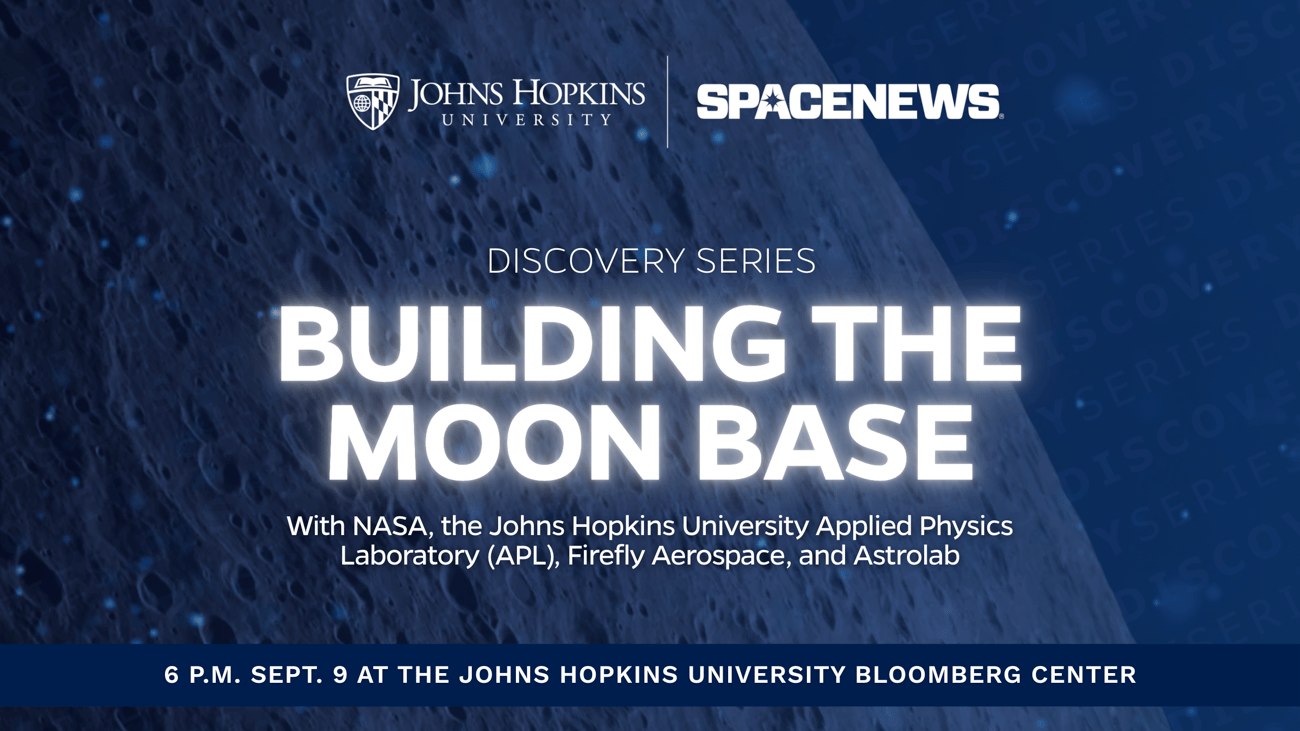 |
Join us in Washington D.C. on Sept. 9 for our next Discovery Series conversation at the Johns Hopkins Bloomberg Center. This in-person event will explore the latest plans for NASA's Moon to Mars architecture alongside the commercial opportunities, investments, and policies needed to build and support work on the lunar surface for months and eventually years at a time. We'll be joined by leaders from NASA, Firefly Aerospace, Astrolab and the Johns Hopkins University Applied Physics Laboratory. Register now. |
|
|
|
|










No comments:
Post a Comment