By Jeff Foust
In today's edition: the Roman Space Telescope is in space, a Chinese upper stage has fragmented on orbit, Trump starts the process on a space academy and more.
If someone forwarded you this edition, sign up to receive it in your inbox every weekday. Have thoughts or feedback? You can hit reply to let me know.
|
|
|
|
|
|
SPONSORED |
 |
As constellations scale, regulatory approvals are stuck in a massive queue. More launches are delayed by paperwork than by hardware. Invariant AI closes that gap: what takes eight months the traditional way, we do in five. We handle FCC, ITU and NOAA authorizations, alongside ITAR, EAR and FAA compliance, for satellite operators and launch providers who can't afford to wait in a queue. Every filing is built and reviewed by a lawyer working alongside our AI platform, which identifies the right approvals, drafts the documents and submits them directly to the regulator, at a fraction of the usual cost. You build. You fly. We own the filings, end to end. |
|
|
|
|
Top Stories
NASA's latest flagship telescope is in space after a launch Sunday morning. A Falcon Heavy lifted off from the Kennedy Space Center at 7:26 a.m. Eastern, deploying the Nancy Grace Roman Space Telescope about a half-hour later. Roman is headed to the Earth-sun L-2 Lagrange point, arriving there in about 100 days. The telescope has a 2.4-meter mirror and a wide-field camera as its primary instrument, allowing it to rapidly survey the sky and collect information intended to resolve long-standing questions in cosmology and discover up to 100,000 exoplanets. A separate coronagraph instrument will also test the ability to directly observe some exoplanets. The $4.3 billion mission was completed on budget and launched about nine months ahead of schedule. [SpaceNews]
President Trump signed an executive order Friday to examine the proposed creation of a U.S. Space Academy. The order creates a commission chaired by the NASA administrator to examine what it described as "a proposed NASA-led federal academy dedicated to combining rigorous technical education with leadership development, discipline and a durable commitment to public service." The commission has 120 days to develop the report, which will address issues ranging from the location of the academy and its structure and curriculum. The announcement was not expected, although NASA Administrator Jared Isaacman had proposed a "Starfleet Academy" for NASA in a private report during his first confirmation process last year. Such an academy would likely require congressional authorization and funding. Trump signed the executive order during a ceremony at the Johnson Space Center where he awarded the four Artemis 2 astronauts the Congressional Space Medal of Honor. [SpaceNews]
A Chinese Long March 6C rocket upper stage has fragmented in orbit days after its launch. The rocket launched last Monday, placing seven satellites into orbit. Less than two days after liftoff, the rocket's upper stage was found to have fragmented, potentially into hundreds of pieces, according to tracking data from LeoLabs. The stage's orbit was roughly 396 by 482 kilometers, which is low enough that the company expects the resulting debris to reenter within a few years. The event is the latest in a series of fragmentations afflicting the Long March 6 series, most notably the Long March 6A, dating back to 2022. [SpaceNews]
Satellite ground services company Northwood Space has opened a new factory. The company said Monday it opened a 185,000-square-foot headquarters and factory in Torrance, California. Northwood makes the antennas and software used to communicate with satellites from the ground and raised $100 million earlier this year. The new facility will allow the company to accelerate production of its Portal phased-array antenna and Prism parabolic antenna. [SpaceNews]
Gravitics is working with Lockheed Martin on Golden Dome. The company revealed in regulatory filings it is building three of its Orbital Carriers for space-based missile defense for Lockheed Martin under a contract signed in May. Gravitics said earlier this month that Lockheed Martin had selected it to support a Defense Department contract "of national importance," but didn't identify the program. Gravitics was founded to develop large modules for commercial space stations but is also using the technology for defense applications. The contract was included in SEC filings as part of plans by Gravitics to merge with Non-Invasive Monitoring Systems, a publicly traded company with no current operating business. That would allow Gravitics to become public traded without going through a traditional IPO. [SpaceNews]
A startup has raised funding to advance work on quantum imaging technologies with space applications. Diffraqtion announced Monday it closed a pre-seed round with $10 million raised from several investors, including the venture arms of Lockheed Martin and Sumitomo. The company has developed technology that enables a camera to detect details, such as the shape and orientation of objects, that cannot be resolved with conventional imaging systems. The company received a DARPA SBIR award earlier this year to test the technology on ground-based telescopes for space domain awareness applications, with plans to test it in space in a couple years. [SpaceNews]
|
|
|
|
|
Other News
A problem with the Crew Dragon spacecraft will delay its next mission to the International Space Station. NASA said late Saturday that workers detected an oxidizer leak in the spacecraft's propulsion system during prelaunch processing for the Crew-13 mission. That mission was scheduled to launch to the ISS in mid-September but has been postponed. NASA did not provide a new launch date for the mission. [NASA]
Two Chinese astronauts performed a spacewalk outside the Tiangong space station Friday. Zhu Yangzhu and Zhang Zhiyuan spent about five and a half hours outside the station in a spacewalk that concluded at 1:59 a.m. Eastern. The astronauts installed debris shields and worked on the station's solar panels. This was the first spacewalk conducted during the Shenzhou-23 that arrived at Tiangong in May. [Xinhua]
NASA and AeroVironment are moving ahead with development of a trio of Mars helicopters. AeroVironment said last week it received a contract from JPL to co-develop the three SkyFall helicopters that will launch to Mars as a payload on the SR-1 Freedom mission launching in late 2028. The helicopters are based on the design of Ingenuity, the Mars helicopter flown on the Perseverance rover mission, but are somewhat larger and carry additional payloads, such as a ground-penetrating radar. The helicopters will not be placed on the surface by a lander but instead released in the atmosphere, performing a "SkyFall maneuver" to come to a hover and then touch down. NASA is still studying potential landing sites on Mars for the helicopters. [SpaceNews]
Airbus is considering selling its U.S. space unit. The company is exploring the sale of the unit, which includes a Florida satellite factory originally built as a joint venture with OneWeb and which produced the first-generation OneWeb satellite constellation. In 2024, Airbus took full control of the joint venture, which now produces the Arrow line of satellite buses. Airbus is building the second generation of OneWeb satellites in France. [Financial Times]
A NASA authorization bill remains stalled in Congress. House and Senate Republicans have been discussing for months reconciling their versions of a NASA authorization, with little progress. Key issues involve plans for NASA's lunar base and language in the Senate bill that would extend the life of the ISS by two years to 2032. One source still expected the House and Senate to reach a compromise to allow an authorization bill to pass by the end of this year. [The Hill]
NASA has restarted science operations of the Swift gamma-ray telescope for a final time. NASA said Friday it turned on two instruments last week and plans to turn on a third in the next few weeks. The instruments were turned off earlier this year so the spacecraft could be oriented in a way to reduce atmospheric drag and slow its rate of descent, buying time for a reboost mission. However, earlier this month NASA and Katalyst Space called off that reboost attempt because of problems with Katalyst's spacecraft. NASA said that Swift should be able to operate for one to two months before its altitude reaches 300 kilometers, below which it becomes difficult to operate the telescope. [NASA]
|
|
|
|
|
|
|
|
The Week Ahead
Monday:
Teleconference: NASA's Aerospace Safety Advisory Panel holds its third quarter public meeting at 2 p.m. Eastern.
Washington: Turkey signs the Artemis Accords in a ceremony at NASA Headquarters at 2:30 p.m. Eastern.
Jiuquan, China: Anticipated inaugural launch of Galactic Energy's Pallas 1 rocket at 10 p.m. Eastern.
Tuesday:
Mahia Peninsula, New Zealand: Scheduled launch of an Electron rocket carrying a Synspective radar-imaging satellite at 7:30 a.m. Eastern.
International Space Station: NASA astronaut Jessica Meir and ESA astronaut Sophie Adenot perform a spacewalk outside the International Space Station starting at about 8:30 a.m. Eastern to complete maintenance tasks.
Tuesday-Wednesday:
Copenhagen: Space for Inspiration 2026, ESA's annual conference on commercial space exploration, will discuss topics such as microgravity R&D and lunar resources.
Washington/Online: The National Academies hosts a meeting of the Space Weather Roundtable to discuss research and operational work on the topic among agencies and organizations.
Wednesday:
Thursday:
Online: The Space Force holds a change of responsibility ceremony at 11 a.m. where Gen. Douglas Schiess becomes the Space Force's Chief of Space Operations.
Sriharikota, India: Scheduled launch of a GSLV Mark 2 rocket carrying the EOS-05 imaging satellite at 5:25 p.m. Eastern.
Friday:
Online: The Mitchell Institute's Schriever Spacepower Series hosts a talk by Brig. Gen. Todd Benson on the Space Force's role supporting U.S. Central Command at 9:30 a.m. Eastern.
Andøya, Norway: Anticipated rescheduled second launch of Isar Aerospace's Spectrum rocket at 4 p.m. Eastern.
Sunday:
|
|
|
|
|
FROM SPACENEWS |
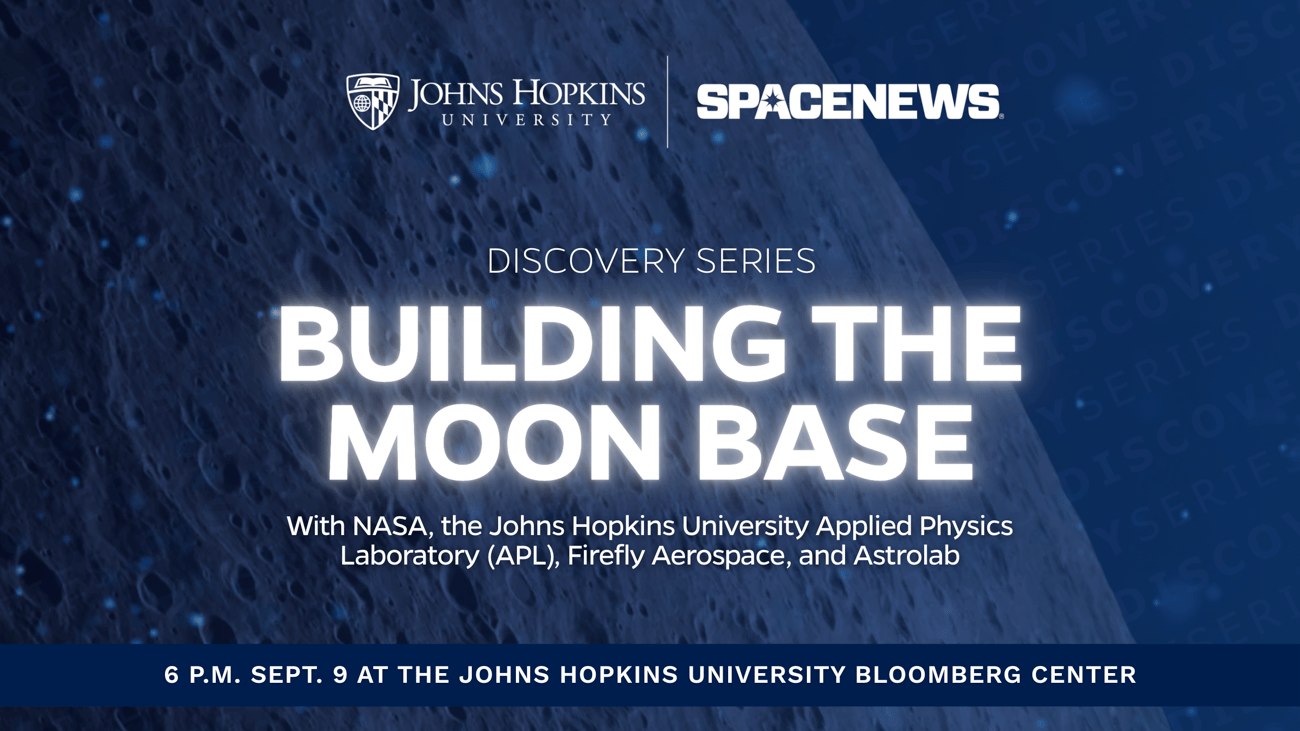 |
Join us in Washington D.C. on Sept. 9 for our next Discovery Series conversation at the Johns Hopkins Bloomberg Center. This in-person event will explore the latest plans for NASA's Moon to Mars architecture alongside the commercial opportunities, investments, and policies needed to build and support work on the lunar surface for months and eventually years at a time. We'll be joined by leaders from NASA, Firefly Aerospace, Astrolab and the Johns Hopkins University Applied Physics Laboratory. Register now. |
|
|
|
|










No comments:
Post a Comment