Plus: Saltzman's farewell address
By Jeff Foust
In today's edition: Swissto12 raises big money for small GEO satellites, Gen. Saltzman's farewell address, the Office of Space Commerce makes its case for mission authorization and more.
If someone forwarded you this edition, sign up to receive it in your inbox every weekday. Have thoughts or feedback? You can hit reply to let me know.
|
|
|
|
FROM SPACENEWS |
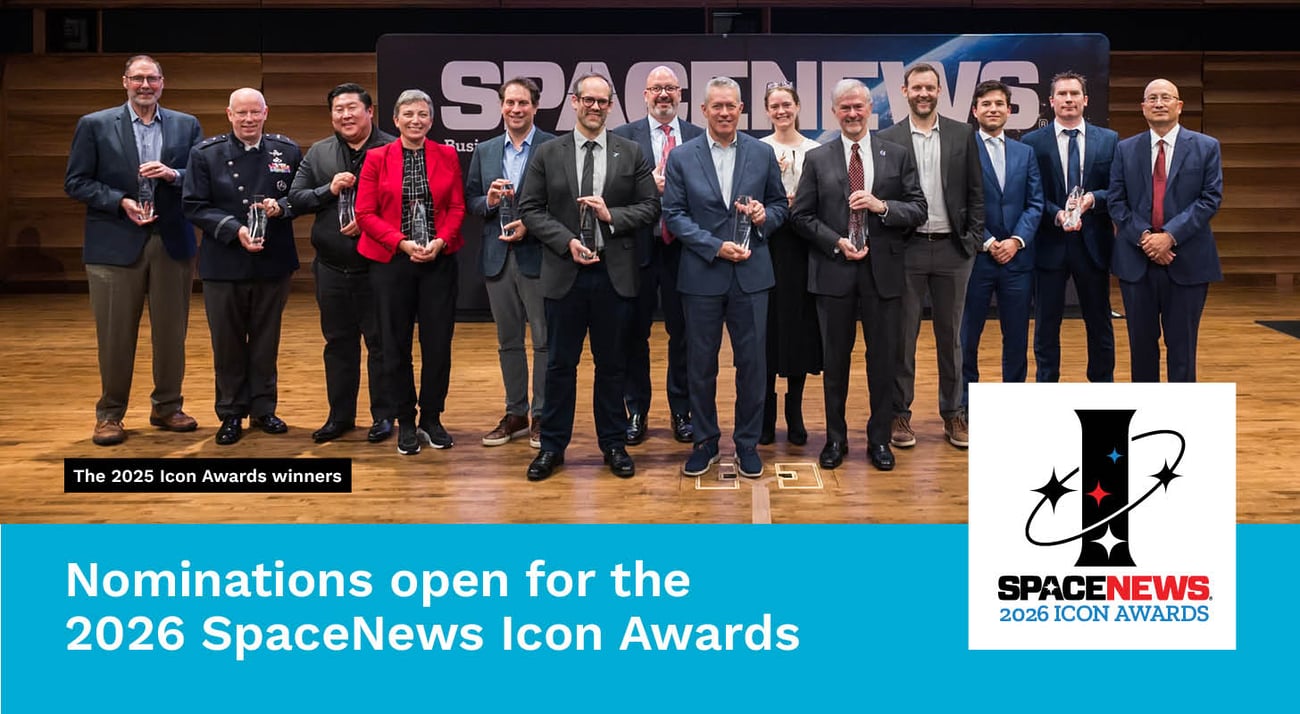 |
Honor the icons shaping space: Since 2017, the SpaceNews Icon Awards have celebrated the companies, teams and individuals driving breakthroughs across civil, commercial and military space. Nominate the innovators, collaborators and leaders whose work over the past year — or an entire career — has left a lasting mark on the industry. Submit your nomination today. |
|
|
|
|
|
Top Stories
Swissto12 has raised $70 million to expand production of its small geostationary orbit satellites. The company announced Thursday the Series C round from undisclosed investors. The Swiss firm reported more than $500 million in contracts for a business spanning satellite subsystems, antennas and multi-orbit payloads to HummingSat, its washing machine-sized satellite designed for GEO. The first of seven HummingSats ordered to date is slated for completion in 2027 for SES. Swissto12 said it generated $140 million in revenue in 2025 and is on track for positive earnings in 2026. [SpaceNews]
The commanding general of the Space Force, in his final public speech, said ensuring peace in space requires preparing for war. Speaking at the Global Air & Space Chiefs' Conference in London on Wednesday, Gen. Chance Saltzman said any conflict in space would affect every nation's satellites, and that the best way to deter such a war is to build military forces capable of fighting and prevailing in space. The address amounted to a strategic summation of Saltzman's nearly four years leading the Space Force, which during that time moved beyond its early struggle to establish an identity separate from the Air Force and concentrated more explicitly on preparing for combat against China and Russia. Saltzman plans to retire next month after a 35-year military career. [SpaceNews]
Slingshot Aerospace won a $69.2 million U.S. Space Force contract to develop artificial intelligence-based training environments. The Small Business Innovation Research Phase 3 contract, spanning four and a half years, supports the service's Operational Test and Training Infrastructure program, or OTTI. That effort aims to give Space Force units more realistic tools for testing systems and preparing personnel for increasingly complex operations in space. Slingshot said it will provide AI-enabled environments in which Space Force operators can rehearse scenarios involving the protection and defense of U.S. space systems, compare possible responses and practice making decisions under conditions designed to resemble an actual conflict. [SpaceNews]
The Office of Space Commerce says its proposal for mission authorization of novel space activities would give companies regulatory certainty without burdensome requirements. At a House Science Committee hearing Wednesday, Taylor Jordan, director of the office, said the voluntary "Space Commerce Certification" system would ensure companies working on concepts not clearly regulated today could get government approvals quickly. The proposal, announced in March, is awaiting approval by the White House; if that comes, the office will put out a call for applications to help test the process. [SpaceNews]
|
|
|
SPONSORED |
|
|
 |
Half a century ago, NASA's Viking 1 touched down on Mars, the first American spacecraft to successfully land and operate on another planet. On July 20th, join The Planetary Society, Johns Hopkins University, the Smithsonian National Air & Space Museum, and SpaceNews on Capitol Hill to mark the milestone. Hear from veterans of Project Viking and today's leaders in Mars exploration, science, and industry. A reception with light refreshments and Mars exploration exhibits follows the program. Register at planetary.org/viking50 |
|
|
|
|
Other News
A Florida startup is working with a Texas university on a orbital debris capture system. Satellite Orbital Access and Removal (SOAR) said Wednesday it is partnering with the University of Texas, El Paso to help develop what the company calls the Passive Orbital Debris Removal System. It is a passive system to capture small orbital debris less than 10 centimeters across. SOAR will work with the university on the right architecture for this debris capture technology. [SpaceNews]
The Indian space agency ISRO is limiting the ability of key staff to depart after a surge of resignations. An internal memo directed ISRO centers not to accept resignation or retirement requests from key scientists and engineers, referring those requests instead to agency leadership. The order came after more than 100 people left the agency recently, some to join space startups in the country. [NDTV]
A former chairman of ISRO is joining the board of an Indian launch startup. Agnikul Cosmos said that S. Somanath, ISRO chairman from 2022 to 2024, will be an observer on its board. The company is developing a small orbital launch vehicle with plans to recover and reuse the first stage. The company says it is preparing for an orbital launch attempt called Mission 02, but did not disclose the schedule for that mission. [The Hindu]
A meteorite that hit a New Jersey home two years ago contains amino acids. The meteorite fell through the roof of a house in Hillsborough, New Jersey, and the homeowner carefully preserved the pieces. Scientists said that made the carbonaceous chondrite samples unusually pristine, allowing for detailed analysis. That analysis found traces of amino acids and other organic compounds, and evidence that the asteroid it came from had been altered by water. It adds to evidence that the building blocks for life to form on Earth came from similar asteroids. [Space.com]
|
|
|
|
|
|
|








No comments:
Post a Comment