
Plus: Amazon Leo got a deadline extension
Welcome to our roundup of top SpaceNews stories, delivered every Friday! This week, NASA announced the Artemis 3 crew, the Federal Communications Commission extended a deadline for Amazon Leo deployment and more.
If someone forwarded you this edition, sign up to receive it directly in your inbox every Friday.
|
|
|
|
|
|
OUR TOP STORY
|
By Jeff Foust NASA has named the astronauts who will fly the next Artemis mission, a test flight in low Earth orbit in which the Orion spacecraft will attempt to dock with prototypes of two lunar landers.
During an event at the Johnson Space Center on June 9, NASA announced the crew selected to fly the Artemis 3 mission in mid-2027.
Commanding the mission will be NASA astronaut Randy Bresnik, a veteran of one of the final space shuttle missions who later spent nearly five months on the International Space Station. The mission’s pilot is Luca Parmitano, a European Space Agency astronaut who spent two long-duration missions on the ISS in 2013 and 2019-20.
|
|
|
|
|
|
COMMERCIAL
|
Amazon no longer faces a July 30 cutoff for deploying half its planned 3,232 broadband satellites, but the reprieve comes with a temporary loss of spectrum priority that could give SpaceX and other rivals more leverage in orbit.
Iceye, a Finnish company that develops and operates radar imaging satellites, announced a funding round worth than 1 billion euros ($1.16 billion) that values the company at more than 10 billion euros.
LeoLabs said June 10 it has deployed a mobile space-tracking radar in the Indo-Pacific region that is being used to monitor Chinese satellites and other spacecraft. Scout-S is the first operational system in a planned family of transportable sensors that LeoLabs says can be rapidly deployed to locations where military operators need additional coverage.
|
MILITARY
|
House defense appropriators unveiled a $1.07 trillion fiscal 2027 spending bill that would provide $55.5 billion for the U.S. Space Force, and does not include billions of dollars in additional defense funding that the Trump administration is seeking through a separate budget reconciliation package.
The Senate Armed Services Committee voted 18-9 to advance its version of the fiscal year 2027 National Defense Authorization Act on June 11, including a provision that would eliminate separate statutory requirements for the Space Development Agency and the Space Rapid Capabilities Office.
K2 Space and Rocket Lab have landed key supplier roles in the U.S. Space Force’s next-generation military communications network. K2 Space will provide the satellite platform for SES’s entry in the Protected Tactical Satcom-Global program, known as PTS-G, while Rocket Lab will supply the spacecraft bus for Viasat’s PTS-G satellite. |
|
|
|
|
|
LAUNCH
|
Japan’s H3 rocket launched June 11 on its first flight since a failure in December. The launch was primarily a test flight of the H3-30S variant but carried six small satellites.
The Space Force released a request for information June 8 seeking interest from launch vehicle operators in Space Launch Complex 9, a proposed launch site at Vandenberg that would be used for small- and medium-class launch vehicles. Responses to the RFI are due July 8.
China has conducted a pair of launches to advance its communications capabilities, using the country’s largest rocket and a commercial launcher. The China Aerospace Science and Technology Corporation confirmed the success of the launch, revealing a previously undisclosed payload to be the Tongxin Jishu Shiyan-25 (TJS-25). |
|
|
|
|
|
 |
SPONSORED CONTENT
|
By BlackSky Across Europe, border environments are becoming increasingly dynamic and complex. Activity can shift within hours—vehicles reposition, staging areas disperse, small watercraft alter routes, and nodes of activity appear and disappear with little warning.
For national security organizations, ministries of interior, and supporting non-governmental partners, the challenge in border monitoring is no longer access to information alone. It is tempo. The ability to observe, understand, and respond before conditions change is a defining advantage. |
|
|
|
FROM SPACENEWS |
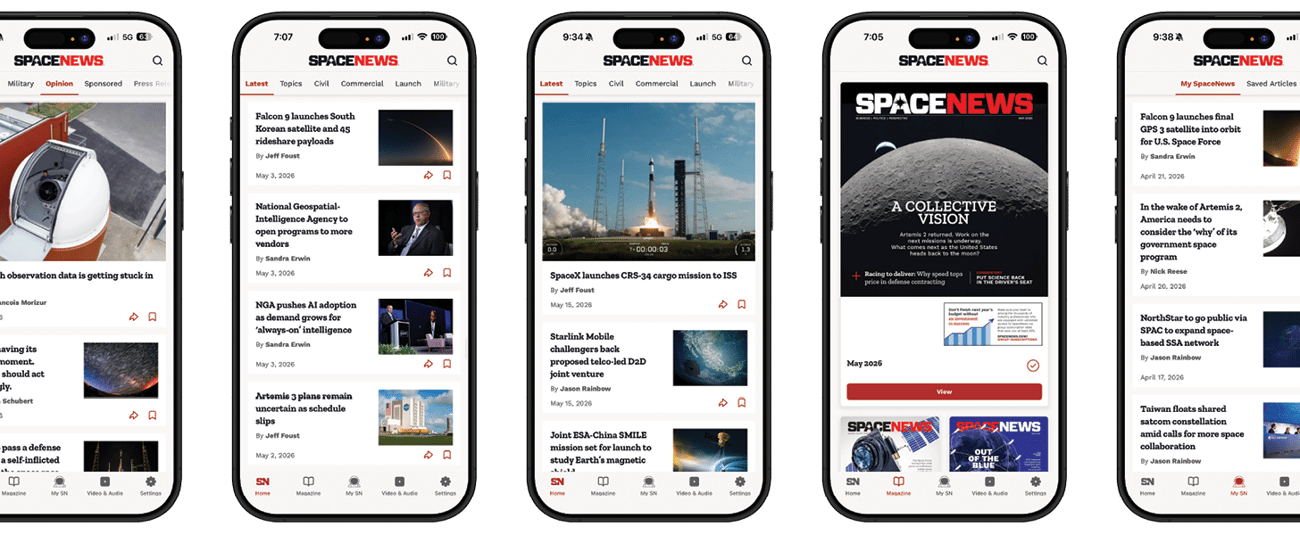 |
The first SpaceNews mobile app is now available on Apple and Android devices. Now, you can get our latest coverage of the companies, policies, tech and trends shaping the business of space whenever you want to catch up quickly. Choose your key topics and authors to curate your personalized My SpaceNews feed and save articles for offline reading. Or download the most recent issue of SpaceNews magazine and tune in to our Space Minds podcasts. It's all in the SpaceNews app. |
| Download the app |
|
|
|
|
|
 |
Latest Press Releases
|
|
|
|
|







No comments:
Post a Comment