Plus: Russia completes Baikonur launch pad repairs
| By Jeff Foust
In this today's edition: the "first mover" role played by space in the Iran attacks, SpaceX partners with Deutsche Telekom for mobile services, Russia compleets Baikonur launch pad repairs and more.
If someone forwarded you this edition, sign up to receive it in your inbox every weekday. Have thoughts or feedback? You can hit reply to let me know.
| | | | | | | SPONSORED |  | | Space Symposium | April 13-16, 2026 | Colorado Springs, CO USA | Space Symposium, created in 1984 by Space Foundation, is the premier gathering of the global space community. More than 10,000 space professionals, business leaders, and decision-makers from over 40 countries convene in Colorado Springs to build partnerships and explore the latest in space technology across every sector of the space ecosystem. Register Now | | | | | | Top Stories
The Pentagon said both space and cyber forces had "first mover" roles during strikes on Iran over the weekend. At a briefing Monday, Gen. Dan Caine, chairman of the Joint Chiefs of Staff, highlighted work by U.S. Space Command and U.S. Cyber Command. He characterized both as "the first movers" that provided "non-kinetic effects disrupting and degrading and blinding Iran's ability to see, communicate and respond." Space Command's duties include ensuring resilient U.S. satellite communications and positioning, navigation and timing, while potentially disrupting an adversary's access to space-enabled capabilities such as satellite communications or reconnaissance. [SpaceNews]
SpaceX is partnering with Deutsche Telekom to provide direct-to-smartphone services in Europe starting in 2028. The German telecoms giant announced the partnership Monday for SpaceX's Starlink Mobile service, formerly known as Direct-to-Cell, which currently uses spectrum from cellular partners and more than 650 satellites to connect subscribers in the United States, Canada and several other countries. Those services are limited to text messaging, voice and certain apps on select devices, but SpaceX plans to provide higher bandwidth services with Starlink Mobile V2 spacecraft slated to start launching in mid-2027 on Starship. SpaceX is also awaiting regulatory approval to acquire EchoStar's MSS spectrum, which underpins plans to provide the next-generation services in Europe. [SpaceNews]
Constellations like Starlink are in a spectrum battle with other systems that use nearby spectrum for weather observations. At a recent meteorology conference, speakers warned that broadband communications constellations threaten to prevent microwave sounders on weather satellites from observing the natural emissions from atmospheric water vapor and precipitation. Scientists analyzing data from Earth science satellites say they are seeing increased radio-frequency interference, as they work to both educate regulators about the importance of preserving certain spectrum bands while also making future instruments more resilient to interference. [SpaceNews]
Redwire announced a new solar array product designed for mass-produced satellites. The company announced Tuesday the Extensible Low-Profile Solar Array, or ELSA, which is based on technology the company developed for the Roll-Out Solar Array, or ROSA, used on the International Space Station and other spacecraft. ELSA is intended for mass-produced satellites with limited mass and volume. The announcement comes amid increasing demand for satellite power systems, driven by the growing number of satellites and interest in high-power applications such as edge computing and orbital data centers. Redwire announced its 2025 financial results last week, reporting a 10% increase in revenue but a steeper net loss. [SpaceNews]
| | | | | | Other News
The Russian space agency Roscosmos says it has completed repairs to a launch pad damaged last November. Roscosmos said the pad at the Baikonur Cosmodrome has been repaired and is ready to support a launch later this month of a Progress cargo mission to the International Space Station. A key platform at the pad was severely damaged during a launch last November, raising concerns that the pad, the only one available for Soyuz and Progress missions to the station, would be out of service for an extended period. [Reuters]
A Japanese cargo spacecraft will leave the ISS this week. The HTV-X1 spacecraft will be unberthed from the station Thursday and released by the station's robotic arm on Friday. The spacecraft, the first in the new HTV-X series of cargo spacecraft, launched to the station in October. Once it departs from the station, HTV-X1 will remain in orbit for three months to perform additional technology demonstrations before reentering. [NASA]
French launch startup MaiaSpace has delayed its first launch to 2027. The company had been working toward a first launch of its small launch vehicle, with a reusable first stage, by the end of this year, but said at an event last month the launch is now scheduled for early 2027. The company said it has a goal of performing its first launch no later than April 2027, five years after the company was formed as a spinoff from ArianeGroup. That launch will take place from a former Soyuz launch pad in French Guiana. [European Spaceflight]
An Alaska spaceport is planning upgrades after securing federal funding. A defense appropriations bill for fiscal year 2026 includes about $22 million for Pacific Spaceport Complex - Alaska on Kodiak Island. That facility hosts missile tests and launches of small rockets. The funds will go toward upgrading a payload processing facility at the spaceport. The bill also included $4 million in upgrades for Poker Flat Research Range, a sounding rocket launch site near Fairbanks, Alaska, that is seeking to attract new customers, which may include operators of small orbital launch vehicles. [KMXT-FM Kodiak, Alaska]
| | | | | | | FROM SPACENEWS | 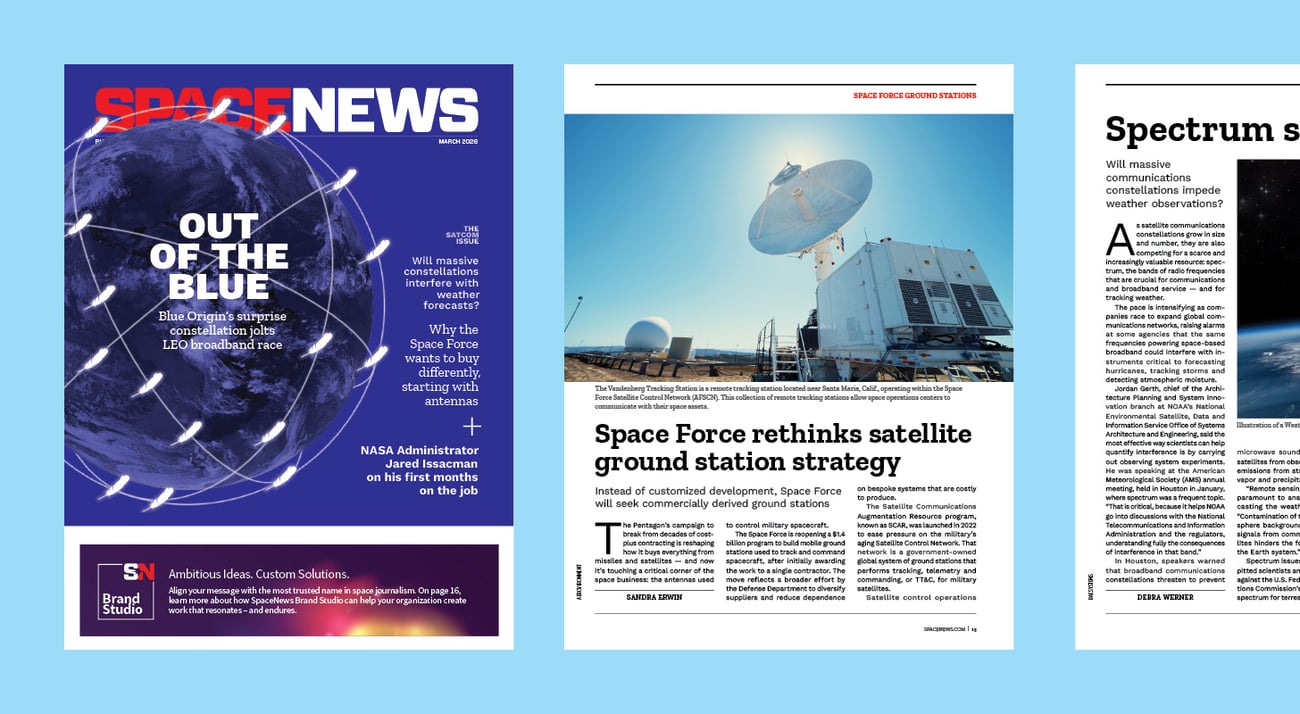 | | The Satcom Issue – Out Now: In the March 2026 issue of SpaceNews magazine, Jason Rainbow details how Blue Origin's surprise constellation has jolted the LEO broadband race, Sandra Erwin reports that the Space Force is rethinking its satellite ground station strategy and Debra Werner explores how massive comms constellations may impede weather observations. Subscribe today to download this latest issue and get access to all our reporting and analysis. | | | | | | Can't Blame Them
| "I'd also say, generally, astronauts prefer to be in space as often as possible, so this is probably welcome news."
| | – NASA Administrator Jared Isaacman at a press conference Friday discussing his plans to increase the cadence of Artemis missions.
| | | | | | |







No comments:
Post a Comment