Tuesday, March 3, 2026

Military Space: What can be learned from the attacks in Iran?


Plus: A high-water mark for space funding
 ‌ ‌ ‌ ‌ ‌ ‌ ‌ ‌ ‌ ‌ ‌ ‌ ‌ ‌ ‌ ‌ ‌ ‌ ‌ ‌ ‌ ‌ ‌ ‌ ‌ ‌ ‌ ‌ ‌ ‌ ‌ ‌ ‌ ‌ ‌ ‌ ‌ ‌ ‌ ‌ ‌ ‌ ‌ ‌ ‌ ‌ ‌ ‌ ‌ ‌ ‌ ‌ ‌ ‌ ‌ ‌ ‌ ‌ ‌ ‌ ‌ ‌ ‌ ‌ ‌ ‌ ‌ ‌ ‌ ‌ ‌ ‌ ‌ ‌ ‌ ‌ ‌ ‌ ‌ ‌ ‌ ‌ ‌ ‌ ‌ ‌ ‌ ‌ ‌ ‌ ‌ ‌ ‌ ‌ ‌ ‌ ‌ ‌ ‌ ‌ ‌ ‌ ‌ ‌ ‌ ‌ ‌ ‌ ‌ ‌ ‌ ‌ ‌ ‌ ‌ ‌ ‌ ‌ ‌ ‌ ‌ ‌ ‌ ‌ ‌ ‌

03/03/2026

READ IN BROWSER

SpaceNews logo
Military Space newsletter logo

Essential coverage, trusted insight: A SpaceNews subscription unlocks reporting on all the developments that drive decisions across the industry. Get access now.

SPONSORED BY

Sponsored by L3Harris

By Sandra Erwin


Welcome to this week's edition of SpaceNews' Military Space, your source for the latest developments at the intersection of space and national security. In this week's edition: the Space Force reframes the debate on its size and spending and a DIU program highlights the role of the space industry in hypersonic testing


If someone forwarded you this edition, sign up to receive it in your inbox every Tuesday. We welcome your feedback and suggestions. You can hit reply or DM me on Signal @SandraErwin.43.

Satellite image captured March 1 by Planet Labs shows an Iranian warship burning after U.S. and Israel strikes on Konarak Naval Basin, Iran. Credit: Planet Labs PBC

Battlefield role strengthens Space Force expansion drive


In 2019, during the creation of the U.S. Space Force, the service's architects promised Congress something modest. The new branch would largely consolidate existing Air Force space functions, not construct another layer of defense bureaucracy. It would be lean, agile and close to cost neutral — a reorganization more than an expansion.


Six years later, the service is rewriting that narrative.


The original sales pitch for the Space Force has given way to a different argument: space is too central and too contested for a minimalist service. The shift reflects a broader change in defense strategy: space is now treated not simply as an enabling function, but as a contested operational domain.


The operational case for more space capacity was underscored by the Feb. 28 U.S. airstrikes against Iranian targets, which highlighted how tightly integrated space has become with combat operations. 


During a press conference on Monday, Chairman of the Joint Chiefs Gen. Dan Caine said, "Coordinated space and cyber operations effectively disrupted communications and sensor networks across the area of responsibility, leaving the adversary without the ability to see, coordinate or respond effectively." 


The remarks pointed to the central role of space-based sensing, communications and command-and-control in shaping the battlefield.


That operational reality is feeding directly into the service's internal budget debate.


Lt. Gen. Douglas Schiess, the Space Force's deputy chief of space operations for operations, put it plainly last week at the Air & Space Forces Association's Warfare Symposium in Colorado. "We've had a lot of increases, and we're going to have continued increases," he said.


The White House has yet to submit its fiscal 2027 budget request, typically delivered in March. Schiess declined to preview the specifics. "But I can tell you, if things are going the way that we think they are, the Space Force is going to have a significant increase," he said. "We have been very thankful to the administration and to Congress that has really given us significant budget growth since we stood up."


The unexpected advocates in the Pentagon


Schiess said the Space Force is receiving strong backing from the other services. "Right now, the other services, they're some of our biggest advocates," he said. During meetings of deputy chiefs, "the other services are doing my briefing for me." Across the Army, Navy, Air Force and Marine Corps, demand for targeting, missile warning, GPS and communications is rising.


Speaking alongside Schiess, Lt. Gen. Gregory Gagnon, the head of Space Force Combat Forces Command, echoed recent comments from Secretary of the Air Force Troy Meink and Chief of Space Operations Gen. Chance Saltzman that the service's footprint no longer matches its workload.


"The Space Force we need probably needs to be twice as large as it is today in manpower, and also needs to grow in infrastructure and in kit," Gagnon said.


Combatant commanders are asking for more space support than the service can provide. "We currently can't say yes to all the asks because we're not large enough."


Schiess reinforced the point. "When we started out, we were lean and agile, which really kind of meant we're small and we don't have enough people," he added. "That's great, and we're doing great things with that, but we've got to increase the number of folks that we have … Guardians are taking on more responsibilities."


SPONSORED

Space is an increasingly contested arena – and becomes more so every day. L3Harris helps ensure the United States remains the leading force in this battlespace and continues that dominance into the future. L3Harris space superiority capabilities provide the foundation for space domain control, protecting assets and preserving strategic advantages. A trusted partner of the U.S. Space Force and other agencies, L3Harris has served the space superiority mission for more than 30 years. Learn more here.

Space funding hits new high — then what?


Fiscal year 2026 represents a high-water mark for military space funding.


In addition to roughly $26 billion in discretionary appropriations, the Space Force is benefiting from about $13.8 billion in mandatory defense spending added through the 2025 reconciliation package, known as the One Big Beautiful Bill Act.


The Trump administration's unclassified spending plan for the broader $151 billion defense reconciliation total indicates that the funds — technically available through September 2029 — will be allocated in fiscal year 2026.


A substantial share flows to missile defense under the Golden Dome effort. Of the $24.4 billion allocated for missile-defense systems, $7.2 billion is set aside for space-based sensors, $5.6 billion for space-based interceptors, $2 billion for air-moving target indicator satellites and $500 million for launch infrastructure.


Additional space funding appears in the $12.3 billion earmarked for U.S. Indo-Pacific Command capabilities. That includes $1 billion for the X–37B military spacecraft program, $3.6 billion for unspecified military satellites, $68 million for Space Force facilities, $150 million for ground moving target indicator satellites, $528 million for the DARC space surveillance radar and the Silent Barker space situational awareness satellites, $125 million for military space communications and $350 million for space command-and-control systems.


Budget analyst Mike Tierney of the National Security Space Association described 2026 as a banner year for military space.


He points in particular to what he calls the Space Force's "space sensing" portfolio — an umbrella category that includes missile warning, tracking and space-based radar. Tierney estimates that portfolio at roughly $11.6 billion in fiscal 2026, "effectively almost the size of the entire Missile Defense Agency budget."


That figure covers Next-Generation Overhead Persistent Infrared satellites in geosynchronous and polar orbit, the Resilient Missile Tracking constellation in medium Earth orbit, and a ground moving target indicator effort to field space-based radar capable of tracking moving targets on land or at sea.


The 2027 question: what happens next?


Tierney's worry is that fiscal 2027 could revert to something closer to the $26 billion discretionary baseline if reconciliation funding is not replicated.


"I'm concerned about what the '27 request is going to look like," Tierney said.


"There's a scenario where all of the reconciliation dollars, which are mandatory, are kind of allocated and delineated at the '26 request level. But there's no real indication in the '27 request of additional dollars.


"Does that bring the base budget request for Space Force back down to $26 billion? … These capabilities that they're starting through reconciliation funding, they're not going away."


In other words, the service may be initiating programs at a funding peak without clarity on the long-term top line.


"Having more than $40 billion this year is amazing," Tierney said. "But how does this move over and integrate into the future requests, and is it really sustainable as a future top line, or are we somewhere in between or even below?"


FROM SPACENEWS

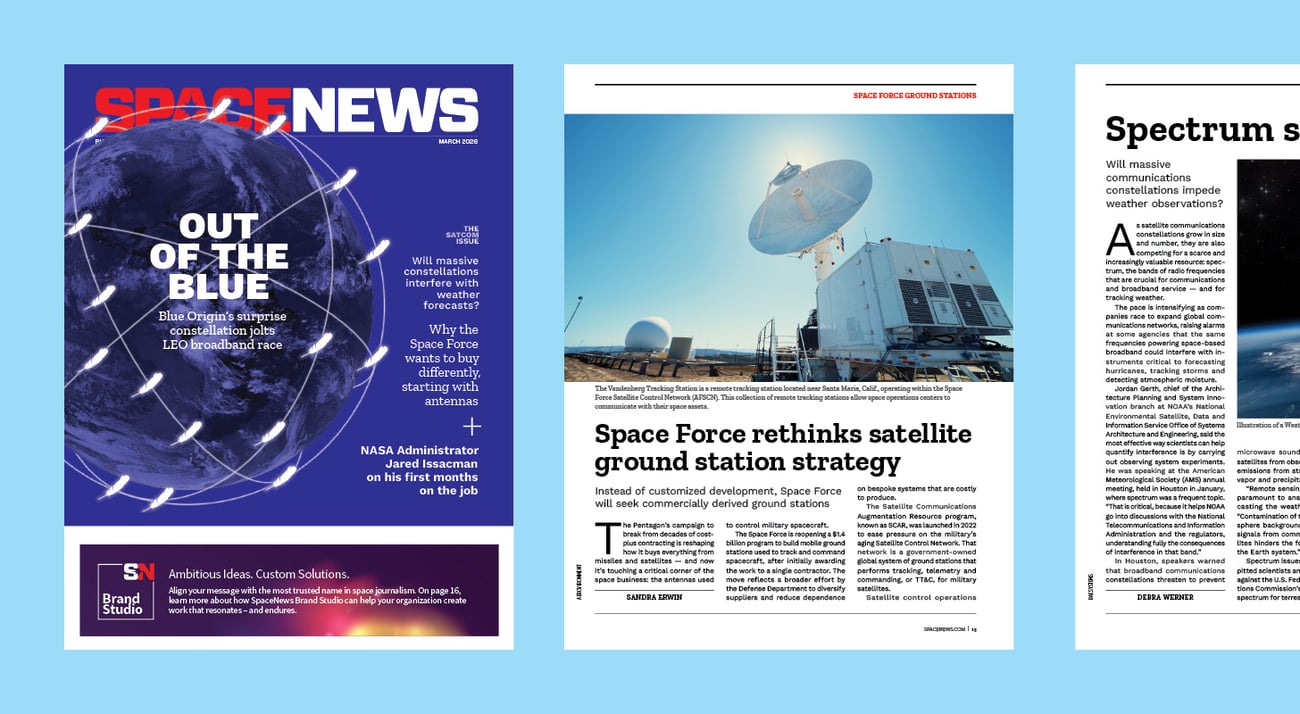
The cover of the March 2026 edition of SpaceNews magazine with the headline Out of the Blue

The Satcom Issue – Out Now: In the March 2026 issue of SpaceNews magazine, Jason Rainbow details how Blue Origin's surprise constellation has jolted the LEO broadband race, Sandra Erwin reports that the Space Force is rethinking its satellite ground station strategy and Debra Werner explores how massive comms constellations may impede weather observations. Subscribe today to download this latest issue and get access to all our reporting and analysis.

Pentagon bets on commercial launch to break hypersonic test logjam


The Pentagon's push to fix one of its most persistent hypersonic headaches — too many programs, not enough flight tests — ran through Wallops Island, Virginia, last week.


Rocket Lab on Friday launched its suborbital Hypersonic Accelerator Suborbital Test Electron, or HASTE, from NASA's Wallops Flight Facility, carrying a hypersonic aircraft built by Australia's Hypersonix. 


The flight was conducted under the Defense Innovation Unit's Hypersonic and High-Cadence Airborne Testing Capabilities, or HyCAT, program, which is aimed at breaking what officials describe as a testing bottleneck.


After HASTE delivered the vehicle to a planned point in the upper atmosphere, the 3.5-meter DART AE demonstrator separated and flew its hypersonic profile. 


Hypersonix said the aircraft exceeded Mach 5 and collected data on propulsion, materials response, guidance and control in actual flight conditions. The scramjet-powered platform uses a hydrogen-fueled engine, and the company says the airframe is entirely 3D-printed.


"At these speeds and temperatures, there is no substitute for flight data. The results from this mission will directly shape the design of future operational hypersonic aircraft," said Hypersonix co-founder Michael Smart, a former NASA scientist.


DIU said the mission combined two pillars of HyCAT: commercial suborbital launch and air-breathing hypersonic testbeds. Instead of relying solely on traditional range-based testing — which is costly, infrequent and tightly scheduled — the Pentagon wants repeatable, lower-cost access to hypersonic flight conditions.


DIU said the Pentagon is managing roughly 70 hypersonic programs and testing capacity is a constraint. 


The Pentagon has been explicit about closing capability gaps with China and Russia while reducing the cost and time required to mature U.S. systems. By increasing test cadence, DIU argues, the department can iterate faster, validate technologies before committing to production and improve architectures designed to track and counter maneuvering hypersonic threats.


Under HyCAT, DIU has awarded contracts to a mix of firms developing hypersonic flyers and suborbital rockets, including Hypersonix, Rocket Lab, Fenix Space, Hermeus and Innoveering. 


The Feb. 27 flight marked Rocket Lab's second successful DIU-backed hypersonic mission in three months and its seventh HASTE launch overall.


SpaceNews' latest national security coverage


Subscribe to SpaceNews


No comments:

Post a Comment

Breaking: PLD Space closes $209 million Series C

It marks the largest fundraising round for a European space firm this year  ‌ ‌ ‌ ‌ ‌ ‌ ‌ ‌ ‌ ‌ ‌ ‌ ‌ ‌ ‌ ‌ ‌ ‌ ‌ ‌ ‌ ‌ ‌ ‌ ‌ ‌ ‌ ‌ ‌ ...