
Plus: The UK funds its new space priorities
| By Jeff Foust
In this today's edition: the U.K. funds new space priorities, China places more emphasis on space in its economic plans, Rocket Lab launches an Electron on short notice and more.
If someone forwarded you this edition, sign up to receive it in your inbox every weekday. Have thoughts or feedback? You can hit reply to let me know.
| | | | | | | SPONSORED |  | | Space Symposium | April 13-16, 2026 | Colorado Springs, CO USA | Space Symposium, created in 1984 by Space Foundation, is the premier gathering of the global space community. More than 10,000 space professionals, business leaders, and decision-makers from over 40 countries convene in Colorado Springs to build partnerships and explore the latest in space technology across every sector of the space ecosystem. Register Now | | | | | | Top Stories
The United Kingdom is investing more than $650 million into its space industry. Liz Lloyd, the U.K. minister whose portfolio includes space, announced the 500 million pound ($668 million) space funding package this week at Space-Comm Expo in London. She said the funding prioritizes satellite communications, assured access to space, in-orbit servicing, assembly and manufacturing and space domain awareness. The package includes 105 million pounds for in-orbit servicing and manufacturing programs and 85 million pounds for the National Space Operations Centre. The announcement follows other recent policy signals pointing to a shift in the U.K.'s approach, especially toward pure science projects and participation in selected European collaborative programs, which include canceling the TRUTHS climate science mission and reducing U.K. contributions to ESA. [SpaceNews]
China has designated aerospace as an "emerging pillar industry" in a draft national economic plan released Thursday. The report places aerospace alongside sectors considered central to the country's long-term technological and industrial development. The move suggests Beijing intends to expand the space sector beyond strategic state programs toward a larger industrial ecosystem encompassing launch services, satellites and downstream data applications. This move appears to align with the recent emergence of the concept of "space+" in China, which envisions space treated less as a separate, standalone sector, and more as an enabling infrastructure to be integrated with other economic and strategic domains and national priorities. [SpaceNews]
The White House's nominee to be NASA deputy administrator sailed through his confirmation hearing Thursday. Matt Anderson faced few questions from members of the Senate Commerce Committee at the hearing, with no members signaling an opposition to his nomination. Anderson, a retired U.S. Air Force officer and a vice president at CACI International, was first nominated to be deputy administrator last May and renominated in January. He used the hearing to discuss his background and his desire to support Administrator Jared Isaacman and the implementation of a national space policy that calls for a human return to the moon by 2028. The committee will vote March 12 to advance the nomination to the full Senate. [SpaceNews]
In-orbit services provider Infinite Orbits said this week it acquired London-based in-orbit servicing and manufacturing startup Lunasa. Founded in France in 2017, Infinite Orbits launched its first satellite, Orbit Guard #1, to geostationary orbit in 2023 to test technologies for Endurance, the company's satellite life-extension service scheduled for 2027. The acquisition of Lunasa is a dual strategy of strengthening the technology behind its products while expanding the company's commercial footprint across Europe. Infinite Orbits also recently acquired LMO, a Luxembourg company that specializes in autonomous space systems. [SpaceNews]
Southern California startup General Galactic plans to test a novel multimode propulsion system in space later this year. The 500-kilogram Trinity mission will launch on the SpaceX Transporter-18 rideshare mission no earlier than October to test Genesis, a system that combines chemical and electric thrusters. General Galactic has raised about $10 million dollars to develop the water-based propulsion system, using a chemical engine for quick maneuvers and a Hall thruster for longer-duration burns. The company argues this architecture will make spacecraft highly maneuverable, supporting the Space Force's desire for dynamic space operations. [SpaceNews]
| | | | | | Other News
Rocket Lab launched a payload on short notice Thursday for an undisclosed customer. The Electron lifted off at 6:53 p.m. Eastern from Launch Complex 1 in New Zealand and placed a single satellite into low Earth orbit. Rocket Lab announced the launch only five hours before liftoff and did not disclose the customer. The most likely customer is BlackSky, which performed a similar short-notice launch on Electron last November to put a Gen-3 imaging satellite into orbit. BlackSky said in an earnings call last week that its next Gen-3 satellite was at the launch site, but did not disclose who would launch it or when. [SpaceNews]
Polish chemical propulsion startup Liftero will provide thrusters for an Indian spacecraft. Liftero will supply two multi-thruster BOOSTER configurations for an upcoming mission by Indian startup OrbitAID expected in the fourth quarter of 2026. The mission will represent the first time a nitrous oxide-based propulsion system will provide six degrees of freedom maneuvering to an in-orbit servicing application, Liftero said. OrbitAID is developing spacecraft to demonstrate in-space servicing. [SpaceNews]
One of the two spacecraft of ESA's Proba-3 mission has malfunctioned. ESA said Friday that the Coronagraph spacecraft suffered an anomaly in mid-February that caused it to lose attitude control and drain its batteries. Coronagraph and Occulter were launched in December 2024 to demonstrate precision maneuvering so that the Occulter spacecraft could precisely block the sun as seen from the Coronagraph spacecraft. The mission has achieved its technology goals and has been used since to study the sun's inner corona. ESA said engineers are studying how to restore operations of Coronagraph, including using the Occulter spacecraft to approach and observe it. [ESA]
Richard Branson says Blue Origin's decision to pause New Shepard suborbital flights is an opportunity for Virgin Galactic. Branson, the founder of Virgin Galactic, said at a conference this week that Virgin can "fill that gap" created when Blue Origin announced in late January it would halt New Shepard flights for at least two years to focus on lunar projects. Virgin Galactic is developing a new suborbital spaceplane expected to begin flights late this year. [Bloomberg]
New observations of a small asteroid have ruled out any chance it would hit the moon in 2032. Asteroid 2024 YR4, discovered in late 2024, briefly had a small chance of hitting the Earth in December 2032, but observations in early 2025 refined its orbit and ruled out any Earth impact. Those observations, though, left a 4.3% chance of the asteroid hitting the moon instead. Observations by the James Webb Space Telescope of the asteroid last month have improved its orbit and now ruled out any chance of a lunar collision. [Scientific American]
| | | | | | | FROM SPACENEWS | 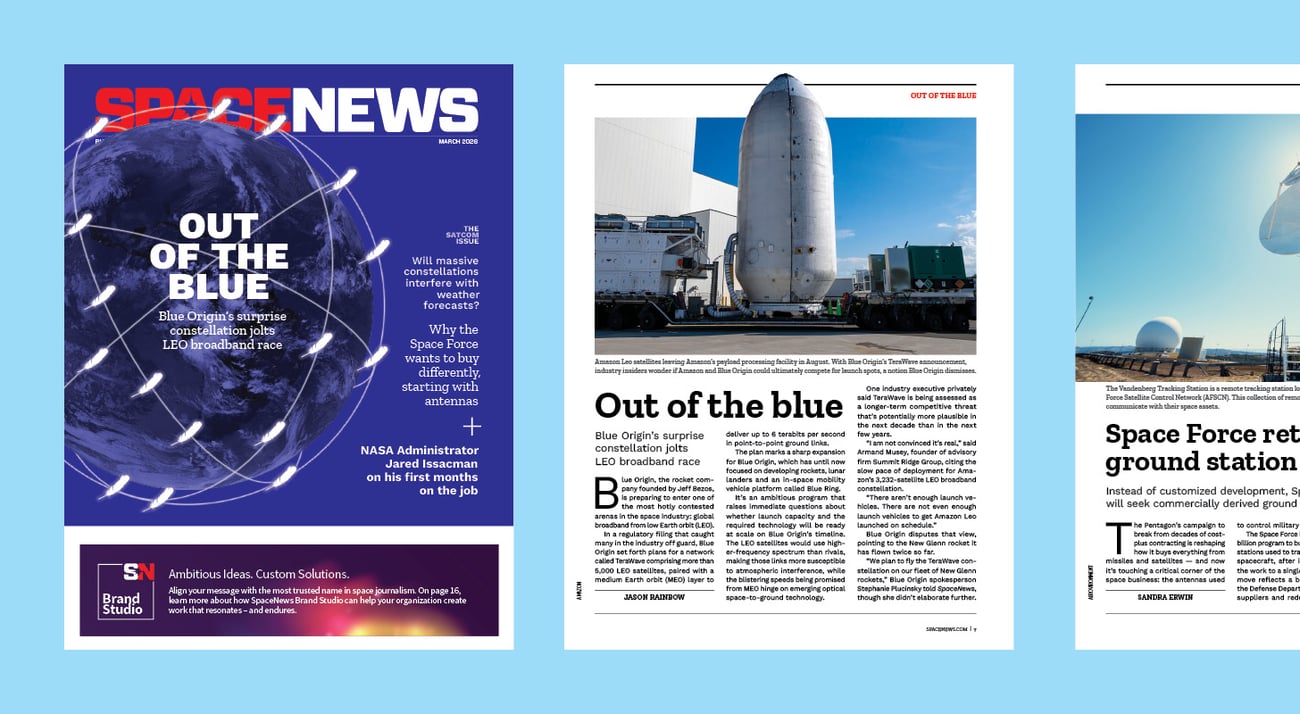 | | The Satcom Issue – Out Now: In the March 2026 issue of SpaceNews magazine, Jason Rainbow details how Blue Origin's surprise constellation has jolted the LEO broadband race, Sandra Erwin reports that the Space Force is rethinking its satellite ground station strategy and Debra Werner explores how massive comms constellations may impede weather observations. Subscribe today to download this latest issue and get access to all our reporting and analysis. | | | | | | Buttered Up
| | Anderson: "We also share the same county where I graduated from high school, so I appreciate our conversation yesterday."
Kim: "Look, you're trying to butter me up, I get it."
Anderson: "Is it working?"
| | – An exchange between NASA deputy administrator nominee Matt Anderson and Sen. Andy Kim (D-N.J.) at Anderson's confirmation hearing Thursday.
| | | | | | |









No comments:
Post a Comment