| By Jeff Foust
In this today's edition: Sierra Space and Vast raise big rounds, a Senate committee advances bill to help NASA revamp Artemis, a Japanese rocket fails again and more.
If someone forwarded you this edition, sign up to receive it in your inbox every weekday. Have thoughts or feedback? You can hit reply to let me know.
| | | | | | | SPONSORED |  | | Space Symposium | April 13-16, 2026 | Colorado Springs, CO USA | Space Symposium, created in 1984 by Space Foundation, is the premier gathering of the global space community. More than 10,000 space professionals, business leaders, and decision-makers from over 40 countries convene in Colorado Springs to build partnerships and explore the latest in space technology across every sector of the space ecosystem. Register Now | | | | | | Top Stories
Sierra Space raised $550 million to support its new focus on national security space. LuminArx Capital Management led the Series C round that valued the company at $8 billion, with participation from existing investors. The company says the new funding will allow it to "further focus on its national security space efforts." Sierra Space was spun out of Sierra Nevada Corporation in 2021 and was initially devoted to development of the Dream Chaser spaceplane. In recent years, the company has expanded into the defense market, including winning contracts to build missile-tracking satellites for the Space Development Agency. Sierra Space recently hired longtime industry executive Dan Jablonsky as its CEO. [SpaceNews]
Commercial space station developer Vast raised $500 million. The company announced Thursday it raised $300 million in a Series A equity round and $200 million in debt. Balerion Space Ventures led the round with participation from several other investors. Vast will use the funding to accelerate work on its Haven line of commercial space stations, starting with the single-module Haven-1 launching in 2027 and the Haven-2 multi-module station proposed for NASA's Commercial LEO Destinations program. Vast had been funded until now by its founder, cryptocurrency billionaire Jed McCaleb, who also participated in the round. [SpaceNews]
Canadian telco Telus has agreed to take a stake in AST SpaceMobile to support its direct-to-smartphone network. As part of the deal, Telus will invest in ground infrastructure needed to connect subscribers to AST Space Mobile's constellation. The partnership follows a similar agreement with Bell, another of Canada's three dominant wireless carriers, which first partnered with AST SpaceMobile in 2021 and backs the company through its corporate venture arm. AST announced several other partnerships this week with mobile network operators in Europe, Hong Kong and Taiwan. AST SpaceMobile plans to deploy at least 45 BlueBird Block 2 satellites by the end of 2026, with intermittent services expected in some markets following the deployment of its first 25 spacecraft. [SpaceNews]
Special purpose acquisition companies, or SPACs, are making a comeback in the space industry. Several space companies used SPACs to go public five years ago, but many of those companies set financial targets that they could not meet, causing investor interest in SPACs to sour. However, SPACs have shown signs of life recently with some deals as well as plans to fund new SPACs focused on the space industry. The difference, investors argue, is that the space industry is more mature and there is a greater appreciation among the broader investment community about the importance of space. [SpaceNews]
The Senate Commerce Committee advanced a NASA authorization bill that would implement some of NASA's proposed changes to Artemis. The committee approved by a voice vote Wednesday a bill allowing NASA to replace the Exploration Upper Stage planned for future versions of the Space Launch System with an alternative. NASA announced last week it planned to do this to "standardize" on an SLS design similar to the current Block 1. The bill would also authorize NASA to develop a lunar base, but with few details on cost and schedule. Other provisions of the bill include a two-year extension of the International Space Station's life to 2032 and a restructuring of the Mars Sample Return program. The bill did not include a rumored provision that would have limited any single launch company to no more than 50% of NASA launch contracts in any year. [SpaceNews]
The Space Force is seeking more personnel and training resources. Gen. Shawn Bratton, vice chief of space operations, told the Senate Armed Services Committee Wednesday that the service needs to double its size and increase training facilities in the coming years to deal with growing threats to space assets. The Space Force currently has about 10,000 uniformed guardians and roughly 5,000 civilian employees. Bratton noted that training exercises and war games are increasingly focused on integrating space capabilities with broader military operations. [SpaceNews]
| | | | | | Other News
The third launch of Japan's Kairos small launch vehicle failed Wednesday night. The rocket lifted off from Spaceport Kii in southern Honshu at 9:10 p.m. Eastern. About 70 seconds after liftoff, though, there appeared to be an explosion, with the rocket breaking up into several fragments. Space One, the company that operates Kairos, said that the flight termination system of the rocket was activated. Officials did not disclose additional details. This was the third launch, and third failure, of Kairos, a solid-fuel rocket designed to place up to 150 kilograms into sun-synchronous orbit. [SpaceNews]
British startup Mutable Tactics has raised $2.1 million in pre-seed funding to enable drones to operate autonomously even without access to satellite communications and navigation. The funding round was led by Seraphim Space, which sees the technology as strengthening the resilience of space-enabled capabilities that its investments often rely on. Mutable Tactics plans to use the funds to expand its engineering team and accelerate software development for a range of unmanned systems, including aerial, maritime and ground drones. [SpaceNews]
NASA unveiled a new initiative Wednesday to bring in private-sector employees for short-term assignments. NASA Force, part of the Office of Personnel Management's Tech Force program, will allow the agency to hire "high-impact technical talent" for as long as two years to work on key NASA projects. NASA announced last month its intent to participate in the Tech Force program as part of other workforce initiatives that include reducing reliance on contractors. It comes after 20% of NASA's civil servant workforce left the agency last year. [NASA]
Lanteris Space Systems won a contract to provide satellite buses for a Space Development Agency contract. Lanteris, the former Maxar Space Systems and now owned by Intuitive Machines, said this week L3Harris will buy 18 satellite buses for that company's SDA Tranche 3 Tracking Layer contract. The companies did not disclose terms of the contract. [Lanteris Space Systems]
The ranking member of the House Science Committee's space subcommittee survived a primary challenge. Rep. Valerie Foushee (D-N.C.) narrowly defeated Nida Allam in a Democratic primary this week, with Allam conceding on Wednesday. Foushee, first elected in 2022, currently serves as the top Democrat on the space subcommittee. In Texas, former astronaut Terry Virts lost his bid to win the Democratic nomination for a House district in the Houston area. Virts finished third in the primary. [New York Times | Texas Tribune]
If the truth is out there, the head of Space Command doesn't know about it. President Trump ordered the release last month of government infomration about unidentified anomalous phenomena (UAPs) and alien life. Those disclosures have not started yet, and asked about them at a conference recently, Gen. Stephen Whiting, head of U.S. Space Command, said he had never seen any data from military tracking networks of anything other than natural phenomena and human-made objects in space. He added, though, that he was "fascinated" by the topic, "and if something's revealed, I'll be interested as an American citizen." [Ars Technica]
| | | | | | | FROM SPACENEWS | 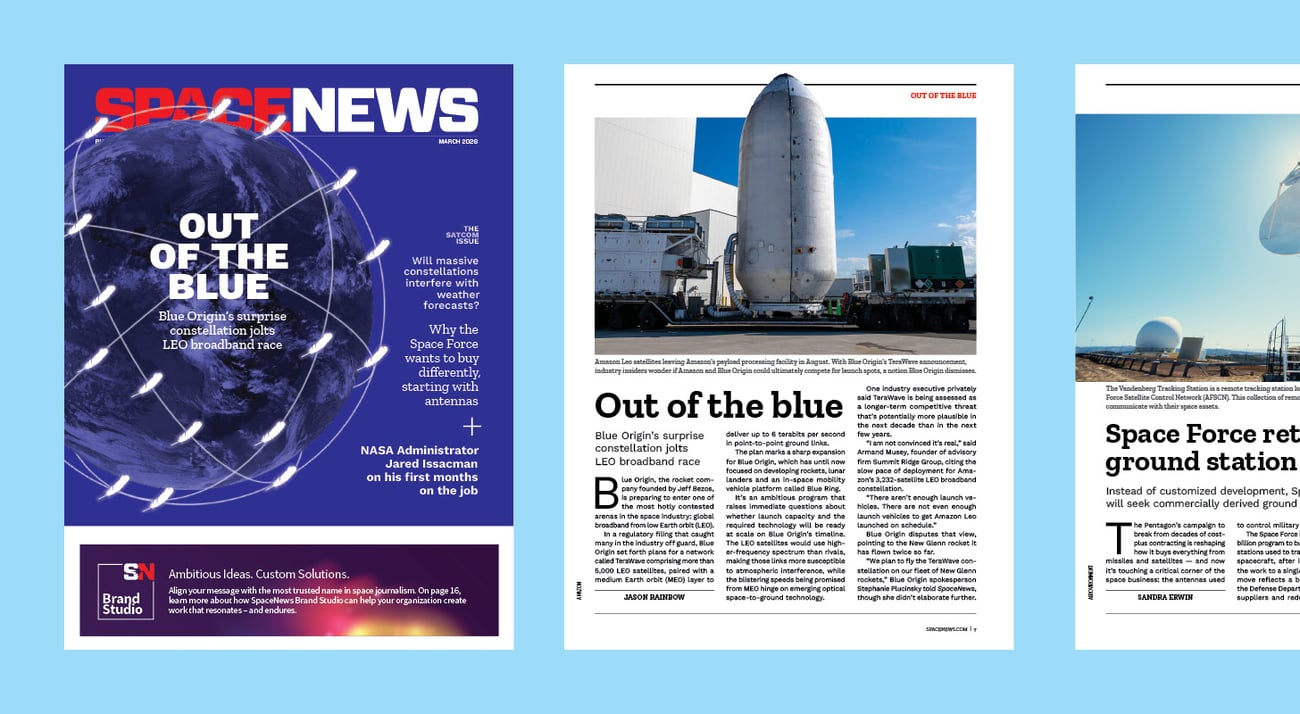 | | The Satcom Issue – Out Now: In the March 2026 issue of SpaceNews magazine, Jason Rainbow details how Blue Origin's surprise constellation has jolted the LEO broadband race, Sandra Erwin reports that the Space Force is rethinking its satellite ground station strategy and Debra Werner explores how massive comms constellations may impede weather observations. Subscribe today to download this latest issue and get access to all our reporting and analysis. | | | | | | A Lot of Words
| "Now a word about the Weather Research and Forecasting Innovation Reauthorization Act — boy, that's a lot of words — of 2026. I wasn't done with those words."
| | – Sen. Ted Cruz (R-Texas), introducing a weather bill at a Senate Commerce Committee markup Wednesday that also considered a NASA reauthorization bill.
| | | | | | |









No comments:
Post a Comment