Wednesday, February 11, 2026

United Launch Alliance's plans for 2026

Plus: Stoke Space raises $350 million
 ‌ ‌ ‌ ‌ ‌ ‌ ‌ ‌ ‌ ‌ ‌ ‌ ‌ ‌ ‌ ‌ ‌ ‌ ‌ ‌ ‌ ‌ ‌ ‌ ‌ ‌ ‌ ‌ ‌ ‌ ‌ ‌ ‌ ‌ ‌ ‌ ‌ ‌ ‌ ‌ ‌ ‌ ‌ ‌ ‌ ‌ ‌ ‌ ‌ ‌ ‌ ‌ ‌ ‌ ‌ ‌ ‌ ‌ ‌ ‌ ‌ ‌ ‌ ‌ ‌ ‌ ‌ ‌ ‌ ‌ ‌ ‌ ‌ ‌ ‌ ‌ ‌ ‌ ‌ ‌ ‌ ‌ ‌ ‌ ‌ ‌ ‌ ‌ ‌ ‌ ‌ ‌ ‌ ‌ ‌ ‌ ‌ ‌ ‌ ‌ ‌ ‌ ‌ ‌ ‌ ‌ ‌ ‌ ‌ ‌ ‌ ‌ ‌ ‌ ‌ ‌ ‌ ‌ ‌ ‌ ‌ ‌ ‌ ‌ ‌ ‌

02/11/2026

READ IN BROWSER

SpaceNews logo
SpaceNext First Up newsletter logo

The SpaceX-era economy is evolving yet again. Understand the launch and Starlink economics behind Elon Musk's data center push in our SpaceNews Intelligence report series. Download now.

By Jeff Foust


In today's edition: a key Chinese spacecraft and launch vehicle test, Stoke Space raised $350 million, ULA's launch plans for 2026 and more. 


If someone forwarded you this edition, sign up to receive it in your inbox every weekday. Have thoughts or feedback? You can hit reply to let me know.


Top Stories


China successfully conducted an in-flight abort test of a new crewed spacecraft and a rocket recovery demonstration. A Long March 10 low-altitude flight demonstration vehicle topped with an uncrewed Mengzhou spacecraft lifted off at 10 p.m. Eastern Tuesday from the Wenchang spaceport. The Mengzhou spacecraft activated its abort system in flight to demonstrate the ability to safely escape its launch vehicle at maximum aerodynamic pressure. The capsule splashed down in the ocean as planned. The rocket stage continued its flight to simulate a full first stage orbital flight profile. The rocket then made a successful reentry burn, performing a propulsive splashdown close to a ship fitted with a wire recovery system for the Long March 10. The demonstration is a crucial step in China's plans to attempt to land astronauts on the moon by 2030, as well as to advance efforts to recover and reuse rocket boosters. [SpaceNews]


Launch vehicle developer Stoke Space has raised an additional $350 million. The company announced an extension Tuesday to a $510 million Series D round from last October, bringing the size of the round to $860 million and the overall amount raised by Stoke to $1.34 billion. Stoke is developing Nova, a launch vehicle whose first and second stages are both designed for reuse. Stoke said the additional Series D funding will "accelerate future elements of its product roadmap" but did not disclose details. [SpaceNews]


The FCC approved additional satellites Tuesday for Amazon's broadband constellation. The FCC authorized Amazon to deploy and operate 3,212 Gen 2 satellites between 590 and 630 kilometers above Earth, alongside 1,292 Polar spacecraft between 600 and 650 kilometers. The two systems are in addition to the 3,232-satellite Gen 1 network operating at similar altitudes to Gen 2, enlarging the company's total constellation to 7,736 satellites. The FCC also authorized Gen 1 satellites to use higher-frequency V-band spectrum in addition to Ka-band. The authorization comes as Amazon seeks approval for an extension to deployment deadlines for its Gen 1 satellites. Amazon separately announced Tuesday its first Amazon Leo maritime broadband reseller agreements, partnering with U.S.-based MTN and ELCOME of the United Arab Emirates. [SpaceNews]


New leadership at United Launch Alliance says this will be the year the company ramps up the Vulcan launch rate. In a call with reporters Tuesday, executives said they are projecting 18 to 22 launches this year, including two to four Atlas 5 launches and 16 to 18 Vulcan Centaur launches. Executives said they have "high confidence" in those projections, despite falling short of similar forecasts last year, as they build out infrastructure to support more launches. The first ULA launch of the year, a Vulcan launch of the USSF-87 mission for the Space Force, is scheduled for early Thursday. [SpaceNews]


The NRO has added three more commercial imaging firms to a growing roster of vendors it is testing for future intelligence missions. The agency said Tuesday it signed Strategic Commercial Enhancements (SCE) agreements with HEO, SatVu and Sierra Nevada Corp. The SCE program is designed to let the NRO evaluate commercially generated data and determine how it could be integrated into intelligence, surveillance and reconnaissance operations. HEO will provide non-Earth imagery focused on objects in orbit, SatVu will deliver medium-wave infrared imagery and Sierra Nevada will support radio-frequency, or RF, sensing. [SpaceNews]


Germany is funding construction of a human exploration control center. The government of Bavaria said it will provide 58 million euros ($69 million) for the Human Exploration Control Center to be built at a German Aerospace Center (DLR) facility near Munich. DLR will provide 20 million euros to complete the center. The center will support European operations for the Gateway program, similar to existing support of work on the Columbus module of the ISS that DLR provides for ESA. Funding the new center aligns with the priorities Germany laid out at the most recent ESA ministerial, where the country was the largest contributor to the agency's human and robotic exploration program, pledging 885 million euros for the next three years. [SpaceNews]


NASA's leader says a failure to return humans to the moon before China could "call into question American exceptionalism" more broadly. Speaking at a conference Tuesday, Administrator Jared Isaacman said he expects that if the Artemis program does not land astronauts on the moon before China's anticipated 2030 landing, "it calls almost everything we are pursuing across all these emerging and important technological domains into question." NASA has a goal of landing astronauts on the moon by 2028, but there remain questions about the status of landers needed to carry that out. [Aerospace America]


Other News


Non-venture investment in space startups surged last year to its highest level since the SPAC era. An analysis by BryceTech found that more than $2 billion went into space startups last year through IPOs, acquisitions and debt financing. The increase in non-venture funding is a sign of a maturing industry, BryceTech concludes. Overall investment in space startups in 2025 was about $10 billion, with venture capital accounting for more than three-quarters of that total. [SpaceNews]


The Aerospace Corporation is sharing DiskSat technology with industry partners. Aerospace said Orbotic Systems, a startup focused on space debris remediation, and edge computing startup Satlyt have signed the first DiskSat commercial licensing agreements. Aerospace is likely to announce additional partnerships as the first DiskSats, launched in December on a Rocket Lab Electron for the U.S. Space Force Space Test Program, complete commissioning and begin operations. [SpaceNews]


Smallsat manufacturers unable to compete to produce megaconstellations are instead seeing opportunities for smaller "mini-constellations." At a SmallSat Symposium panel Tuesday, officials with several manufacturers say they are seeing demand for constellations of dozens to a few hundred satellites. The interest is coming from both governments and companies who are wary of relying entirely on commercial megaconstellations for services. [SpaceNews]


Companies building an "internet for space" based on laser-linked satellites need to move beyond technical promise and demonstrate concrete use cases. At a SmallSat Symposium panel, executives said terms such as "space data layer" have become fashionable shorthand for modernization, even as end users remain focused on outcomes rather than architecture. While there are emerging opportunities for satellite systems that offer low-latency, high-bandwidth communications, customers are less interested in whether data moves by radio or laser than in how it is organized, shared and exploited once it is available. [SpaceNews]


Spaceium, a startup planning to establish a network of in-space refueling and repair stations, says it demonstrated a key technology in orbit. The company said it tested the actuator for a robotic arm on a spacecraft launched on the Transporter-15 rideshare mission in November. The tests confirmed the performance of the actuator, enabling high-precision motion needed for future refueling and servicing spacecraft. [SpaceNews]


A new Australian organization plans to use space-related products and services to address national and regional challenges. The Australian Space Innovation Institute (ASII) started operations in January and builds on the work of the SmartSat Cooperative Research Centre, a consortium established in 2019 to bolster research and development of space technologies. With SmartSat set to end in June, ASII will take SmartSat intellectual property with promising commercial or research applications and seek to apply it to areas from agriculture to disaster management. [SpaceNews]


Two startups are partnering on ways to improve in-orbit data relay services. A satellite to be built by Canadian startup Galaxia for launch in 2027 will be used by Apolink to test intersatellite data links in either S- or X-band spectrum. Apolink is developing a low Earth orbit relay network to fill connectivity gaps when other LEO satellites are out of view of terrestrial ground stations, and the collaboration with Galaxia will allow the companies to test customized configurations to achieve higher data rates. [SpaceNews]


FROM SPACENEWS

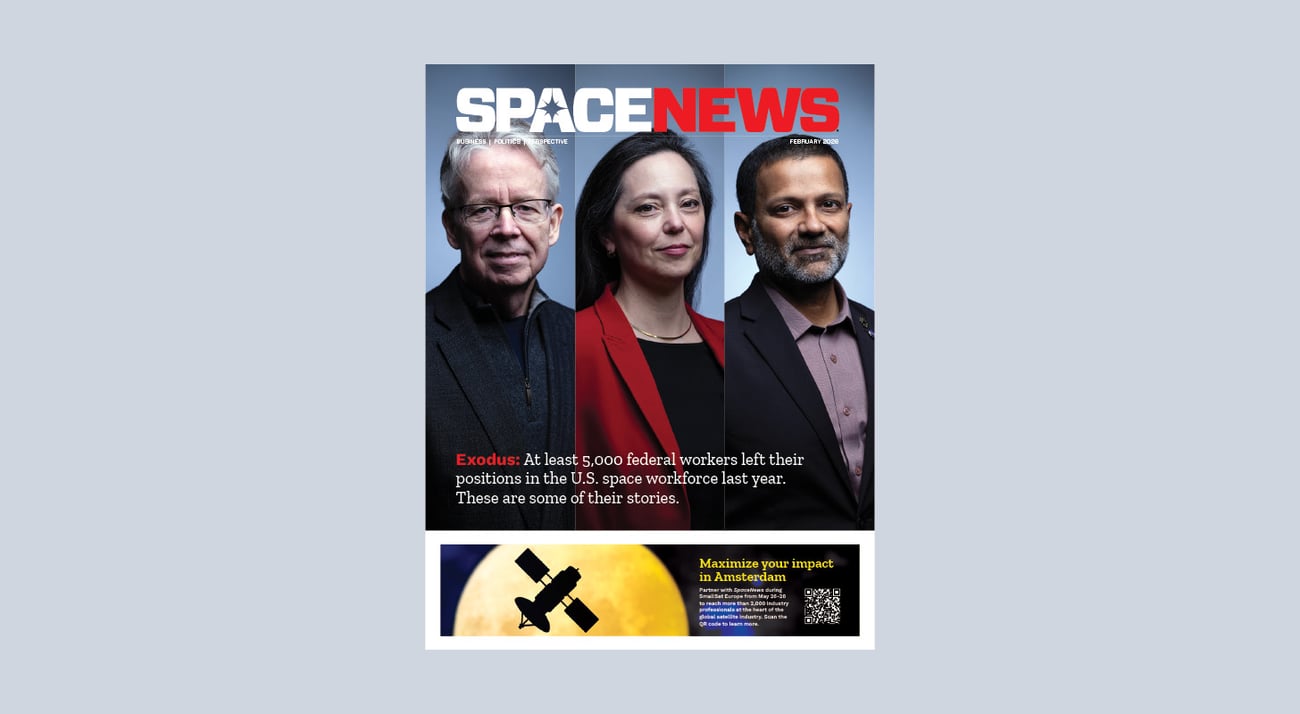
Read the cover story from the February issue of SpaceNews

Exodus: The shrinking federal space workforce: At least 5,000 federal workers left their positions in the U.S. space workforce last year. Senior executives with decades of experience retired alongside younger staffers whose posts were eliminated or who sought opportunities in the private sector or academia. Read SpaceNews correspondent Debra Werner's conversations with former officials from NASA, NOAA, the Air Force Research Laboratory, NGA and Space Systems Command.

Tuesday Afternoon


"With Motorola and the Iridium Mark 1's back in the '90s, we spent $5 billion to put up 80 satellites in one year. That's a Tuesday afternoon for SpaceX now, right?"


– Rusty Thomas, CEO of smallsat manufacturer Endurosat USA, during a panel Tuesday at the SmallSat Symposium.


Subscribe to SpaceNews


No comments:

Post a Comment

Military Space: Rift with Washington accelerates sovereign space spending

Golden Dome: Industry leans in despite lingering questions  ‌ ‌ ‌ ‌ ‌ ‌ ‌ ‌ ‌ ‌ ‌ ‌ ‌ ‌ ‌ ‌ ‌ ‌ ‌ ‌ ‌ ‌ ‌ ‌ ‌ ‌ ‌ ‌ ‌ ‌ ‌ ‌ ‌ ‌ ‌ ...