Thursday, February 12, 2026

Orbex heads for bankruptcy

Plus: Competing with SpaceX for investment
 ‌ ‌ ‌ ‌ ‌ ‌ ‌ ‌ ‌ ‌ ‌ ‌ ‌ ‌ ‌ ‌ ‌ ‌ ‌ ‌ ‌ ‌ ‌ ‌ ‌ ‌ ‌ ‌ ‌ ‌ ‌ ‌ ‌ ‌ ‌ ‌ ‌ ‌ ‌ ‌ ‌ ‌ ‌ ‌ ‌ ‌ ‌ ‌ ‌ ‌ ‌ ‌ ‌ ‌ ‌ ‌ ‌ ‌ ‌ ‌ ‌ ‌ ‌ ‌ ‌ ‌ ‌ ‌ ‌ ‌ ‌ ‌ ‌ ‌ ‌ ‌ ‌ ‌ ‌ ‌ ‌ ‌ ‌ ‌ ‌ ‌ ‌ ‌ ‌ ‌ ‌ ‌ ‌ ‌ ‌ ‌ ‌ ‌ ‌ ‌ ‌ ‌ ‌ ‌ ‌ ‌ ‌ ‌ ‌ ‌ ‌ ‌ ‌ ‌ ‌ ‌ ‌ ‌ ‌ ‌ ‌ ‌ ‌ ‌ ‌ ‌

02/12/2026

READ IN BROWSER

SpaceNews logo
SpaceNext First Up newsletter logo

The SpaceX-era economy is evolving yet again. Understand the launch and Starlink economics behind Elon Musk's data center push in our SpaceNews Intelligence report series. Download now.

By Jeff Foust


In today's edition: Orbex heads for bankruptcy, an "observation" during the latest Vulcan launch, trying to compete with SpaceX for contracts and investment and more. 


If someone forwarded you this edition, sign up to receive it in your inbox every weekday. Have thoughts or feedback? You can hit reply to let me know.


Top Stories


Eutelsat has secured nearly one billion euros in export credit financing for future OneWeb satellites. Eutelsat said Wednesday it signed a 975 million euro ($1.2 billion) financing package from a group of commercial banks, backed by a French state guarantee via Bpifrance Assurance Export. The package, along with 1.5 billion euros raised from shareholders last year, means the company has now secured financing to cover the estimated 2.2 billion euros needed to replenish OneWeb over the next three years. The operator has already ordered 440 satellites from Airbus Defence and Space for the plan, with deliveries slated to begin at the end of 2026. [SpaceNews]


U.K.-based small launch vehicle developer Orbex is preparing for bankruptcy. The company said Wednesday it filed a notice of intention to appoint administrators — a process in the United Kingdom that's similar to declaring bankruptcy — after fundraising, merger and acquisition efforts concluded without success. That included an announcement last month that it was exploring a potential acquisition by The Exploration Company. Orbex has been working on Prime, a vehicle designed to place about 200 kilograms into orbit, but its first launch has been delayed by several years. Orbex was one of five preselected companies in ESA's European Launcher Challenge, but the company received only a fraction of the funding the other four firms received last November. [SpaceNews]


SpaceX's IPO could take attention away from other companies in the market, at least in the short term. During a panel at the SmallSat Symposium Wednesday, some investors cautioned that the run-up to that IPO, expected this summer, could draw attention away from other space companies seeking to go public or raise money around the same time. However, the attention generated by that IPO could help companies in the longer term as more investors examine opportunities in the space sector beyond SpaceX. [SpaceNews]


The head of the FCC's Space Bureau says the agency's regulatory reform efforts are tied to broader goals. Speaking at the SmallSat Symposium Wednesday, Jay Schwarz said the commission wants to "lay the foundation for the new space age" with a series of reforms that are ongoing. Those reforms are tied to improving the speed, flexibility and predictability of the licensing process, as well as freeing up additional spectrum for satellite communications. [SpaceNews]


Space industry executives said they are continuing to invest in the Golden Dome missile defense initiative despite uncertainty about the effort. The Pentagon has released few details about the Golden Dome architecture, electing to keep it classified. Executives said that while they understood that rationale, they worried it could impede "open innovation" and the ability to bring in ideas from companies outside large defense contractors. They added, though they expected Golden Dome to continue in some form after the current administration given the urgency of missile defense. [SpaceNews]


Launch companies are split on how to compete with SpaceX. During a panel at the SmallSat Symposium Wednesday, some warned against competing head-to-head with SpaceX on price, instead differentiating themselves on factors such as performance and customer service. Others, though, said it was essential to lower costs to more effectively compete. The debate occurs as the industry faces constrained launch supplies as a glut of vehicles once expected to come into the market failed to materialize because of technical or financial setbacks. [SpaceNews]


Vertical integration of megaconstellations is squeezing smallsat manufacturers. As companies like Amazon and SpaceX produce their own satellites, it becomes harder for independent operators to compete on cost, scale or access to customers, industry officials said at the SmallSat Symposium this week. That could lead to consolidation among smallsat producers to help them achieve "constellation-level economics." The move toward mass production and constellation-scale deployment, though, could create opportunities for companies capable of delivering specialized spacecraft that large manufacturers increasingly deprioritize. [SpaceNews]


Other News


ULA launched a classified Space Force mission on a Vulcan rocket early Thursday. The Vulcan lifted off from Cape Canaveral Space Force Station at 4:22 a.m. Eastern, about halfway into a two-hour window. During liftoff, some observers noticed an irregular plume on one of the four solid-rocket boosters, and ULA said later it had "an observation" on the booster but that the vehicle remained on a nominal trajectory. The USSF-87 mission is carrying the latest satellites for the Geosynchronous Space Situational Awareness Program (GSSAP), which carry optical sensors designed to track and characterize objects in and around GEO. Previous launches carried two GSSAP satellites each but the Space Force declined to identify the number on this launch. The launch also carried as a secondary payload a propulsive ESPA ring hosting additional spacecraft for the Space Force. [SpaceNews]


SpaceX launched more Starlink satellites Wednesday. A Falcon 9 lifted off from Vandenberg Space Force Base in California at 12:11 p.m. Eastern, placing 24 Starlink spacecraft into orbit. The launch was the 16th so far this year by SpaceX, 12 of which have carried Starlink satellites. [Spaceflight Now]


A Proton rocket launched a Russian weather satellite Thursday. The Proton lifted off from the Baikonur Cosmodrome at 3:52 a.m. Eastern carrying the Elektro-L No. 5 weather satellite, bound for geostationary orbit. The launch was scheduled for December but delayed by technical issues with the Proton's upper stage. The launch was the first in nearly three years for Proton, a vehicle once in high demand for government and commercial missions. [TASS]


A Chinese rocket launched from a ship early Thursday. The Jielong-3, or Smart Dragon-3, rocket launched from a ship off the coast from Guangdong province at 1:37 a.m. Eastern. The rocket carried seven satellites, including a remote sensing satellite for Pakistan. [Xinhua]


More countries are seeking their own Earth observation satellite systems. Representatives of Earth observation companies said at the SmallSat Symposium this week that middle powers that previously relied on space systems operated by powerful allies or partners are now clamoring for sovereign capabilities. Many of those countries, though, may struggle to afford full control of such systems and may instead seek to purchase individual satellites in a constellation or specific services. [SpaceNews]


The Exploration Company completed mock splashdown tests for its Nyx space capsule. The company used a one-fourth-scale model of Nyx at a towing tank facility in Italy to study how the capsule behaves upon splashdown. The tank tests follow the June 2025 failure of the company's Mission Possible reentry test, where contact with the capsule was lost before splashdown, preventing the company from collecting data for that part of the mission. However, The Exploration Company said that the recent validation splash test was not triggered by, nor is related to, the lack of splashdown data from Mission Possible. [SpaceNews]


FROM SPACENEWS

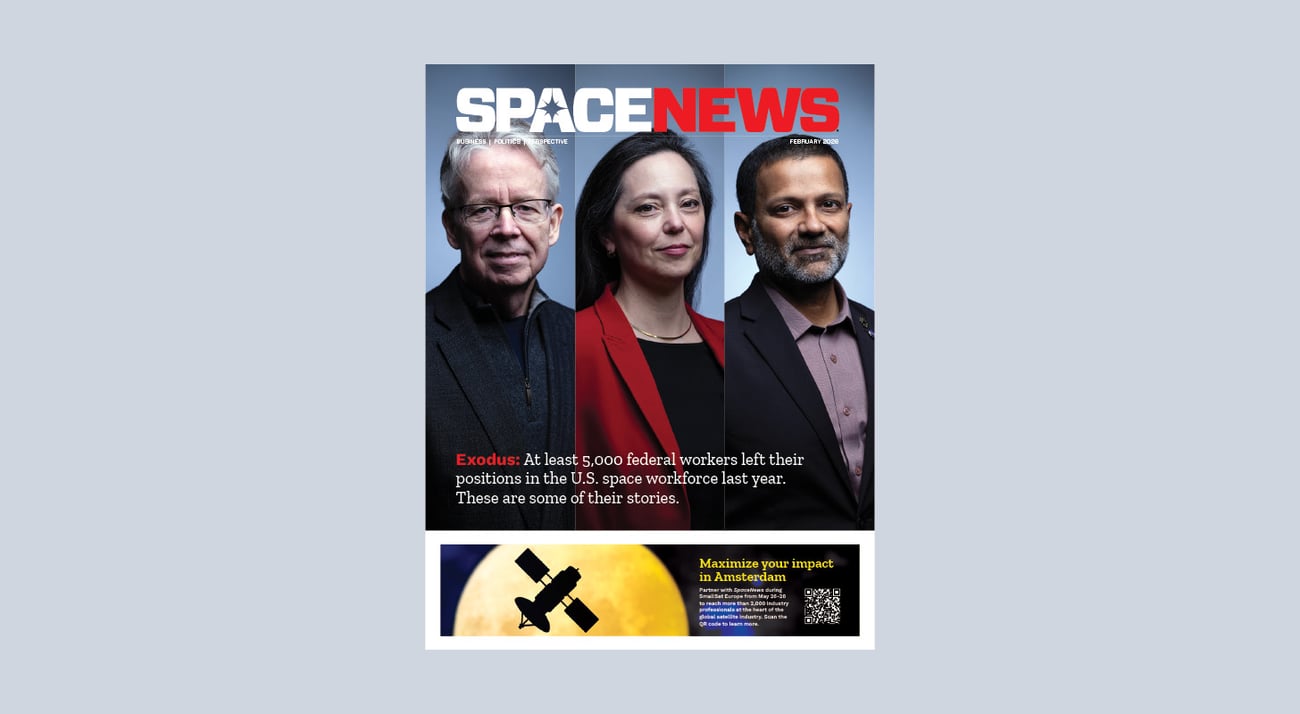
Read the cover story from the February issue of SpaceNews

Exodus: The shrinking federal space workforce: At least 5,000 federal workers left their positions in the U.S. space workforce last year. Senior executives with decades of experience retired alongside younger staffers whose posts were eliminated or who sought opportunities in the private sector or academia. Read SpaceNews correspondent Debra Werner's conversations with former officials from NASA, NOAA, the Air Force Research Laboratory, NGA and Space Systems Command.

Putting the AI into Spaice


"I think anybody here trying to raise money should, if your name has 'space' in it, just spell it S-P-A-I-C-E and you will get a lot of money fast."


– Matt O'Connell, operating partner at Data Collective Venture Capital, discussing the wave of spending on AI during a panel at the SmallSat Symposium Wednesday.


Subscribe to SpaceNews


No comments:

Post a Comment

Military Space: Rift with Washington accelerates sovereign space spending

Golden Dome: Industry leans in despite lingering questions  ‌ ‌ ‌ ‌ ‌ ‌ ‌ ‌ ‌ ‌ ‌ ‌ ‌ ‌ ‌ ‌ ‌ ‌ ‌ ‌ ‌ ‌ ‌ ‌ ‌ ‌ ‌ ‌ ‌ ‌ ‌ ‌ ‌ ‌ ‌ ...