Plus: NATO selects 150 companies for its DIANA accelerator.
SpaceNews journalists are reporting from the 2025 Spacepower Conference, held in Orlando, Florida. We'll bring highlights to your inbox — for full coverage, go to spacenews.com/spacepower-conference-2025/.
|
|
|
|
By Sandra Erwin Blue Origin's New Glenn rocket will have to complete four successful orbital flights as its pathway to certification under the U.S. Space Force's National Security Space Launch program, Lt. Gen. Philip Garrant said Dec. 10 at the Spacepower conference.
Garrant, who leads the Space Systems Command, said Blue Origin selected the four-flight benchmark and the government agreed. "The government is supporting a four-flight certification for New Glenn," he told reporters. The rocket has logged two successful missions so far, and Garrant said a third launch is expected "earlier in the new year than later." If upcoming flights stay on track, he added, "I think they're going to be in a fantastic place to become our third certified provider and compete for missions."
| | |
|
|
|
| NATO has picked 150 companies from 24 of its member countries to join its Defence Innovation Accelerator for the North Atlantic (DIANA) next year, including more than two dozen with ties to the space sector.
Voyager Technologies secured a $21 million U.S. Air Force Research Laboratory contract to develop artificial intelligence-enabled signals processing tools. The work centers on software and computing techniques that can interpret raw intelligence, surveillance and reconnaissance data collected by sensors.
L3Harris satellite-jamming system approved for export to close U.S. allies
A ground-based satellite-jamming system made by L3Harris Technologies for the U.S. Space Force has been approved for potential export to select American allies, marking a rare expansion of foreign access to sensitive electromagnetic-warfare tools. | | |
|
|
|
| Muon Space has secured a $1.9 million contract to develop an infrared sensing payload for missile detection and tracking, the startup announced Dec. 9. The award is a Small Business Innovation Research Direct to Phase 2 contract from SpaceWERX, the U.S. Space Force's technology arm. The Direct to Phase 2 path lets companies skip an initial feasibility study and move straight to prototype development.
LeoLabs said Dec. 9 it won an interagency contract to provide space-surveillance data for the U.S. government, supporting adversarial spacecraft monitoring and the TraCSS orbital traffic coordination platform due to enter full service early next year.
Two defense technology companies from Norway and Germany have joined forces to bolster Europe's sovereign intelligence and communications capabilities, with plans to start deploying small satellites in about three years. |
|
|
|
| | FROM SPACENEWS | 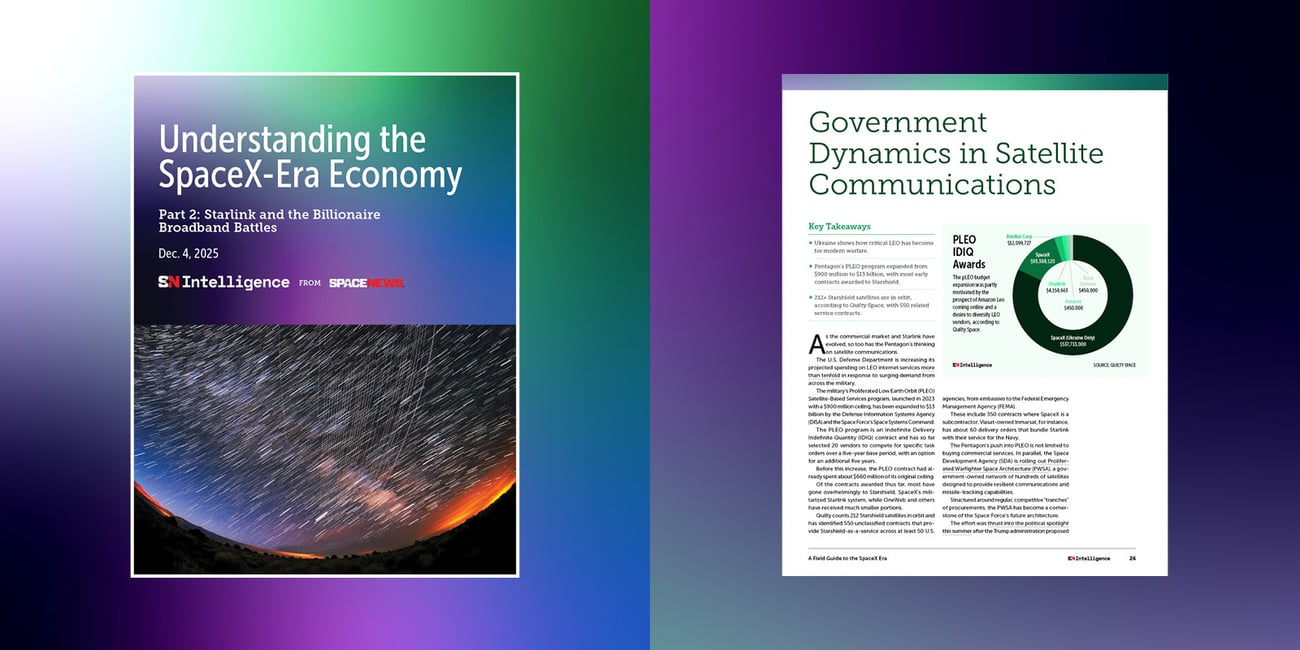 | As Starlink becomes embedded in military communications and government systems around the world, its unprecedented growth raises questions about sovereignty, supply-chain resilience and operational risk. Part 2 of our free Understanding the SpaceX-Era Economy series explores how the United States and its allies are recalibrating policy around proliferated LEO, while China and others accelerate their own strategic constellations. It's essential reading for defense and government professionals navigating an era where commercial space infrastructure is inseparable from national security. Download the report from SpaceNews Intelligence. |
|
|
|
|






No comments:
Post a Comment