Friday, December 12, 2025

K2 Space’s big round to make big satellites

China prepares for its next reusable rocket test,‌ and the effects of a potential SpaceX IPO
 ‌ ‌ ‌ ‌ ‌ ‌ ‌ ‌ ‌ ‌ ‌ ‌ ‌ ‌ ‌ ‌ ‌ ‌ ‌ ‌ ‌ ‌ ‌ ‌ ‌ ‌ ‌ ‌ ‌ ‌ ‌ ‌ ‌ ‌ ‌ ‌ ‌ ‌ ‌ ‌ ‌ ‌ ‌ ‌ ‌ ‌ ‌ ‌ ‌ ‌ ‌ ‌ ‌ ‌ ‌ ‌ ‌ ‌ ‌ ‌ ‌ ‌ ‌ ‌ ‌ ‌ ‌ ‌ ‌ ‌ ‌ ‌ ‌ ‌ ‌ ‌ ‌ ‌ ‌ ‌ ‌ ‌ ‌ ‌ ‌ ‌ ‌ ‌ ‌ ‌ ‌ ‌ ‌ ‌ ‌ ‌ ‌ ‌ ‌ ‌ ‌ ‌ ‌ ‌ ‌ ‌ ‌ ‌ ‌ ‌ ‌ ‌ ‌ ‌ ‌ ‌ ‌ ‌ ‌ ‌ ‌ ‌ ‌ ‌ ‌ ‌

12/12/2025

READ IN BROWSER

SpaceNews logo
SpaceNext First Up newsletter logo

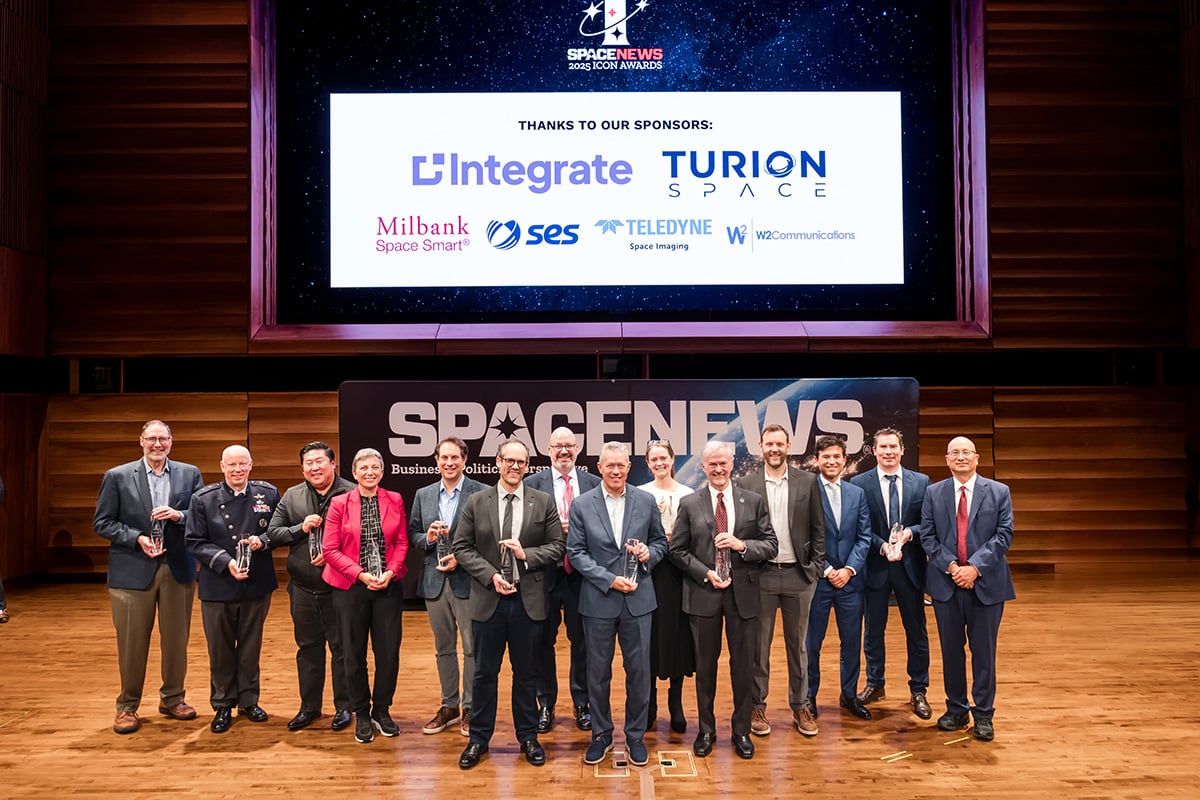
The 2025 Icon Awards: Meet the people, programs and technologies that have most influenced the direction of the space industry in the past year. See the winners. 

SPONSORED BY

BAE Systems

By Jeff Foust


In today's edition: K2 Space raises a big round for big satellites, Meink's warning about Chinese space capabilities, NASA heliophysics goes to the CINEMA, and more. 


If someone forwarded you this edition, sign up to receive it in your inbox every weekday. Have thoughts or feedback? You can hit reply to let me know.


Top Stories


Satellite manufacturer K2 Space announced Thursday it raised $250 million to scale up production. The company said its Series C was led by Redpoint, with additional backing from several other investors. K2 was founded in 2022 to build large satellites with more onboard power and volume than typical platforms in low, medium or geostationary orbit. It plans to launch "Gravitas," the first unit of its "Mega Class" line, in March, and will use the funding to scale up production of that class of spacecraft. [SpaceNews]


The United States should not assume China's accelerating progress in space and missile technology is simply the result of copying American systems, Air Force Secretary Troy Meink warned. Speaking at the Spacepower Conference Thursday, Meink said that while China is copying U.S. capabilities in some ways, such as development of its launch complexes, the country is also "super innovative" in areas like operations. A central concern, Meink said, is China's ability to manufacture and field systems at far greater scale than the United States. Meink's warning comes as the Pentagon and the defense industrial base are looking to accelerate development timelines, adopt more agile acquisition practices and increase production capacity. [SpaceNews]


SpaceX's new interest in pursuing an IPO could lead other space companies to follow. One investor said that a SpaceX IPO, potentially as soon as the second half of next year, would be a "seismic event for the space economy," while another said that an IPO might encourage others in the industry to also go public. One such deal, on a far smaller scale, is Starfighters Space, which announced this week it will go public on the NYSE American exchange, seeking to raise $40 million. The company operates a fleet of aging F-104 Starfighter jets with plans to use them as air-launch platforms. [SpaceNews]


NASA selected a heliophysics mission to move into the next phase of development. NASA said Thursday it will provide funding for the Cross-scale Investigation of Earth's Magnetotail and Aurora, or CINEMA, mission to go into Phase B of development. CINEMA would fly nine smallsats in polar orbits to study the magnetotail, an extension of the Earth's magnetic field linked to geomagnetic storms. At the end of the Phase B study, costing $28.2 million over 10 months, NASA will then decide whether to proceed into full development, with a total cost not to exceed $182.8 million. CINEMA was one of four mission concepts NASA picked in 2023 for additional study as part of the heliophysics Small Explorer, or SMEX, program. NASA will also provide $2 million to another SMEX proposal, Chromospheric Magnetism Explorer, or CMEx, to mature its design for potential future consideration. The award comes as the heliophysics community is reeling from proposed major budget cuts and mission cancellations that raised doubts about the ability to implement the missions recommended in the field's latest decadal survey a year ago as well as to retain researchers. [SpaceNews]


An improved budget profile is giving new cause for optimism for NASA's astrophysics program. That division was facing a budget cut of nearly two-thirds in the administration's 2026 budget proposal, forcing the cancellation of many active or proposed missions. However, the acting director of NASA's astrophysics division said at an event this week that he has been told to plan to funding levels in a House spending bill, which largely rejected the cuts but offers slightly less than a Senate bill. With that budget profile, NASA is moving ahead with a selection of a probe-class astrophysics mission next year along with the launch of the Roman Space Telescope as soon as next fall. Several smaller missions are also set to fly in the coming months, as well as an effort to reboost the Swift mission. [SpaceNews]


Other News


China launched more Guowang satellites as it prepares for another attempt to land a booster. A Long March 12 rocket lifted off at 6 p.m. Eastern Thursday from the coastal Hainan commercial space launch center. It placed into orbit the 16th group of satellites for the Guowang broadband constellation, likely featuring nine satellites. A variant of that rocket, the Long March 12A, is expected to launch next Tuesday from the Jiuquan spaceport. That version of the rocket includes a booster designed to land and be reused, although Chinese officials have not disclosed if they will attempt a landing on this launch. [SpaceNews]


SpaceX set a pad turnaround record for its latest Starlink launch Thursday. A Falcon 9 lifted off from Cape Canaveral Space Force Station's SLC-40 at 5:01 p.m. Eastern, putting 29 Starlink satellites in orbit. The launch took place less than 51 hours after the previous Falcon 9 launch from SLC-40, the NROL-77 mission. A SpaceX executive said on social media that the rocket was ready for launch just 40 hours after the NROL-77 liftoff, but SpaceX waited for the "optimal deployment" time for the Starlink satellites. [Spaceflight Now]


BAE Systems won a DARPA contract to continue work on software for autonomous satellite tasking. The $16 million contract is for Phase 2 of DARPA's Oversight program and follows a $7 million Phase 1 contract issued in 2023. Oversight is a software-focused effort to coordinate and assign work across proliferated space systems, a growing mix of military and commercial spacecraft that carry radar, optical and radio-frequency sensors. The software is designed to automate the process of determining what satellite should observe what target on the ground and at what time in order to maintain "constant custody" of those targets. [SpaceNews]


The U.S. Space Force is rolling out a new naming scheme for its satellites, cyber tools and other space-warfare systems. Speaking at the Spacepower Conference Thursday, Chief of Space Operations Gen. Chance Saltzman said the service will begin assigning meaningful nicknames to operational systems, drawing on themes meant to reflect each mission area's character and give guardians a clearer cultural anchor. The taxonomy ranges from serpents for electromagnetic warfare systems to ghosts for space domain awareness systems. Saltzman said the shift is intended to build a stronger sense of identity among guardians who operate systems often hidden behind classified designations or opaque acquisition labels. The names will be in addition to new alphanumeric designations for satellites modeled on those used by the Air Force for aircraft. [SpaceNews]


The Exploration Company is working on a satellite servicing vehicle. The company, which is developing a spacecraft to transport cargo to and from space stations, is leading a consortium of several other European companies on ESA's In-Space Proof-of-Concepts (InSPoC) initiative to design a variant called Oura for satellite refueling. A demonstration of Oura is planned for 2028, where it will dock with a satellite built by Thales Alenia Space in low Earth orbit and transfer non-cryogenic propellant. [European Spaceflight]


🚀 🕑 🎧 Don't miss SpaceNews' First Up Audio
The day's most important space headlines delivered in less than 10 minutes every Monday-Friday. Listen on our website, YouTube, Apple Podcasts, Spotify or your favorite podcast app.


FROM SPACENEWS

Meet the 2025 Icon Award winners

Meet the 2025 Icon Award Winners: This year's recipients range from a company that successfully landed on the moon to an agency leader who transformed NASA's relationship with industry, making room for commercial lunar landers in the first place. On Tuesday, Dec. 2 in Washington D.C., we awarded this year's Icon Awards during a program at the Johns Hopkins University Bloomberg Center. Learn more about what made this year's class stand out.

Resistance Is Futile, After All

"I was told I had to make Star Trek references… Let me just say it this way: everyone who joins the Accords, their cultural distinctiveness will be added to our own.


— NASA Associate Administrator Amit Kshatriya at an event at the Meridian International Center on Thursday celebrating the fifth anniversary of the Artemis Accords.


Subscribe to SpaceNews


No comments:

Post a Comment

K2 Space’s big round to make big satellites

China prepares for its next reusable rocket test,‌ and the effects of a potential SpaceX IPO  ‌ ‌ ...