| By Jeff Foust
In this today's edition: NASA's new lunar base and commercial space station plans, SES orders 28 K2 Space satellites, geopolitical threats and opportunities for satellite operators and more.
If someone forwarded you this edition, sign up to receive it in your inbox every weekday. Have thoughts or feedback? You can hit reply to let me know.
| | | | | | | SPONSORED |  | | The future of space is being built right now — will you be in the room? ASCEND 2026 is where the global space community comes together to turn bold ideas into real outcomes. Bringing together 2,000+ leaders from industry, government, and academia, ASCEND covers everything from space economy and national security to lunar exploration and next-gen technology — across 130 sessions and 190 technical papers. Powered by AIAA and backed by partners including Lockheed Martin and the ISS National Laboratory, this is the event that drives the space sector forward. Secure your seat today Your off-world future starts here.
| | | | | | Top Stories
NASA rolled out a major revamp of its exploration plans Tuesday, including development of a lunar base. At a day-long event at NASA Headquarters, agency leaders discussed changes to its Artemis architecture that include halting work on the lunar Gateway. In its place, NASA proposed spending $20 billion over the next seven years to start development of a lunar base, including landers, rovers and other infrastructure. The base would leverage some existing programs, although with modifications, along with new projects. NASA also proposed increasing the cadence of crewed and robotic lunar lander missions and developing a nuclear electric propulsion demonstration mission that would launch to Mars in late 2028. [SpaceNews]
NASA also proposed changing its approach to commercial space station development. Agency officials said the commercial market for such stations was not developing as fast as previously projected, raising concerns about the business case for them. NASA said it is considering a new model where NASA would procure a core module that would be installed on the ISS, providing a more incremental path to creating commercial space stations. NASA also plans to allow more private astronaut missions to the ISS to stimulate demand. [SpaceNews]
SES has ordered an initial 28 satellites from manufacturing startup K2 Space for a future medium Earth orbit (MEO) constellation. SES said Tuesday the meoSphere satellites would deliver high-speed broadband, support optical intersatellite links for data relay and enable hosted payloads across commercial and government missions. SES is co-developing meoSphere with K2, providing payloads built in Luxembourg for integration with K2's satellite bus in California. SpaceX is slated to launch an initial SES-K2 meoSphere pathfinder March 30 on a rideshare mission. The pathfinder, which at 2,200 kilograms would be the same size as the operational spacecraft, includes optical technology designed primarily to test links between satellites and an optical ground station supplied by France's Cailabs. [SpaceNews]
The Space Development Agency is slowing the pace of satellite launches as it works through technical issues with spacecraft already in orbit. Gurpartap "GP" Sandhoo, the agency's acting director, said at Satellite 2026 this week the next launch of the Proliferated Warfighter Space Architecture's Tranche 1 satellites will not occur until at least May or June, marking a gap of roughly seven months since the last launch in mid-October. He said the pacing factor is now the work required to bring satellites into operational use, including raising them to final orbits, checking out systems and demonstrating early integration. So far, 42 of the 154 satellites planned for Tranche 1 have been launched, all for the Transport Layer providing communications. [SpaceNews]
Geopolitical shifts are creating new opportunities but also new challenges for satellite operators. As countries increasingly prioritize national security and sovereignty, satellite operators are being forced to rethink a historical push toward globalized supply chains in favor of less efficient, more regionally aligned models. That pressure to adapt is matched by a surge in demand tied directly to geopolitical tensions as space becomes an increasingly strategic domain. That surge in national security demand, though, brings new risks to operators as they potentially become targets. [SpaceNews]
Electronic warfare is a growing threat to U.S. space systems. During a threat briefing at Satellite 2026, U.S. Space Force Chief Master Sergeant Ron Lerch, senior enlisted advisor to the Deputy Chief of Space Operations for Intelligence, said China and Russia are developing electronic warfare technologies, such as jamming satellite communications services with drones. Another recent Chinese research paper described a high-power ground-based microwave to target satellites. [SpaceNews]
| | | | | | Other News
A Russian Progress cargo spacecraft docked to the ISS Tuesday. The Progress MS-33 spacecraft, called Progress 94 by NASA, docked with the station's Poisk module at 9:40 a.m. Eastern. Russian cosmonauts on the ISS handled the docking manually after one of the antennas for the spacecraft's automated docking system failed to deploy after launch on Sunday. [NASA]
Weather postponed a Rocket Lab launch of European navigation satellites. Rocket Lab said it called off the Electron launch from its New Zealand spaceport, scheduled for early this morning, because of poor weather that is expected to last several days. Rocket Lab did not announce a new launch date for the mission, carrying two Celeste navigation tech demo satellites for the European Space Agency. [X @RocketLab]
Chinese launch startup Astronstone has secured new funding as it builds toward the first flight of its reusable AS-1 rocket. The company said it raised a "Pre-A+" funding round involving a mix of financial, state and industrial capital, bringing its total raised to date to $72 million. The funding will be used for rocket final assembly and testing, validation of "chopstick" recovery technology, expansion of rocket production capacity and team growth. Astronstone says it aims for a debut flight of its two-stage AS-1 rocket in the first quarter of 2027. The company claims a capability of 15,700 kilograms to low Earth orbit for AS-1 when expendable, and 10,000 kg when recovered. [SpaceNews]
Moog is buying solar arrays from Redwire. Under the contract announced Tuesday, Redwire will deliver Extensible Low-Profile Solar Array (ELSA) wings for Moog's Meteor satellite bus ordered by an undisclosed national security customer. ELSA, unveiled earlier this month, is designed to provide 50% more power per unit of volume than traditional solar arrays. [SpaceNews]
The Artemis 2 launch could be a windfall for Florida's Space Coast. Local officials estimate the launch, scheduled for as soon as April 1, could attract 400,000 visitors and generate $160 million in economic impact for the region through hotel reservations, dining and other entertainment. The Artemis 1 launch in 2022, by contrast, attracted 100,000 to 200,000 visitors. [Florida Today]
NASA will provide an instrument for a joint Indian-Japanese lunar mission. NASA said it will provide a neutron spectrometer for the Lunar Polar Exploration (LUPEX) mission being developed by ISRO and JAXA. LUPEX will land near the south pole of the moon in 2028 and deploy a rover to identify and characterize water ice. [NASA]
Correction: Yesterday's entry about Mike Melvill incorrectly stated when he piloted SpaceShipOne on two suborbital spaceflights. Those flights took place in 2004.
| | | | | | | FROM SPACENEWS | 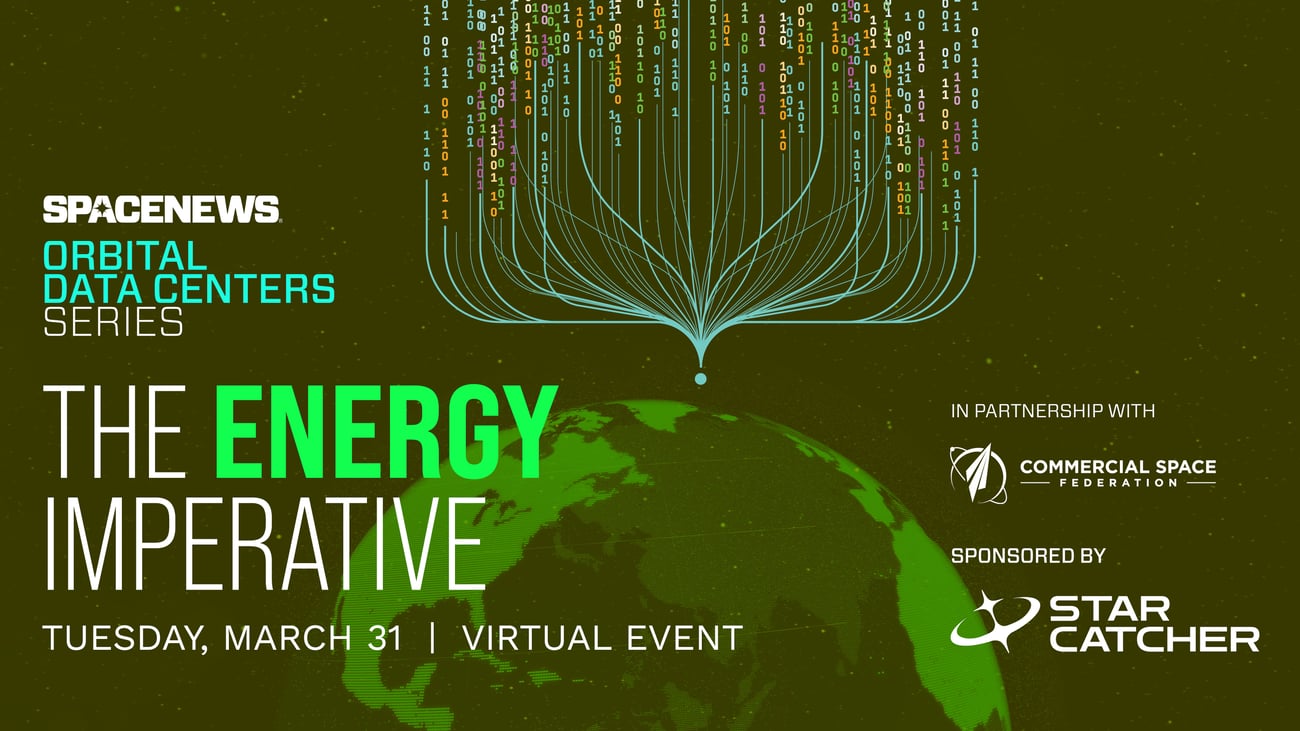 | | March 31 at 1 p.m. ET: Join SpaceNews and Star Catcher, in partnership with the Commercial Space Federation, for a conversation on the energy and computing needs driving the push toward orbital data centers, where there are gaps and where there are opportunities and what comes next in this fast-moving field. Register now. | | | | | | He's Written the Checks
| "I can say, with a lot of direct experience and confidence in my answer, that putting humans into space is extremely expensive."
| | – NASA Administrator Jared Isaacman, who funded and commanded two private astronaut missions before joining NASA, speaking at a press conference about the agency's revamped exploration plans Tuesday.
| | | | | | |








No comments:
Post a Comment