Plus: How to build sovereign European space intelligence
| By Dan Robitzski
Welcome back to our weekly newsletter highlighting the opinions and perspectives of the SpaceNews community.
| | | | | | |
As megaconstellation launches continue to add thousands of new satellites into orbit, how should the astronomy community move forward? Often, the commercial space industry and the astronomy research community are portrayed at odds, but there is a path that supports economic development in orbit and scientific research, according to a commentary penned by several members of the National Space Society and astronomy researchers.
While preserving dark skies would make life easier for scientists conducting research and gathering data from terrestrial observatories, many of their problems would go away — and commercial firms would be freed up to continue launching — if the research community made a concerted shift to space-based observatories.
"Under current technological conditions, where astronomy is conducted has become as important as how it is conducted," the authors wrote. "Ground-based observatories face limits that cannot be regulated away, including atmospheric distortion, increasing light pollution and growing radio interference. At the same time, space-based systems accessible through networked platforms offer new opportunities to broaden participation, expand discovery and reimagine public engagement with astronomy."
Read the rest of the article here. | | | | |
With growing diplomatic tension between the United States and Europe, the latter of which has historically been dependent on American space intelligence, Europe may need to bolster its own intelligence, surveillance and reconnaissance satellite capabilities in the interest of sovereignty.
Some of the legal and diplomatic frameworks that Europe could use to establish its own space intel network are already in place, according to an opinion article by Cameron Olbert from the Transatlantic Security Program at the Center for a New American Security. He described some of the existing avenues, such as EU's Permanent Structured Cooperation mechanism, and the Common Hub for Governmental Imagery.
But pulling it off will take a significant shift in how the continental alliance operates, and will rely on countries having "the political will to pool information traditionally kept in their respective capitols."
Read the rest here. | | | | | |  | | Starship/Super Heavy on the launch pad before the Flight 11 launch. Credit: SpaceX
| | | |
Space tourism is often dismissed as a plaything of the ultra wealthy. But that's a short-sighted view, according to Lynk Global co-founder Charles Miller and BlackSky Global founder Jason Andrews, who wrote an opinion article arguing that early, exorbitant costs for space tourism will inevitably pave the way to accessible space tourism, travel and access for the broader public.
In their article, they compared these early days of space travel to the early days of aviation, when plane tickets were similarly prohibitive.
"Space is at the same inflection point," they wrote. $10 million per seat may seem extreme, but many can and will pay. Their purchases fund the infrastructure, flight cadence and learning curves that eventually make access affordable for millions."
See the rest of the article here.
SpaceNews is committed to publishing our community's diverse perspectives. Whether you're an academic, executive, engineer or even just a concerned citizen of the cosmos, send your arguments and viewpoints to opinion (at) spacenews.com to be considered for publication online or in our next magazine. If you have something to submit, read some of our recent opinion articles and our submission guidelines to get a sense of what we're looking for. The perspectives shared in these opinion articles are solely those of the authors and do not necessarily represent their employers or professional affiliations. | | | | | | | FROM SPACENEWS | 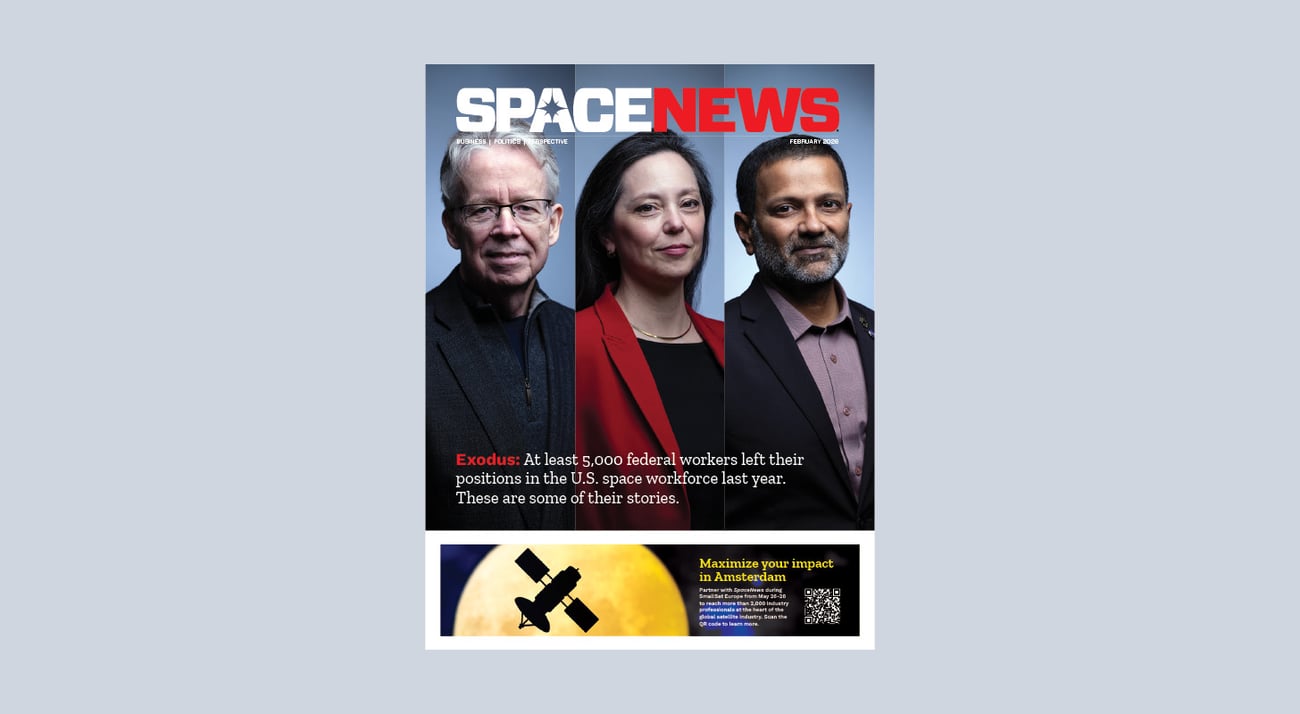 | | Exodus: The shrinking federal space workforce: At least 5,000 federal workers left their positions in the U.S. space workforce last year. Senior executives with decades of experience retired alongside younger staffers whose posts were eliminated or who sought opportunities in the private sector or academia. Read SpaceNews correspondent Debra Werner's conversations with former officials from NASA, NOAA, the Air Force Research Laboratory, NGA and Space Systems Command. | | | | |









No comments:
Post a Comment