| By Jeff Foust
In today's edition: big funding rounds for Axiom Space and China's iSpace, first Ariane 64 launches Amazon Leo satellites, more ways for space startups to get liquidity and more.
If someone forwarded you this edition, sign up to receive it in your inbox every weekday. Have thoughts or feedback? You can hit reply to let me know.
| | | | | | Top Stories
A new crew is on its way to the International Space Station after a launch early this morning. A Falcon 9 lifted off at 5:15 a.m. Eastern from Cape Canaveral's Space Launch Complex 40, placing a Crew Dragon spacecraft into orbit on the Crew-12 mission. The Dragon is scheduled to dock with the ISS Saturday at 3:15 p.m. Eastern, delivering astronauts from NASA, ESA and Roscosmos for an eight-month mission. The launch was just the second crewed mission to use SLC-40 as SpaceX moves all Falcon launches, including Dragon missions, there from Launch Complex 39A. Crew-12 also kicks off a busy schedule of arriving and departing vehicles at the station that include cargo Dragon, HTV-X, Cygnus and Progress spacecraft, as well as potentially another uncrewed Starliner test flight. [SpaceNews]
Chinese launch firm iSpace has secured a record funding round. Beijing Interstellar Glory Space Technology Ltd., also known as iSpace, announced the Series D++ funding worth 5.037 billion yuan ($729 million) Thursday, after raising 700 million yuan last September. The round appears to be the largest disclosed funding round thus far for a Chinese launch startup, eclipsing the previous rounds secured by Space Pioneer ($350 million) and Galactic Energy ($336 million) in 2025. The company says the funds will be used to further accelerate the development and commercialization of iSpace's reusable methane-liquid oxygen launch vehicle models, as well as sea-based recovery plans. The company has been working toward a first launch of its first liquid propellant rocket, the Hyperbola-3, but did not announce a launch date in the funding announcement. [SpaceNews]
Axiom Space has raised an additional $350 million. The commercial space station and spacesuit developer announced Thursday the new funding round, led by Type One Ventures and Qatar Investment Authority with several other investors participating. Axiom said most of the funding will go toward work on Axiom Space, its commercial space station, completing a first module set to launch in 2028 and advancing development of a second module to launch in 2029. The company is waiting on NASA to decide on its plan for the next phase of the Commercial LEO Destinations program to support development of commercial stations, but the company noted it did not expect any changes in that program to significantly affect its work on Axiom Station. The company added it is making good progress on spacesuits to be used on Artemis 3 and future lunar landing missions, with delivery of the suits on schedule for 2027. [SpaceNews]
Vast has won its first private astronaut mission to the ISS. NASA announced Thursday it awarded the mission to Vast, which will take place no earlier than mid-2027. This is the sixth private astronaut mission NASA had awarded overall but the first to go to a company other than Axiom Space, which won the first five missions. Vast announced two years ago its interest in flying a private ISS mission to gain experience for its future commercial stations. The ISS mission will use a Crew Dragon, which Vast also plans to use for flights to its Haven-1 station. [SpaceNews]
Space startups are gaining more ways to cash out or raise larger pools of capital as the industry matures. During a panel at the SmallSat Symposium Thursday, investors said there are more options for companies, such as going public and being acquired by larger aerospace and defense contractors. An emerging option is to sell to an AI or data center company given the growing interest in orbital data centers. However, others on the panel noted that startups can continue to rely on private financing as capital markets show continued willingness to invest in them. [SpaceNews]
| | | | | | Other News
The first Ariane 64 successfully launched a set of Amazon Leo satellites Thursday. The rocket lifted off from French Guiana at 11:45 a.m. Eastern and completed deployment of 32 Amazon Leo satellites nearly two hours later. The launch was the first for the Ariane 64, the version of the Ariane 6 with four solid-fuel boosters that doubles the rocket's payload performance over the two-booster Ariane 62. It also marked the first use of a 20-meter-long payload fairing, longer than those used on previous Ariane 6 launches. Arianespace has a contract for 18 Ariane 6 launches of Amazon Leo satellites as Amazon works to accelerate the deployment of its broadband constellation. [SpaceNews]
Satellite antenna manufacturer ThinKom Solutions won an extension of a Pentagon contract to demonstrate phased-array portable ground stations. ThinkKom said a previous $1.9 million Small Business Innovation Research contract has been increased to $3.9 million to provide portable ground stations capable of delivering satellite connectivity without fixed infrastructure. ThinKom's antenna technology is a steerable, mechanically actuated phased array designed to track satellites in geostationary and non-geostationary orbits. The contract is designed to test the antenna's use by dismounted forces, or personnel operating on foot rather than inside armored vehicles or aircraft. [SpaceNews]
Integrate, a startup that develops project management software for the space and defense industries, has raised $17 million. The company announced the Series A round this week along with a new contract from the Space Force. The company has created a collaborative project management platform designed for distributed teams operating in classified environments, including a Defense Department network used to handle top secret information. Integrate said the new funding will support expansion beyond space programs, such as the maritime, aviation and automotive sectors. [SpaceNews]
NASA has been testing repairs to liquid hydrogen fueling systems for the Space Launch System. Crews loaded liquid hydrogen into the rocket during an unannounced test Thursday at Launch Complex 39B. NASA Administrator Jared Isaacman said Friday morning during the Crew-12 launch that the tests were a series of "mini wet dress rehearsals" to see if recent work fixed hydrogen leaks during a wet dress rehearsal last week. He said that will determine if NASA is ready to attempt another full-scale wet dress rehearsal ahead of a launch in early March or if more repairs are needed. [Spaceflight Now]
Orbex, the U.K. launch company going into bankruptcy, is attracting interest from another launch firm. Skyrora, also based in the United Kingdom, said Thursday it is interested in buying the assets of Orbex, stating it would be willing to spend up to £10 million ($14 million) on selected assets. Skyrora, like Orbex, is developing a small launch vehicle, but has yet to attempt an orbital launch. A flight of a Skyrora suborbital rocket from Iceland failed in 2022 moments after liftoff. [The Herald]
Rocket Lab says a series of engine test failures for its Neutron rocket is not a cause for concern. An Archimedes engine blew up on a test stand at the Stennis Space Center in Mississippi in November. That incident was one of at least two such test failures in the last three months involving Archimedes, the engine Rocket Lab developed for Neutron. Rocket Lab CEO played down the failures, saying they are part of a process that is intentionally testing engines to failure. The tests come as Rocket Lab presses towards a first launch of Neutron later this year. [Ars Technica]
| | | | | | | FROM SPACENEWS | 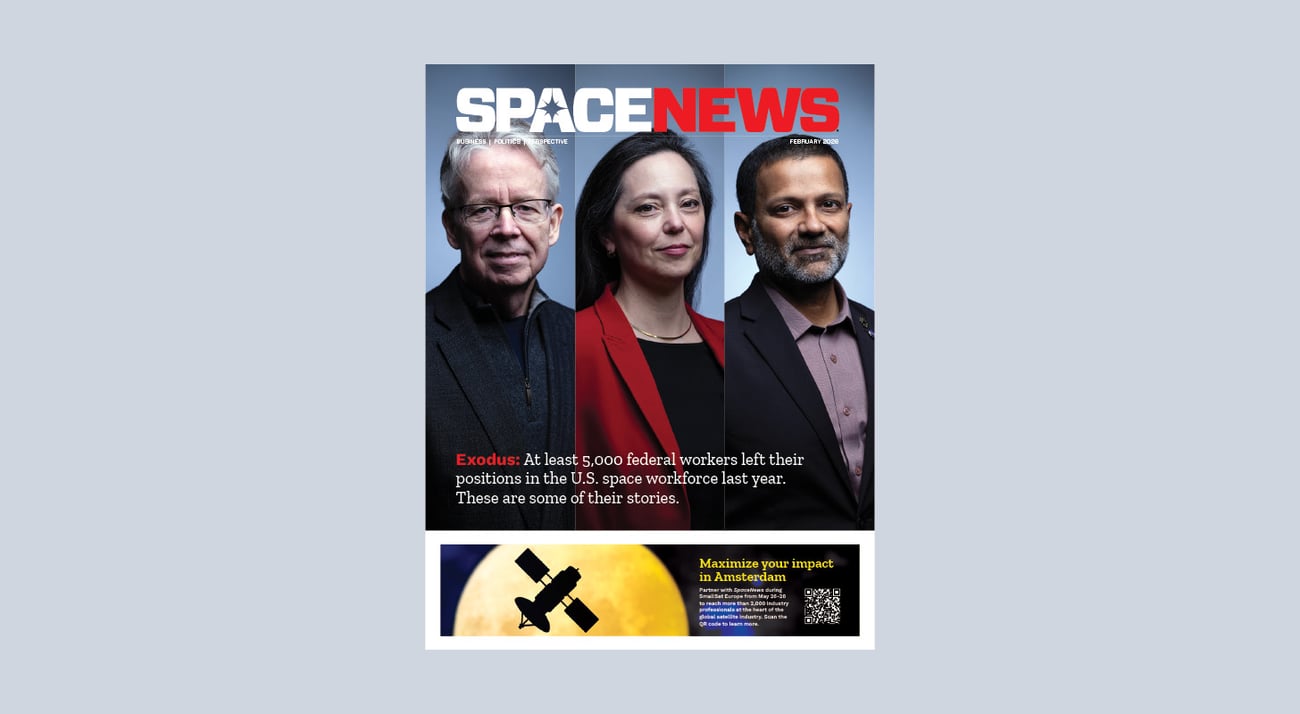 | | Exodus: The shrinking federal space workforce: At least 5,000 federal workers left their positions in the U.S. space workforce last year. Senior executives with decades of experience retired alongside younger staffers whose posts were eliminated or who sought opportunities in the private sector or academia. Read SpaceNews correspondent Debra Werner's conversations with former officials from NASA, NOAA, the Air Force Research Laboratory, NGA and Space Systems Command. | | | | | | Space Plumber
| "I found out that if you can fix the potty on a spaceship, you're a Guardian of the Galaxy."
| | – NASA astronaut Doug Wheelock, describing on the NASA Crew-12 webcast Friday morning how he agreed to fix the toilet on the ISS in exchange for having another astronaut do his science experiments.
| | | | | | |








No comments:
Post a Comment