Plus: The NDAA compromise bill zeroes in on space acquisitions, launch infrastructure
By Sandra Erwin
Welcome to this week's edition of SpaceNews' Military Space, your source for the latest developments at the intersection of space and national security. In this week's edition: The Golden Dome chief pushes back on criticism of excessive secrecy, MDA clarifies goals of 'SHIELD' contract and the NDAA compromise bill is unveiled.
If someone forwarded you this edition, sign up to receive it in your inbox every Tuesday. And we're eager to hear your feedback and suggestions. You can hit reply to let me know directly or DM me on Signal @SandraErwin.43. | | |
|
|
|
Golden Dome chief says industry isn't in the dark
Gen. Michael Guetlein, who leads the Pentagon's Golden Dome homeland missile-defense effort, pushed back on criticism that industry is being asked to invest in next-generation technologies without a clear view of program goals. Speaking on Saturday at the Reagan National Defense Forum, he said companies "have a pretty good insight" into the work and noted he has held one-on-one meetings with more than 200 firms. Golden Dome aims to field a multi-layer, space-centric architecture able to counter hypersonic glide vehicles, advanced ballistic missiles and fractional orbital bombardment systems. The program is tasked with integrating sensors, command-and-control systems, and kinetic weapons into a unified shield, with space-based interceptors as a core feature. A key element is a high-speed space transport network to move targeting and warning data in real time and support space-based fire control. Guetlein said the United States already has the underlying technology and that the harder problem is integrating "capabilities that have never before been integrated together" under a system-of-systems model. Guetlein's office, which reports directly to Deputy Defense Secretary Steve Feinberg, has broad authority to draw resources across the services. He said the goal is to partner with industry "in new and innovative ways," though many program details cannot be shared publicly. The secrecy could ease next year, he said, pending internal reviews.
Sen. Deb Fischer (R-Neb.), who chairs the Senate Armed Services Committee's Strategic Forces panel, said she has no complaints about how much the Pentagon is disclosing to Congress. She argued the department should decide when more information can be released.
Guetlein said the administration wants an operational Golden Dome capability in place by summer 2028. He described it as an initial defensive layer rather than the final architecture.
On procurement, he said his office is staying lean by relying on existing service contracts. Needs already submitted include larger munitions buys and expanded space transport, missile-warning and tracking capacity. The Space Force is moving ahead on acquiring interceptors for Golden Dome, awarding 18 Other Transaction Agreement deals for space-based interceptor prototypes. Contractor names were not disclosed.
Those OTAs form the basis of a multi-year, multi-phase down-select competition. Vendors receive limited base funding and can earn larger payouts by meeting technical milestones in a prize-based structure worth nearly $3 billion.
The model shifts more financial and execution risk onto industry and favors firms with capital and launch access. It seeks to reward results rather than fund programs that slip in cost and schedule.
| | |
|
|
|
MDA 'SHIELD' vendor list not a roadmap for Golden Dome
The Missile Defense Agency last week clarified that its new contracting vehicle should not be viewed as an early read on Golden Dome requirements. On Dec. 2, the agency named 1,014 companies to the first tranche of the Scalable Homeland Innovative Enterprise Layered Defense (SHIELD) IDIQ, a 10-year vehicle with a $151 billion ceiling. No funds were obligated, and the winners were selected from 2,463 proposals. SHIELD establishes a large pool of prequalified vendors for future task-order competitions across homeland-defense modernization. IDIQs let agencies buy hardware and services as needs emerge. An agency spokesperson said SHIELD is simply the first step in building a portfolio of eligible contractors and does not reflect "firm requirements for Golden Dome or otherwise." The clarification comes as industry searches for clues about how the Pentagon intends to structure Golden Dome.
MDA, the Space Force and other agencies are contributing design and prototype work, but few acquisition details have been made public. MDA emphasized that Golden Dome task orders could run through SHIELD but requirements will be defined only after further discussions with vendors. For contractors, the vehicle offers a long-term entry point into homeland-defense work. But MDA has not indicated how much Golden Dome activity, if any, will flow through SHIELD versus standalone programs.
| | |
|
|
|
FROM SPACENEWS | 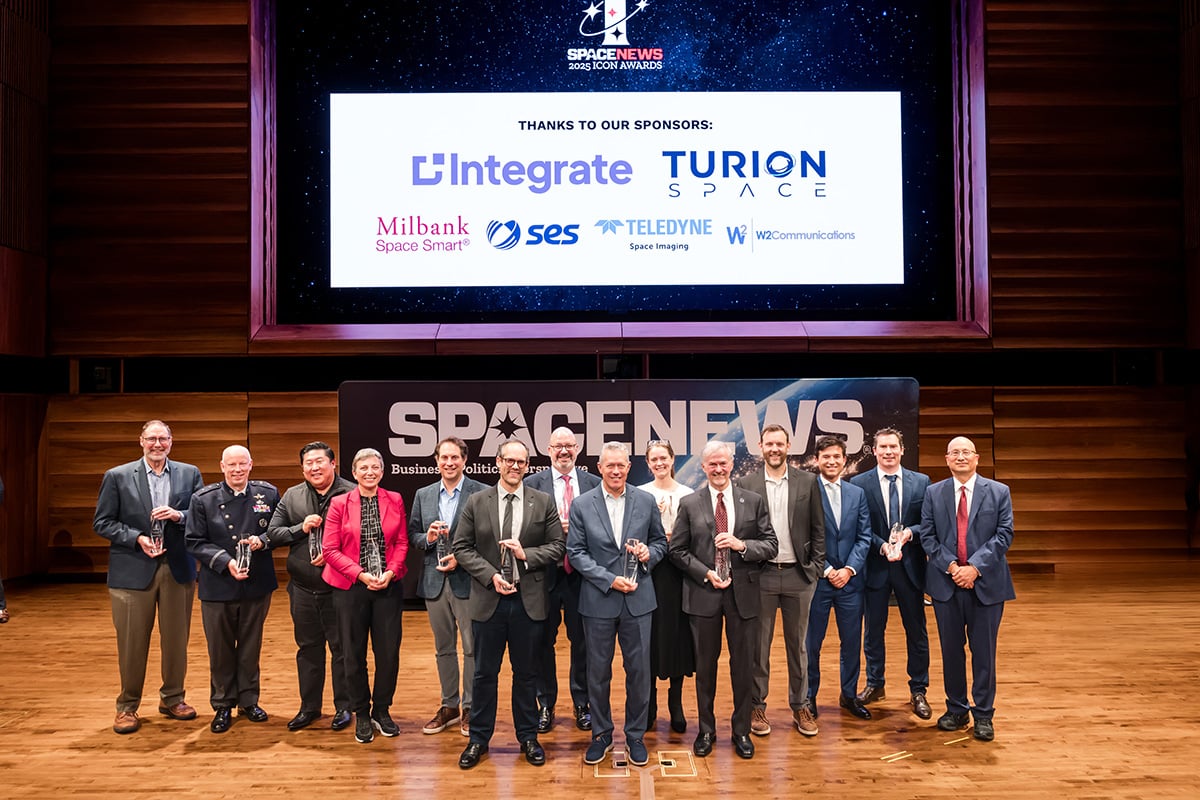 | Meet the 2025 Icon Award Winners: This year's recipients range from a company that successfully landed on the moon to an agency leader who transformed NASA's relationship with industry, making room for commercial lunar landers in the first place. On Tuesday, Dec. 2 in Washington D.C., we awarded this year's Icon Awards during a program at the Johns Hopkins University Bloomberg Center. Learn more about what made this year's class stand out. | | |
|
|
|
Compromise NDAA zeroes in on space acquisitions, launch infrastructure
The leaders of the House and Senate Armed Services Committees late on Sunday released the text of the final National Defense Authorization Act for Fiscal Year 2026. The package represents the compromise version crafted after reconciling competing House and Senate drafts, reflecting the trade-offs needed to secure bipartisan support ahead of floor votes in both chambers.
The bill includes a series of space-related directives related to the Space Force's acquisition enterprise, DoD's responsibilities in space warfighting and plans for long-term national launch infrastructure needs. Lawmakers direct the Department of the Air Force to build a more deliberate Space Force acquisition workforce. A new statutory requirement mandates that newly trained officers be assigned in a way that sustains acquisition billets on par with operational slots. The department must brief Congress annually through 2030 on manning levels and any gaps that could undermine program execution. Congress also codifies a mandate for the Pentagon to acquire and operate dedicated systems for space warfighting and space control. The bill instructs DoD to field capabilities that meet combatant-command requirements, while allowing commercial systems to augment those missions only under the direction of a uniformed space operations commander. Launch infrastructure receives significant attention. A new Spaceport of the Future initiative tasks the Pentagon with a long-range plan for national launch capacity, including assessments of Cape Canaveral Space Force Station and Vandenberg Space Force Base, plus detailed analysis of potential alternate launch sites. The effort requires annual updates through 2031 on project status, costs, environmental constraints and regulatory hurdles. Additional provisions call for noise-mitigation measures tied to launch operations and standardized blast-damage assessment guidance for Air Force launch complexes. "We've worked together to deliver the most significant acquisition reforms in a generation — cutting red tape, accelerating decision-making, and improving our ability to get modern capabilities into the hands of our troops on time and on budget," the committees' leaders said on Monday in a joint statement.
| | |
|
|
|
SpaceNews' latest national security coverage
|
|
|
|
|




No comments:
Post a Comment