Plus: China's rapid-fire launch cadence
By Dan Robitzski
Jared Isaacman is one step closer to becoming NASA Administrator — as of this week, his renomination has now reached the same point in the approval process that he reached the first time around before the Trump administration abruptly withdrew his nomination.
The Senate Commerce Committee voted 18-10 to advance Isaacman's nomination to the full Senate Dec. 8, and there's been widespread chatter that Congress will attempt to complete the process before the end of the year. Notable, though, is the fact that some of the votes within the Commerce Committee have shifted. Back in April, the 15 Republican committee members were joined by four Democrats, resulting in a 19-9 vote. This time around, two of those Democrats — John Hickenlooper of Colorado and Andy Kim of New Jersey — said no, while John Fetterman of Pennsylvania, who skipped the hearing but submitted questions, switched from a "no" to a "yes."
One of Fetterman's questions was about NASA's lunar surface power portfolio.
Here's what Isaacman said: "It is imperative that NASA return to the moon before our great competitor and establish the infrastructure necessary to realize the scientific, economic and national security benefits of a sustained presence. That certainly includes solar power, of which I am a strong proponent. That said, not every scientific mission will be able to rely on solar energy — whether due to distance from the Sun in deep space, power-generation requirements (resource manufacturing), or other constraints — which is why I am also a strong advocate for urgent investment in space-based nuclear programs (propulsion and surface power)."
None of the senators offered statements to explain why they changed their mind, but during the hearing they took issue with Project Athena, a recently-leaked planning document Isaacman prepared during his first nomination that, among other things, would direct NASA to lean more heavily on commercial purchases and would take NASA "out of the taxpayer-funded climate science business."
Industry players rallied behind Isaacman's renomination given his vocal support of the commercial sector; the big question now is whether other members of Congress will similarly take issue with his vision.
| | |
|
|
|
SIGNIFICANT DIGIT
| 735 million euros
| The amount ($855.5 million) Poland agreed to contribute to ESA during last month's ministerial, a significant increase from the 198 million euros it committed at the previous ministerial in 2022.
| | |
|
|
|
RAPID-FIRE LAUNCHES FOR CHINA
| China launched six missions in five days this past week, rapidly accelerating the deployment of its Guowang LEO megaconstellation and Yaogan Earth observation satellites — and leaving its previous record for annual launches in the dust. The frequency of launches, which is expected to continue through December, encapsulates how China is now able to reap the benefits of its concerted effort to develop launch capabilities and develop a national space ecosystem that rivals that of the United States and its commercial firms. | | |
|
|
|
| | The Department of the Air Force has approved plans to convert a former Delta 4 launch site at Cape Canaveral into a complex for SpaceX's Starship.
| | | | LeoLabs won an interagency contract to provide space-surveillance data for the U.S. government, supporting adversarial spacecraft monitoring and the TraCSS orbital traffic coordination platform due to enter full service early next year.
|
|
| | Muon Space has secured a $1.9 million contract to develop an infrared sensing payload for missile detection and tracking.
| | | | Gen. Michael Guetlein, the Pentagon official running the Golden Dome missile defense program, pushed back on criticism that the initiative is unfolding behind a curtain of secrecy while companies are being asked to invest in advanced technologies with limited insight into program goals.
|
|
|
|
FROM SPACENEWS | 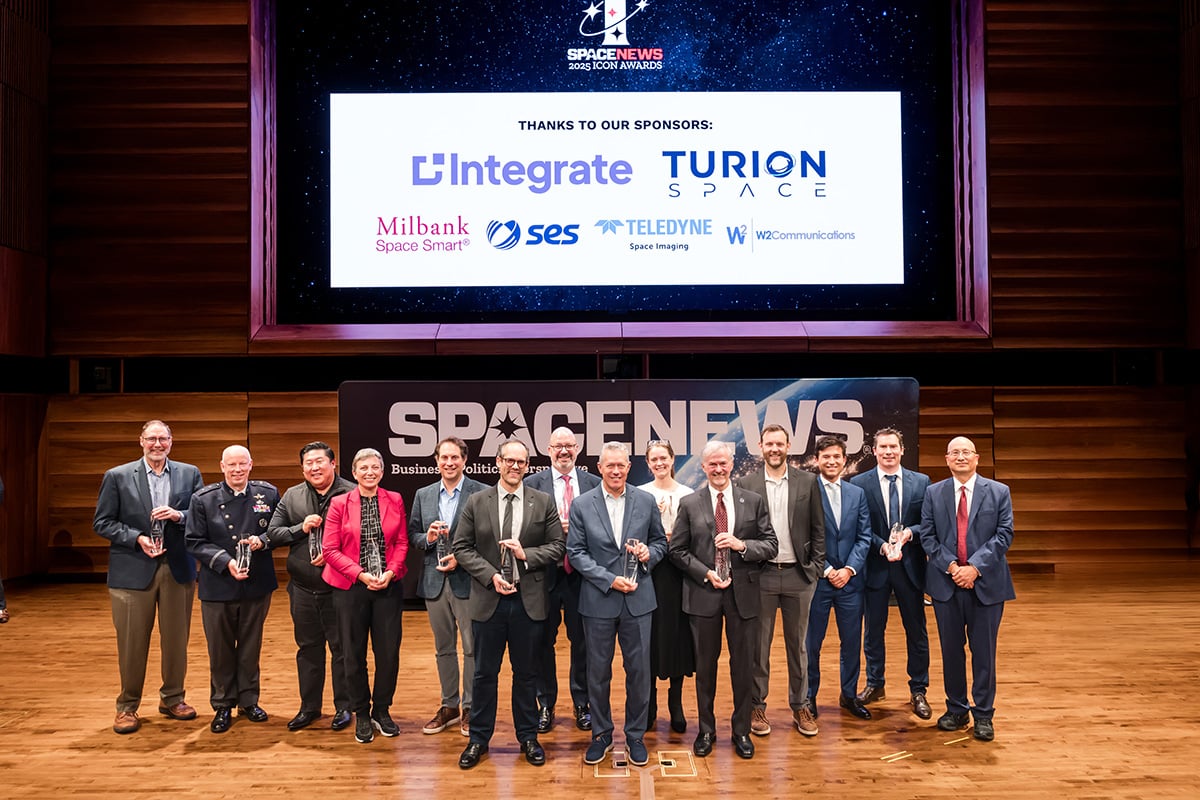 | Meet the 2025 Icon Award Winners: This year's recipients range from a company that successfully landed on the moon to an agency leader who transformed NASA's relationship with industry, making room for commercial lunar landers in the first place. On Tuesday, Dec. 2 in Washington D.C., we awarded this year's Icon Awards during a program at the Johns Hopkins University Bloomberg Center. Learn more about what made this year's class stand out. |
|
|
|
|






No comments:
Post a Comment