Highlights from World Space Business Week
Thanks for a great week in Paris at World Space Business Week in Paris. In lieu of this week's Opinions newsletter, check out the most-read highlights of our conference coverage that you may have missed.
|
|
|
|
SPONSORED |  | At Maxar Space Systems, we enable both commercial and government customers with agile and cost-effective solutions, addressing a broad spectrum of needs to unleash innovation and go beyond the horizon. Learn more about how we are shaping the future of space exploration. | | |
|
|
|
| SpaceX President Gwynne Shotwell said at the World Space Business Week conference Sept. 16 that the company is now working with a wide range of technology and telecom partners to use S-band spectrum SpaceX purchased for $17 billion from EchoStar in cash and stock to begin testing direct-to-device services.
EchoStar is looking for ways to expand its communications business as an "asset-light growth company," CEO Hamid Akhavan said Sept. 15, after regulatory pressure prompted a series of spectrum sales in what he called a "forced pivot" away from deploying a low Earth orbit direct-to-device constellation.
In a presentation at the World Space Business Week conference Sept. 17, Chris Kemp, chief executive of Astra, said the company was on track for a first launch of Rocket 4 in summer 2026 from Cape Canaveral, Florida.
During a briefing held in conjunction with World Space Business Week, company executives discussed the March 30 launch of Spectrum from the Andøya Spaceport in northern Norway, when the vehicle activated its flight termination system roughly 30 seconds after liftoff. The company is now working towards a second flight of Spectrum. The first stage of that vehicle is at Andøya for pre-launch tests while the second stage completes assembly at Isar's factory in Germany.
Executives speaking at a Sept. 15 panel at the World Space Business Week conference highlighted efforts to scale up flights of new vehicles that have entered service in the last two years, reiterating plans to sharply increase flight rates to meet growing government and commercial demand, even as some fall short of earlier projections.
| | |
|
|
|
| Expanding defense budgets and the direct-to-device race are driving growth in the global space economy, Novaspace CEO Pacôme Révillon, said at the outset of the World Space Business Week conference.
Canada's Telesat is pitching Lightspeed as a bridge to IRIS² as its low Earth orbit broadband constellation is set to come online in 2027, at least three years before Europe's sovereign multi-orbit network is due to enter service.
Europe should be investing in disruptive capabilities like spaceplanes, said Maj. Gen. Philippe Koffi, French armament agency DGA strategic lead for air, land and naval combat. At the Paris Air Show in June, Dassault Aviation announced an agreement with DGA to develop VORTEX, a four-meter-long spaceplane demonstrator with a mass of less than one metric ton. A first flight is expected in 2028.
Viasat and Space42 have agreed to pool their Mobile Satellite Services spectrum, aiming to provide direct-to-device services from the world's largest coordinated block of D2D frequencies within three years.
Amazon is preparing to double the size of its Project Kuiper constellation to over 200 satellites this year with three more launches, supporting broadband services in the U.S. and four other countries by the end of March. |
|
|
|
| | 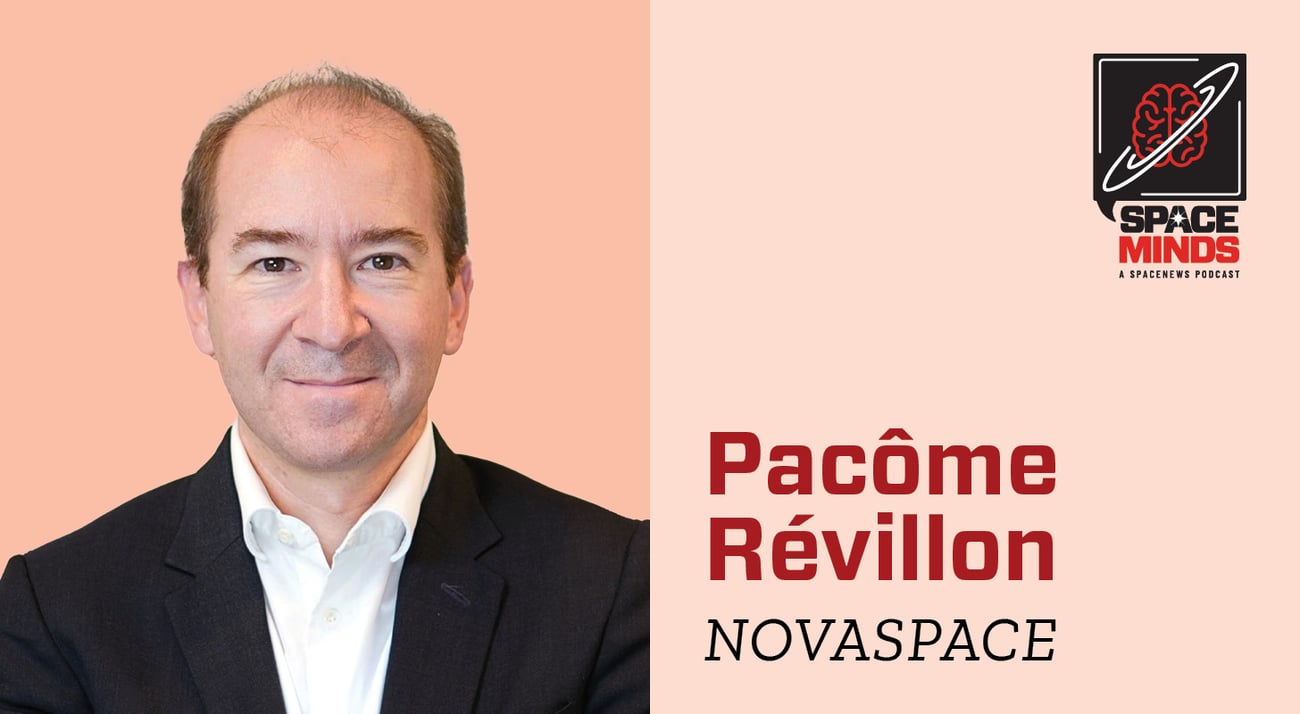 | For our CEO Series of Space Minds, we're at World Space Business Week in Paris. In this episode, SpaceNews' Mike Gruss talks with Novaspace CEO Pacôme Révillon. They discuss the accelerating race in direct-to-device satellite communications, the surge in defense spending and dual-use technologies and the growing role of sovereignty in global space strategies. Révillon also shares insights on consolidation trends within the industry, the future of AI in space applications and predictions for what's ahead in launch and defense markets. |
|
|
|
|













No comments:
Post a Comment