| By Jeff Foust
In today's edition: Umbra gets in the satellite component business, DiskSats prepare for flight, companies work on making smallsats smarter and more.
If someone forwarded you this edition, sign up to receive it in your inbox every weekday. Have thoughts or feedback? You can hit reply to let me know.
| | | | | | Top Stories
Synthetic aperture radar (SAR) company Umbra is expanding into the satellite components business. Umbra announced Monday it was creating a new business unit, Space Systems, that will sell components it makes for its own SAR satellites. Those components cover subsystems such as power, attitude control, communications and separation systems. All components have either flown on orbit or are scheduled to fly in upcoming missions. Umbra said it created the new business line to address persistent supply chain bottlenecks in the U.S. satellite industry, where buyers often face limited qualified suppliers, long lead times and reliance on foreign vendors. [SpaceNews]
Booz Allen Hamilton's venture capital arm is seeking to ramp up space investments after tripling its funding pool to $300 million. The company said last month it was increasing its venture capital investments after deploying nearly all of its original pool of $100 million created in 2022. Although just three of its 17 portfolio companies currently focus on space, Booz Allen Ventures sees growing opportunity in the sector, from improving space domain awareness to bolstering border security and modernizing the U.S. military. Now, it is looking for infrastructure opportunities that support the shift toward proliferated systems of small satellites that promise greater resilience and real-time responsiveness. [SpaceNews]
Smallsat manufacturer NOVI plans to develop spacecraft for Earth observation services. The company said Monday that its first two Geospatial Ecosystem for Near Real-Time Information at the Edge, or GENIE, spacecraft are scheduled to fly in early 2026 on SpaceX's Transporter-16 and Transporter-17 rideshare missions to low Earth orbit. NOVI builds satellites equipped with onboard computers that analyze data directly in space, reducing the amount of data that needs to be transmitted to the ground. The company aims to serve a mix of customers, he said, including those who need quickly analyzed satellite data and those who want to develop and test artificial intelligence algorithms on NOVI's orbital platforms. [SpaceNews]
Geopolitical shifts are creating new opportunities but also new problems for European smallsat manufacturers. A surge in defense spending in Europe is expected to translate into more satellite contracts for those companies, executives said at a recent conference. They noted, though, that companies have to navigate procurement processes that vary from country to country within Europe and often show a preference for firms based in their home nation. An emerging challenge for those companies is tariffs levied by the U.S. on imports of European satellites and components. That creates problems for their supply chains and increased costs that often are passed on to customers. [SpaceNews]
French satellite antenna manufacturer Anywaves is setting up a U.S. subsidiary. Anywaves US, led by former Mangata Networks vice president of global strategy Nicolas Hine, is evaluating potential sites for offices and, eventually, manufacturing facilities. The creation of Anywaves US is part of a multinational strategy by Anywaves to better serve customers in their local markets. [SpaceNews]
The first DiskSats are scheduled to launch later this year. The Aerospace Corporation, which developed the smallsat bus that, as the name suggests, is shaped like a disk, said four DiskSats will launch on a Rocket Lab Electron from Wallops Island, Virginia, before the end of the year. That launch was scheduled for 2026 but moved up at the request of the customer, NASA's Space Technology Mission Directorate. The DiskSat design is intended to optimize satellite volume and surface area. [SpaceNews]
Kongsberg Satellite Services, or KSAT, announced plans Monday to extend its ground-based communications network into space. Satellites called Hyper, currently being developed, will be added to KSAT's communications infrastructure to reduce latency for time-sensitive data. KSAT said the satellites will be deployed into orbital planes, or "Loops," intended to serve as extensions of KSAT's ground network. KSAT called the satellite system a "precision augmentation layer" to close coverage gaps and reduce latency. Details on the Hyper rollout, including the number of satellites to be sent to low Earth orbit, will be disclosed in the fall. [SpaceNews]
| | | | SPONSORED | | | |  | | Take your mission from concept to cosmos with the Blue Canyon Technologies Saturn-400, now the largest offering in our line of spacecraft. Designed for high-agility missions, demanding power needs, cislunar applications and high delta-V configurations, the Saturn-400 features: -
Low-jitter, advanced spacecraft agility enabled by Blue Canyon's reaction wheel or control moment gyroscope technology -
Increased payload capacity -
Higher power and volume scaling -
Heritage design that reduces program risk. -
Flexible mission capability in dynamic environments.
The Saturn-400 is intentionally engineered with customizable features to meet your mission needs, supporting higher-impact missions with greater capability at still a fraction of traditional costs. Learn more.
| | | | | | Other News
A Falcon 9 launched a second batch of Project Kuiper satellites as SpaceX nears that vehicle's peak launch date. The Falcon 9 lifted off from Cape Canaveral at 8:35 a.m. Eastern Monday, putting 24 Kuiper satellites into orbit. The launch was the second of three under a contract between SpaceX and Amazon. SpaceX has performed nearly 100 Falcon 9 launches this year and is on track for about 160 launches in 2025. A company executive said at a conference last month that this year and next will be the peak of Falcon launches as SpaceX expects to start moving launches to its Starship vehicle after that. [SpaceNews]
United Launch Alliance is on track for its first national security Vulcan Centaur launch tonight. Liftoff of the Vulcan on the USSF-106 mission is scheduled for 7:59 p.m. Eastern from Cape Canaveral, with a one-hour launch window. The launch will carry Navigation Technology Satellite (NTS) 3 for the Air Force Research Laboratory. NTS-3, built by L3Harris Technologies, is a $250 million, 1,250-kilogram geostationary mission designed to demonstrate advanced positioning, navigation and timing technologies. Vulcan, equipped with four strap-on boosters, will deploy NTS-3 directly into geostationary orbit. [SpaceNews]
Smallsat launch services provider SEOPS will offer customers on-orbit spacecraft identification and tracking services. Two months of satellite identification, tracking and collision-avoidance services will be provided free of charge by India-based space situational awareness specialist Digantara, the companies announced Monday. The service will help customers identify and establish contact with their satellites 24 to 48 hours after deployment, a critical phase in those satellites' missions. SEOPS said many of its customers have had difficulties making early contact with their satellites, particularly on rideshare missions when dozens of spacecraft are deployed at once. [SpaceNews]
LeoLabs has signed an agreement with NASA where the agency will evaluate the use of LeoLabs data in its collision avoidance processes. Under the agreement, NASA's Conjunction Assessment Risk Analysis (CARA) program will review LeoLabs' satellite tracking data and test whether the data can be combined with tracking information from the U.S. Department of Defense's Space Surveillance Network (SSN) to improve the accuracy of close-approach risk assessments. NASA currently relies on SSN data for its CARA program, which provides collision risk assessments and maneuver recommendations for the agency's spacecraft, including crewed missions. [SpaceNews]
Belgian startup Edgx has raised a seed round for work on onboard artificial intelligence systems. The company announced 2.3 million euros ($2.7 million) in venture funding Monday, supporting an in-orbit demonstration slated to fly on a SpaceX Falcon 9 in February. Edgx is developing Sterna, an artificial intelligence computer designed to run complex algorithms onboard satellites to speed decisions and use limited bandwidth more efficiently. Sterna can be used on spacecraft as small as 12U cubesats, helping spacecraft process data in real time and transmit only valuable information to optimize scarce spectrum. [SpaceNews]
Ascending Node Technologies has added a constellation-design tool to its Spaceline mission-planning software. Spaceline's constellation tool can accomodate customers sending satellites into multiple orbits around Earth or other planets. The company, founded by three people who worked on the design of the NASA OSIRIS-REx asteroid sample return mission, is also testing optimization algorithms to help users design the right constellation for their mission needs. [SpaceNews]
A fragment of an asteroid older than the Earth nearly hit a Georgia man. Meteorites from a fireball seen across much of the southeastern U.S. June 26 hit a house in McDonough, Georgia, south of Atlanta. The fragments went through the roof of the house and made a dent in laminate flooring, missing the person living there by just a few meters. Analysis of the meteorites show they are 4.56 billion years old, or slightly older than the Earth itself. They are linked to a family of asteroids in the main belt created by the breakup a much larger asteroid about 470 million years ago. [New York Times]
| | | | | | A Galaxy for a Dollar
| "Over the two-year planned mission, the SPHEREx observatory will collect data on more than 450 million galaxies. That's just less than one galaxy per dollar, by the way. A very, very economical mission."
| | – Nicky Fox, NASA associate administrator for science, discussing the SPHEREx astrophysics mission launched earlier this year during a keynote Monday at the Small Satellite Conference.
| | | | | | | FROM SPACENEWS | 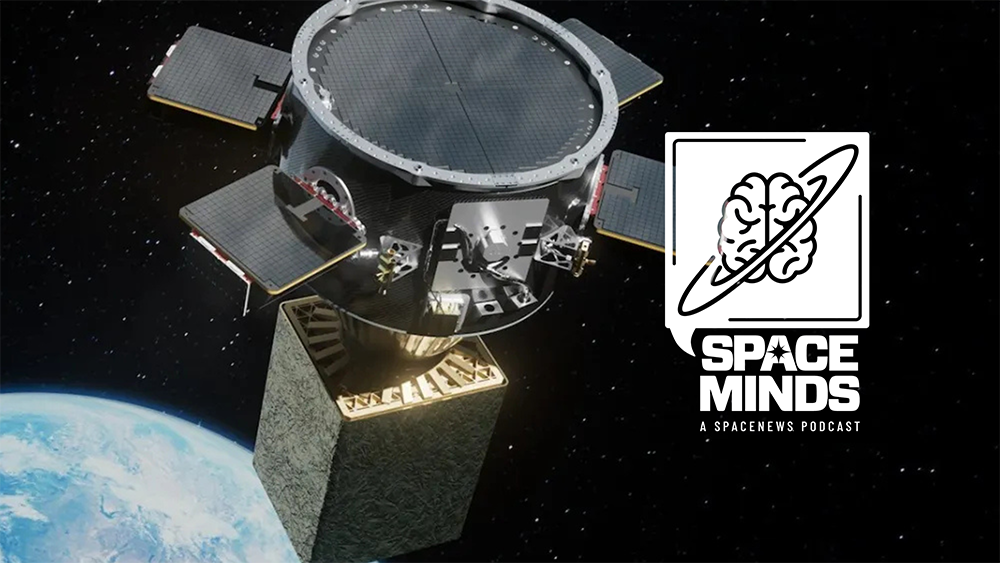 | | The evolution of multi-mission orbital vehicles: In this episode of Space Minds, catch SpaceNews' Jeff Foust panel discussion with Space Force and Firefly Aerospace leaders on what it takes to create agile, high-delta-V spacecraft capable of fulfilling multiple operational roles in orbit. Tune in for insights on the future of spacecraft modularity, propulsion innovations, and the real challenge: changing the mindset of space acquisition. | | | | | | | 🚀 🕑 🎧 Don't miss SpaceNews' FirstUp Audio
The day's most important space headlines delivered in less than 10 minutes every Monday-Friday. Listen on our website, YouTube, Apple Podcasts, Spotify or your favorite podcast app.
| | | | | | Sign up for our other newsletters -
Military Space: Veteran defense journalist Sandra Erwin delivers news and insights for the military space professional. Delivered Tuesday. -
China Report: Analysis of China's space activities and what it means as one of the United States' top competitors from correspondent Andrew Jones. Delivered every other Wednesday. -
SpaceNext AI: Exploring the intersection of space and artificial intelligence. Delivered Thursday.
-
SpaceNews This Week: A round-up of the week's top stories, including our conference coverage. Delivered Friday. -
Video & Audio: Upcoming live programs, scheduled guests, and recent Space Minds podcast episodes, webinars and other events. Delivered Friday. -
Marketing Minute: Covering PR, marketing, and advertising trends, upcoming SpaceNews opportunities, and editorial insights for communications and marketing leaders. Delivered monthly. | | | | |









No comments:
Post a Comment