| By Sandra Erwin
Welcome to this week's edition of SpaceNews' Military Space, your source for the latest developments at the intersection of space and national security. In this week's edition: space-based interceptors, rocket motors and AI are in play for Golden Dome. Plus, space is the next battlefield for Army recruits
If someone forwarded you this edition, sign up to receive it directly in your inbox every Tuesday. And we're eager to hear your feedback and suggestions. You can hit reply to let me know directly. | | | | | | Golden Dome looms large at Huntsville missile defense meeting — without being named
At last week's Space & Missile Defense Symposium in Huntsville, Alabama, one subject overshadowed all others, even as speakers avoided saying its name. The Trump administration's Golden Dome initiative, billed as the largest U.S. missile defense investment in decades, is reshaping priorities across the Pentagon and industry.
Government officials at the event with record-setting attendance were told not to mention Golden Dome directly, instead referring to "next-generation systems," "advanced capabilities," "integrated air and missile defense," and "protection of the homeland." The program aims to build a layered shield against threats ranging from hypersonic weapons to intercontinental ballistic missiles from China, Russia and North Korea.
Even in its early, largely undefined phase, Golden Dome is driving budget changes that the Aerospace Corporation's Center for Space Policy and Strategy calls the most significant since the Space Force's creation in 2019.
The program is lifting the Space Force's fiscal 2026 budget to about $40 billion, with $15.7 billion directly tied to Golden Dome under the "One Big Beautiful Bill Act." Major contractors are already aligning for the work:
• Lockheed Martin is developing concepts for space-based missile interceptors (SBIs) and aims for an orbital demonstration by 2028. The company sees SBIs as a "first line of defense" during the boost phase, faster than ground- or sea-based interceptors, but officials say the command-and-control challenge is unprecedented.
• Northrop Grumman is pointing to its $1 billion investment in solid rocket motor production — propulsion systems central to kinetic interceptors in Golden Dome's layered design. The company also plans to propose SBI designs.
• NASA's Marshall Space Flight Center, located in Huntsville, is pitching dual-use technologies in propulsion, propellant management and AI-based spacecraft control that could support Golden Dome development.
Experts' take: While placing sensors and missile interceptors in space is seen as technically viable, the harder problem is integrating global sensor data quickly enough to assign interceptors within seconds.
| | | | | | Army building space cadre
U.S. Army leaders in Huntsville last week discussed the service's plan to recruit soldiers interested in becoming space operators. For years, service officials have argued that ground units need their own space experts as satellites become central to combat. -
The new 40 Delta Space Operations Specialist role will start recruiting in early 2026, with soldiers training in Colorado Springs, Colorado. Full operational capability is expected by October 2026. -
The move is part of a broader plan to stand up a dedicated "space branch" of about 1,000 soldiers and officers — akin to Infantry or Armor — to secure funding, develop doctrine, and keep expertise in-house. -
The push follows lessons from Ukraine, where jamming, cyberattacks and satellite disruptions are routine. Army units have already been fielding tools like BADGR, a backpack-sized electronic attack system designed in-house. Critics call this an encroachment on the Space Force. Army brass say it's about speed — getting satellite intel and space-based threat warnings to troops in seconds, without waiting for outside help.
| | | | | | Logistics gap in orbit
The head of U.S. Space Command wants the Pentagon to stop treating satellites like disposable cars and start building the kind of logistics backbone that keeps ships sailing and jets flying.
Speaking at the Space & Missile Defense Symposium, Gen. Stephen Whiting said the United States needs "sustained space maneuver" — the ability to refuel, repair and reposition satellites — if it's going to keep an edge against China and other adversaries developing anti-satellite weapons. -
Right now, Whiting said, "if we run out of gas and get a proverbial flat, we're not refueling or changing out the component. We're buying a new car, a new satellite." That means U.S. spacecraft are locked into predictable orbits and finite lifespans — a vulnerability adversaries can exploit. -
China, meanwhile, is demonstrating in-space refueling tech, a sign the People's Liberation Army wants its own orbital logistics chain. The ongoing debate inside the Space Force: is it better to build a servicing-and-refueling architecture for key assets in geosynchronous orbit — especially space situational awareness satellites — or stick with cheaper, short-lived spacecraft and replace them as needed? Whiting's pitch: whoever masters space logistics first "may hold a decisive advantage" in a future orbital fight. | | | | | | SpaceNews' latest national security coverage
| | | | | | | FROM SPACENEWS | 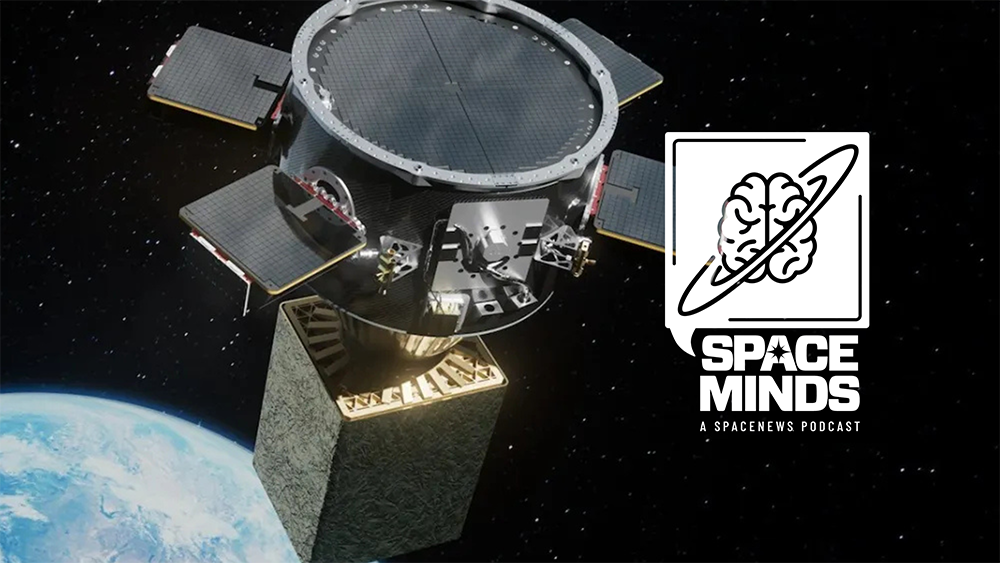 | | The evolution of multi-mission orbital vehicles: In this episode of Space Minds, catch SpaceNews' Jeff Foust panel discussion with Space Force and Firefly Aerospace leaders on what it takes to create agile, high-delta-V spacecraft capable of fulfilling multiple operational roles in orbit. Tune in for insights on the future of spacecraft modularity, propulsion innovations, and the real challenge: changing the mindset of space acquisition. | | | | | | Sign up for our other newsletters -
First Up: The latest civil, commercial and military space news, curated by veteran journalist Jeff Foust. Delivered Monday to Friday mornings. -
China Report: Analysis of China's space activities and what it means as one of the United States' top competitors from correspondent Andrew Jones. Delivered every other Wednesday. -
SpaceNext AI: Exploring the intersection of space and artificial intelligence. Delivered Thursday. -
SpaceNews This Week: A round-up of the week's top stories, including our conference coverage. Delivered Friday. -
Video & Audio: Upcoming live programs, scheduled guests, and recent Space Minds podcast episodes, webinars and other events. Delivered Friday. -
Marketing Minute: Covering PR, marketing, and advertising trends, upcoming SpaceNews opportunities, and editorial insights for communications and marketing leaders. Delivered monthly. | | | | |








No comments:
Post a Comment