By Jeff Foust
In today's edition: a White House executive order revamps commercial space regulation, a retiring general's thoughts about the Space Force, insurers return to the space market and more.
If someone forwarded you this edition, sign up to receive it in your inbox every weekday. Have thoughts or feedback? You can hit reply to let me know.
| | |
|
|
|
Top Stories
An executive order released by the White House Wednesday will reshape commercial space regulation. The order makes a series of changes to launch, spaceport and other regulations with the intent of "enabling a competitive launch marketplace and substantially increasing commercial space launch cadence and novel space activities" by 2030. The order directs the FAA to "reevaluate, amend, or rescind, as appropriate" the existing Part 450 launch and reentry licensing regulations that many in the industry have complained about. It would scale back environmental regulations involving launch and spaceport projects. It also directs the Commerce Department to establish a mission authorization system for "novel space activities" not currently regulated by other agencies. The order makes some administrative changes, such as moving the Office of Space Commerce from NOAA to the office of the Secretary of Commerce. The executive order, widely expected for weeks, was praised by companies and industry groups, but other groups criticized the rollback of environmental regulations. [SpaceNews]
A retiring Space Force general says the service has made great progress since being established in 2019 but needs more funding. Lt. Gen. DeAnna Burt, deputy chief of space operations for operations, cyber and nuclear, is retiring on Oct. 1 after 33 years of service. In an interview, she said she believed the Space Force was adapting to an environment where space is an increasingly contested domain, and expected it would play a major role in the Golden Dome missile defense system. She said one challenge has been budgets that have failed to grow sufficiently even as officials proclaim the importance of space. She called for constant growth in annual funding for the Space Force. [SpaceNews]
Military satellite operators are still determining what can be automated even as the capabilities to do so grow. During a side meeting at this week's Small Satellite Conference, panelists agreed that satellite maintenance and routine communications should be automated, an acknowledgement that is particularly important given limited government funding and personnel to manage day-to-day satellite operations. Collision avoidance is another task that could be automated, panelists said. Such automation faces challenges in the form of limitations on in-space computing capabilities and communications. [SpaceNews]
Norway's Kongsberg Defence & Aerospace (KDA) is preparing to expand its small satellite footprint over the Arctic. The company, which acquired smallsat manufacturer NanoAvionics in 2022, is seeing rising surveillance and communications needs as the strategic importance of the Arctic grows. KDA recently deployed its first three satellites, built in-house by what is now called Kongsberg NanoAvionics, with radar detection and Automatic Identification System (AIS) payloads to provide maritime monitoring data to the Norwegian government and allied nations. The company is also looking to combine its Arctic space capabilities with a broader Kongsberg portfolio that also includes underwater monitoring systems and autonomous ships. [SpaceNews]
Impulse Space says a bet it made a year ago on a GEO rideshare program has paid off. The company announced last year it would offer rideshare services for GEO smallsats using its high-energy Helios orbital transfer vehicle, stating at the time it wanted to see what kind of demand there would be. At the Small Satellite Conference this week, Impulse said that demand has materialized, with the first of what it calls Caravan missions fully booked for launch on a Falcon 9 in the third quarter of 2026. The company will offer Caravan missions annually, taking up to four tons of payloads to GEO and deploying them just above the GEO arc eight hours after launch. [SpaceNews]
Insurers who pulled out of the space business after a string of large claims are coming back. Several underwriters left the space insurance market after $2 billion in reported claims from incidents in 2023. Some insurers are returning, though, as insurance rates climb and some reported claims have been reduced after efforts to restore capability to affected satellites. However, there is a danger of underwriting discipline slipping in the future, as the market needs to earn $500–600 million annually to remain viable. [SpaceNews]
| | | SPONSORED |
|
|
|
 | Take your mission from concept to cosmos with the Blue Canyon Technologies Saturn-400, now the largest offering in our line of spacecraft. Designed for high-agility missions, demanding power needs, cislunar applications and high delta-V configurations, the Saturn-400 features: Low-jitter, advanced spacecraft agility enabled by Blue Canyon's reaction wheel or control moment gyroscope technology Increased payload capacity Higher power and volume scaling Heritage design that reduces program risk. Flexible mission capability in dynamic environments.
The Saturn-400 is intentionally engineered with customizable features to meet your mission needs, supporting higher-impact missions with greater capability at still a fraction of traditional costs. Learn more.
| | |
|
|
|
Other News
SpaceX launched a set of Starlink satellites overnight after days of delays. A Falcon 9 lifted off from Vandenberg Space Force Base in California at 1:05 a.m. Eastern Thursday and placed 24 Starlink satellites into orbit. The launch was the first Falcon 9 mission from Vandenberg in two weeks, and this launch had slipped several days for undisclosed reasons. [Spaceflight Now]
SpaceX says it is offering customers of its rideshare services additional schedule flexibility. The company, in a presentation this week at the Small Satellite Conference, said it has launched more than 1,400 satellites since starting its rideshare program five years ago, using both dedicated launches and excess capacity on other launches. Customers facing satellite delays have the ability to easily rebook their launch on a later mission, officials said. In addition, SpaceX is offering "bridge contracts" that allow customers to move up to an earlier launch if space becomes available on it. [SpaceNews]
Rogue Space Systems is growing and reorganizing ahead of a 2027 mission. The space logistics company hired Brook Leonard, a retired U.S. Space Force major general, as CEO, with former CEO Jon Beam becoming president and chief strategy officer. The 30-person company expects to expand its workforce by about one-third in the next quarter as it works on projects like two ESPA-class Orbot satellites, scheduled for launch in 2027. Those satellites will demonstrate rendezvous, proximity operations and docking, refueling and will offer room for hosted payloads. [SpaceNews]
Two Chinese astronauts are preparing for another spacewalk. The China Manned Space Agency said two members of the Shenzhou-20 crew are preparing for a spacewalk outside the Tiangong space station in "the next few days." Such announcements usually come within a day or so of the planned spacewalk. The announcement did not disclose which astronauts would perform the spacewalk, the third since arriving at the station in April, or their planned tasks. [Xinhua]
New Mexico's Spaceport America is touting the economic impact it has on the region. A study released this week by the spaceport and New Mexico State University concluded the spaceport had a total economic impact of $240 million in 2024, up from $72 million in 2019. It supported more than 300 direct jobs and 800 total jobs from the spending created by that economic activity. [KTSM-TV El Paso, Texas]
If you rode crypto to the moon, now you can use it to fly to the Kármán Line. Payment processing company Shift4 announced this week an agreement with Blue Origin to allow customers to pay for flights on the New Shepard suborbital vehicle using cryptocurrencies such as bitcoin and Ethereum. The companies said the agreement will allow Blue Origin to "tap into a growing user base of crypto holders" interested in flying to space. Virgin Galactic announced in 2013 it would accept bitcoin for flights on its suborbital vehicles. [Shift4]
| | |
|
|
|
Really, Really Big
| "Space is big. That's what I've heard. I haven't been up there."
| – Dmitry Poisik, program manager of the TraCSS space traffic coordination system, during a panel discussion on space sustainability at the Small Satellite Conference on Wednesday.
| | |
|
|
|
FROM SPACENEWS | 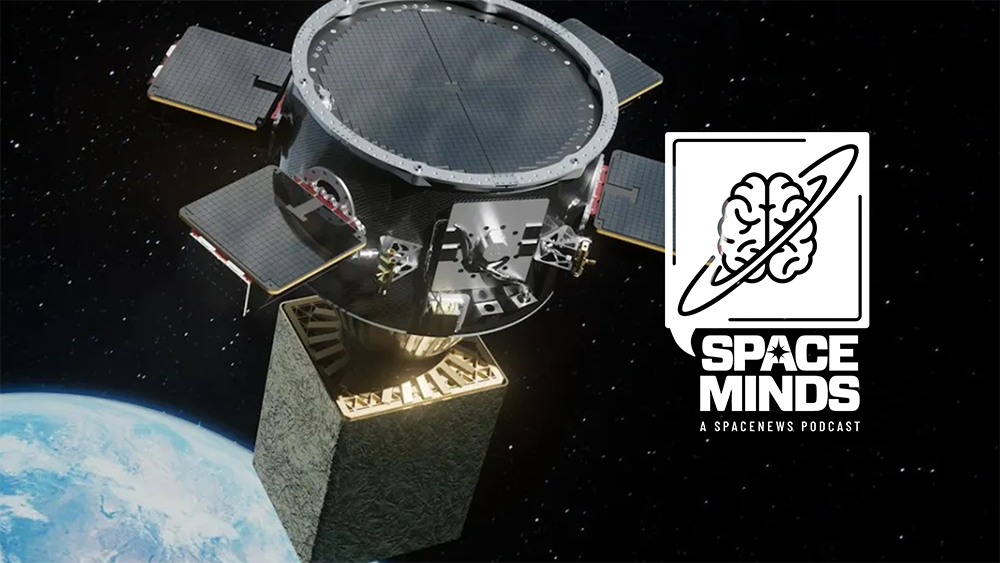 | The evolution of multi-mission orbital vehicles: In this episode of Space Minds, catch SpaceNews' Jeff Foust panel discussion with Space Force and Firefly Aerospace leaders on what it takes to create agile, high-delta-V spacecraft capable of fulfilling multiple operational roles in orbit. Tune in for insights on the future of spacecraft modularity, propulsion innovations, and the real challenge: changing the mindset of space acquisition. | | |
|
|
|
🚀 🕑 🎧 Don't miss SpaceNews' FirstUp Audio
The day's most important space headlines delivered in less than 10 minutes every Monday-Friday. Listen on our website, YouTube, Apple Podcasts, Spotify or your favorite podcast app.
| | |
|
|
|
Sign up for our other newsletters Military Space: Veteran defense journalist Sandra Erwin delivers news and insights for the military space professional. Delivered Tuesday. China Report: Analysis of China's space activities and what it means as one of the United States' top competitors from correspondent Andrew Jones. Delivered every other Wednesday. SpaceNext AI: Exploring the intersection of space and artificial intelligence. Delivered Thursday.
SpaceNews This Week: A round-up of the week's top stories, including our conference coverage. Delivered Friday. Video & Audio: Upcoming live programs, scheduled guests, and recent Space Minds podcast episodes, webinars and other events. Delivered Friday. Marketing Minute: Covering PR, marketing, and advertising trends, upcoming SpaceNews opportunities, and editorial insights for communications and marketing leaders. Delivered monthly. |
|
|
|
|












No comments:
Post a Comment