By Jeff Foust
In today's edition: a Chinese launch failure, SpaceX complains about broadband subsidies, studies to save a NASA astrophysics spacecraft and more.
If someone forwarded you this edition, sign up to receive it in your inbox every weekday. Have thoughts or feedback? You can hit reply to let me know.
| | |
|
|
|
Top Stories
A Chinese commercial Zhuque-2 rocket failed to reach orbit in a launch Thursday. The Zhuque-2E methane-liquid oxygen rocket, built by Landspace, lifted off at around 9:17 p.m. Eastern from the Jiuquan Satellite Launch Center. Video of the launch showed a white plume coming from the vehicle less than two minutes after liftoff. Landspace confirmed the loss of the mission more than eight hours after liftoff but did not disclose details about the failure. Landspace did not identify the payloads on board. The launch was the sixth launch of the Zhuque-2 series and ended a run of four successful flights after the failure of its inaugural launch in late 2022. [SpaceNews]
Landspace is among the Chinese launch companies proposing to go public. Landspace filed preliminary documents with the Shanghai Stock Exchange's tech-focused STAR Market in late July, potentially eyeing an IPO in early 2026. Separately, CAS Space has completed IPO counseling with regulators, a first step towards going public on the STAR Market. CAS Space flies solid rockets and is developing its first reusable liquid propellant rockets, as well as working on suborbital rockets for science payloads and space tourism. The company reported $34 million in revenue but $105 million in losses in 2024, with an additional $43 million in losses in the first half of 2025. [SpaceNews]
The FAA has dismissed the entire membership of a commercial space advisory group. Members of the Commercial Space Transportation Advisory Committee (COMSTAC) received letters this week informing them that their membership on the committee had been terminated. The letters did not explain why the members were being removed from COMSTAC. A Department of Transportation spokesperson said it was part of a broader effort by the department to "reconstitute" membership of its advisory boards, including COMSTAC. The committee, with more than 20 members, last met in September 2024, discussing regulatory and other issues related to commercial space transportation. [SpaceNews]
SpaceX says it is being shut out of a program in Virginia to provide rural broadband services. Virginia picked SpaceX's Starlink for around 4% of the roughly 127,000 locations under consideration for subsidized installations under BEAD, or Broadband Equity, Access, and Deployment, despite Trump administration efforts to give satellites equal footing with fiber. The company claims it was unfairly denied the ability to serve more users, noting that 95% of BEAD locations in the state already have a Starlink subscriber within one mile. Amazon's proposed Project Kuiper LEO constellation, still in early phases of deployment, is in line for $4.5 million of the subsidies for 6,957 locations, more than the $3.3 million SpaceX would get for 5,579 sites. [SpaceNews]
Despite rapidly growing revenues, SpaceX is paying little or no taxes. An analysis of internal company documents found that SpaceX has nearly $3 billion in losses in previous years that can be applied against taxes it owes in future years, known as a net operating loss carryforward. SpaceX has told investors that "more likely than not that some portion or all of the deferred tax assets will not be realized," meaning that the company thinks it may never need to pay federal taxes. Financial analysts say the size of that carryforward is unusually large, particularly for a company that does large amounts of business with the government. The documents show that nearly 84% of the company's revenue in 2020 came from federal contracts. [The New York Times]
The Space Force will assume control of all space missions currently handled by Air National Guard units by Oct. 1. Air Force Secretary Troy Meink ordered the shift in a recent memo, directing that space missions handled by Guard units shift to the Space Force. About 578 Guard positions are affected. The move undercuts proposals to create a Space National Guard. Instead, the Space Force is rolling out a single-component personnel model combining both full-time and part-time service. [SpaceNews]
| | | SPONSORED |
|
|
|
 | Take your mission from concept to cosmos with the Blue Canyon Technologies Saturn-400, now the largest offering in our line of spacecraft. Designed for high-agility missions, demanding power needs, cislunar applications and high delta-V configurations, the Saturn-400 features: Low-jitter, advanced spacecraft agility enabled by Blue Canyon's reaction wheel or control moment gyroscope technology Increased payload capacity Higher power and volume scaling Heritage design that reduces program risk. Flexible mission capability in dynamic environments.
The Saturn-400 is intentionally engineered with customizable features to meet your mission needs, supporting higher-impact missions with greater capability at still a fraction of traditional costs. Learn more.
| | |
|
|
|
Other News
SpaceX launched a set of Starlink satellites Thursday morning. A Falcon 9 lifted off from Cape Canaveral at 8:29 a.m. Eastern, placing 28 Starlink satellites into orbit. The booster landed on a droneship to complete its 10th flight. [Space.com]
A California commission has, as expected, voted to block an increase in SpaceX launches from Vandenberg Space Force Base. The California Coastal Commission voted unanimously to oppose a proposal to increase the number of Falcon 9 launches from 50 to 95 per year, plus five Falcon Heavy launches annually. Members said they opposed the increase because of a lack of data on environmental impacts. They acknowledged, though, that their opposition is unlikely to block the increase because the military can override it, as it did last year when the commission opposed an increase to 50 launches. [Noozhawk]
China has performed the first static-fire test of the Long March 10 rocket. A shortened first stage test article with seven YF-100K ignited at 3 a.m. Eastern Friday from a pad at the Wenchang spaceport. The test lasted about 30 seconds. The China Manned Space Engineering Office suggested additional tests may follow. The successful test is a key step in the development of the Long March 10, a three-core, three-stage launcher designed for China's crewed lunar landing program. A single-core version, Long March 10A, could start launching as soon as next year. [SpaceNews]
Canadian launch startup Reaction Dynamics Ltd. (RDX) will launch from, and take a stake in, a Canadian spaceport. RDX announced it will conduct launches of its Aurora-8 small launch vehicle from Spaceport Nova Scotia, being developed by Maritime Launch Services (MLS). As part of the deal, RDX will also invest about $1 million Canadian ($725,000) in MLS. The first Aurora-8 launch from the spaceport is projected for the third quarter of 2028. [SpaceQ]
NASA has selected several companies to study the feasibility of reboosting the orbit of the Swift astrophysics spacecraft. Swift, launched in 2004, is still operational but its orbit is decaying and it could reenter as soon as late 2026. NASA this week said it awarded small study contracts to Cambrian Works and Katalyst Space Technologies to examine missions that could reboost Swift. Cambrian Works is collaborating with Astroscale U.S. on its study. NASA will also work with Starfish Space to see how an inspection spacecraft that company is building could be used for the mission. Even if a reboost mission is feasible, NASA cautions it has no specific plans, or funding, for a reboost mission at this time, treating the studies, for now, as an exercise to study satellite servicing technology. [SpaceNews]
A potentially Earth-like exoplanet turns out not to be much like the Earth. The planet, TRAPPIST-1d, is one of several orbiting the red dwarf star TRAPPIST-1 in its habitable zone, where liquid water could exist on its surface. Data from the James Webb Space Telescope, though, found no evidence for water, methane or carbon dioxide in any atmosphere the planet has. Scientists said that while there is no evidence of an atmosphere on TRAPPIST-1d, it may be possible that other planets, more distant from the star, could be habitable. [Space.com]
| | |
|
|
|
It's Rocket (and Satellite) Science
| "I'm an academic, but I'm not an aerospace engineer at all. As a matter of fact, I have zero background in engineering, meaning that when I look at the conference program here, half of the titles I cannot understand what is going on."
| – Yue Song, associate professor of entrepreneurship and innovation at San Diego State University, in a talk at the Small Satellite Conference this week about the development of the smallsat industry.
| | |
|
|
|
FROM SPACENEWS | 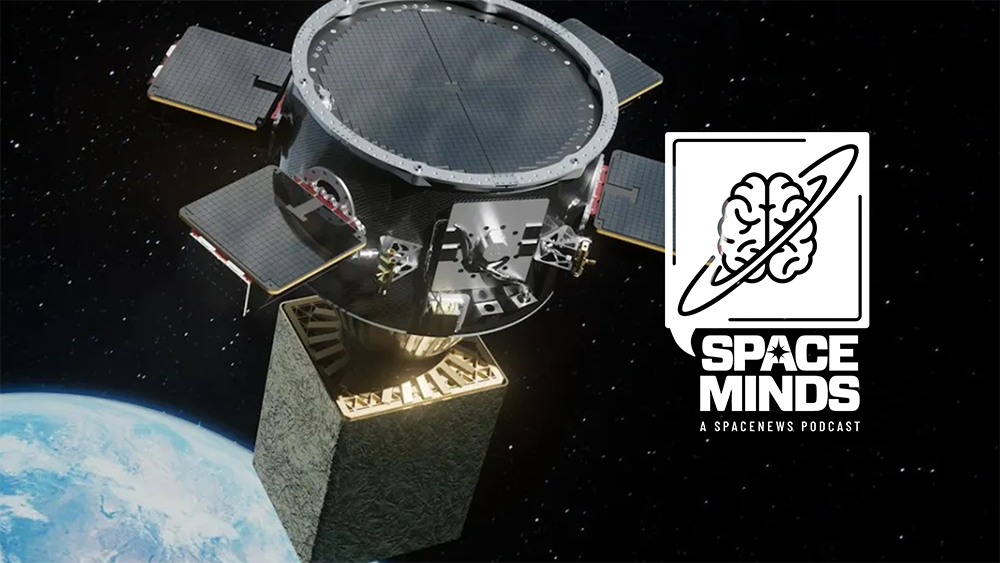 | The evolution of multi-mission orbital vehicles: In this episode of Space Minds, catch SpaceNews' Jeff Foust panel discussion with Space Force and Firefly Aerospace leaders on what it takes to create agile, high-delta-V spacecraft capable of fulfilling multiple operational roles in orbit. Tune in for insights on the future of spacecraft modularity, propulsion innovations, and the real challenge: changing the mindset of space acquisition. | | |
|
|
|
🚀 🕑 🎧 Don't miss SpaceNews' FirstUp Audio
The day's most important space headlines delivered in less than 10 minutes every Monday-Friday. Listen on our website, YouTube, Apple Podcasts, Spotify or your favorite podcast app.
| | |
|
|
|
Sign up for our other newsletters Military Space: Veteran defense journalist Sandra Erwin delivers news and insights for the military space professional. Delivered Tuesday. China Report: Analysis of China's space activities and what it means as one of the United States' top competitors from correspondent Andrew Jones. Delivered every other Wednesday. SpaceNext AI: Exploring the intersection of space and artificial intelligence. Delivered Thursday.
SpaceNews This Week: A round-up of the week's top stories, including our conference coverage. Delivered Friday. Video & Audio: Upcoming live programs, scheduled guests, and recent Space Minds podcast episodes, webinars and other events. Delivered Friday. Marketing Minute: Covering PR, marketing, and advertising trends, upcoming SpaceNews opportunities, and editorial insights for communications and marketing leaders. Delivered monthly. |
|
|
|
|












No comments:
Post a Comment