| By Jeff Foust
In today's edition: Rocket Lab's "green light" schedule for a first Neutron launch this year, Crew-10 returns home, China unveils its first booster landing droneship and more.
If someone forwarded you this edition, sign up to receive it in your inbox every weekday. Have thoughts or feedback? You can hit reply to let me know.
| | | | | | Top Stories
A SpaceX Crew Dragon spacecraft splashed down Saturday, concluding a five-month mission to the International Space Station. The Crew Dragon spacecraft Endurance splashed down off the coast of San Diego, California, at 11:33 a.m. Eastern, more than 17 hours after undocking from the station. The splashdown completed the Crew-10 mission, returning NASA astronauts Anne McClain and Nichole Ayers, Japanese space agency JAXA astronaut Takuya Onishi and Roscosmos cosmonaut Kirill Peskov after nearly five months in space. They were replaced by Crew-11, which launched at the beginning of August. NASA officials said after the Crew-10 splashdown they are still studying whether to extend the Crew-11 mission from six months to eight, which depends on certifying Crew Dragon for a longer on-orbit life, but are planning as though the mission will be extended. [SpaceNews]
Rocket Lab says a first launch of Neutron is still possible this year as long as it can stick to a "green light" schedule. In an earnings call last week, Rocket Lab CEO Peter Beck said his company was working hard to launch the medium-class reusable rocket by the end of the year, but "every single thing needs to go to plan for the schedule to hold." He suggested that is unlikely, stating that the company would not "rush and take stupid risks" to stay on that schedule. Rocket Lab continues to make good progress on Neutron, he said, and plans to formally open the rocket's launch site, Launch Complex 3 at Wallops Island, Virginia, on Aug. 28. He also said the company is sizing up opportunities to participate in the Golden Dome missile defense program, including using sensor technologies from Geost, a company it is acquiring. [SpaceNews]
Intuitive Machines now plans to build its lunar communications in-house. The company said in an earnings call last week that it is investing in capabilities to produce on its own the five satellites it needs for a lunar communications network to support NASA and other customers. The company previously contracted with York Space Systems for those satellites. Building the satellites internally provides more control over cost and schedule, Intuitive Machines executives argued, and could create additional business. The first of those satellites will launch as a rideshare on the IM-3 lunar lander mission, which will be pushed back to the second half of 2026. The company took a $19.8 million estimate-at-completion adjustment in the second quarter to reflect the impact of bringing satellite production in-house. [SpaceNews]
Redwire is making a bigger push into space pharmaceutical development with a new business entity devoted to the field. The company said last week it was standing up SpaceMD, an entity that will commercialize its Pharmaceutical In-Space Laboratory, or PIL-BOX, technology used on the ISS. Redwire said it has a licensing agreement in place with one pharmaceutical company to develop drugs to treat bone disease, and Redwire would receive royalties from commercial sales of any drugs developed through that agreement. Redwire argues that improvements in space access and in-space technologies, as well as growing awareness of the benefits of microgravity research, make space pharmaceutical work more commercially feasible. [SpaceNews]
A move to accelerate development of space nuclear reactors has industry support. A recent NASA directive calls for a new procurement to develop a 100-kilowatt reactor that would be ready to fly by 2030 and could be used on the moon for future Artemis missions. The plan enacts many of the recommendations of a recent report that called for accelerating work on space nuclear power and propulsion. Industry officials said they believe the plan is technically feasible, building on past work on smaller reactors. Some challenges the plan faces, though, include availability of a workforce to develop such reactors, untested regulatory frameworks and funding. [SpaceNews]
| | | | SPONSORED | | | |  | | Take your mission from concept to cosmos with the Blue Canyon Technologies Saturn-400, now the largest offering in our line of spacecraft. Designed for high-agility missions, demanding power needs, cislunar applications and high delta-V configurations, the Saturn-400 features: -
Low-jitter, advanced spacecraft agility enabled by Blue Canyon's reaction wheel or control moment gyroscope technology -
Increased payload capacity -
Higher power and volume scaling -
Heritage design that reduces program risk. -
Flexible mission capability in dynamic environments.
The Saturn-400 is intentionally engineered with customizable features to meet your mission needs, supporting higher-impact missions with greater capability at still a fraction of traditional costs. Learn more.
| | | | | | Other News
A Chinese rocket placed 11 satellites into orbit for a commercial Internet of Things (IoT) constellation. A Jielong-3 solid propellant rocket lifted off at 12:31 p.m. Eastern Friday from a barge off the coast of the Chinese city of Rizhao. The launch sent 11 satellites into orbit for the Geely-04 constellation operated by Geespace, a private satellite maker and subsidiary of Geely Holding Group, an automotive conglomerate. The satellites are part of a planned 72-satellite first phase to provide near-global IoT connectivity services, with Geespace focusing on business opportunities in the Middle East, southeast Asia, Africa and Latin America. [SpaceNews]
Chinese startup iSpace has launched the nation's first rocket recovery ship. The ship, named Xingji Guihang ("Interstellar Return"), will allow for the offshore recovery of medium- and large-scale reusable rockets. The Interstellar Return was designed specifically for recovering the first stages of iSpace's Hyperbola-3 methane-liquid oxygen rocket but could also be used for other medium- and large-scale reusable rockets. The first Hyperbola-3 launch is projected to take place by the end of the year. [SpaceNews]
Indian launch startup Skyroot Aerosopace successfully tested the largest privately developed solid rocket motor in the country. The static-fire test of the Kalam 1200 motor took place at ISRO's Satish Dhawan Space Centre as the motor ran for 110 seconds. The motor serves as the first stage of Skyroot's Vikram-1 small launch vehicle, with a first launch planned by the end of the year. [Republic World]
The effort by Texas members of Congress to move a shuttle to Houston has taken another turn with a complaint to the Chief Justice of the Supreme Court. In a letter to Chief Justice John Roberts, who also serves as chancellor of the Smithsonian Institution, Sen. John Cornyn (R-Texas) and Rep. Randy Weber (R-Texas) complained that the Smithsonian staff "has taken affirmative steps to oppose the passage and implementation" of a provision in the budget reconciliation bill that directs NASA to transfer a "space vehicle" to a NASA center involved in the commercial crew program. The intent of the provision, its proponents state, is to move Discovery from the National Air and Space Museum to Space Center Houston. The letter claims that the Smithsonian was violating federal law by stating that the institution, not NASA, held the title to Discovery, and asked Roberts to investigate, what they argue, was lobbying by the Smithsonian when it made such statements. The Smithsonian stated it was confident it was in compliance with anti-lobbying laws. [collectSPACE]
Jim Lovell, the NASA astronaut who commanded Apollo 13, has died. Lovell died Thursday at the age of 97, his family and NASA announced Friday. Lovell, a Navy test pilot, was selected as a NASA astronaut in 1962 and flew on Gemini 7 and Gemini 12 before serving as command module pilot for Apollo 8 in 1968, the first crewed mission to orbit the moon. He was set to walk on the moon as commander of Apollo 13 in 1970, but an explosion in the service module of the spacecraft on its way there instead turned the mission into a fight to keep the three astronauts on board alive. Lovell gained new fame a quarter-century later with the release of the movie Apollo 13, a dramatization of the mission starring Tom Hanks as Lovell. [New York Times]
| | | | | | The Week Ahead
Monday: -
Cape Canaveral, Fla.: Rescheduled launch of a Falcon 9 carrying Amazon Project Kuiper satellites at 8:35 a.m. Eastern. -
Vandenberg Space Force Base, Calif.: Rescheduled launch of a Falcon 9 carrying Starlink satellites at 10:05 p.m. Eastern. Monday-Wednesday: -
Salt Lake City: The 39th Annual Small Satellite Conference discusses smallsat missions and technologies, with NASA's Nicky Fox as the keynote speaker. Visit SpaceNews at booth T22 to meet our team and enter our Smallsat contest to win free SpaceNews swag and an annual subscription. Be sure to follow our show coverage all week long. Tuesday: -
Cape Canaveral, Fla.: Scheduled launch of a ULA Vulcan Centaur on the USSF-106 mission for the Space Force at 7:59 p.m. Eastern. -
Kourou, French Guiana: Scheduled launch of an Ariane 6 carrying the MetOp-SGA1 satellite at 8:37 p.m. Eastern. Tuesday-Thursday: Wednesday: -
Wenchang, China: Anticipated launch of a Long March 5B at 2:45 a.m. Eastern. -
Cape Canaveral, Fla.: Scheduled launch of a Falcon 9 carrying Starlink satellites at 7:09 a.m. Eastern. -
Washington/Online: The Atlantic Council holds a discussion on "Experts read between the lines of the US Space Force's warfighting strategy" at 10 a.m. Eastern. -
Vandenberg Space Force Base, Calif.: Scheduled launch of a Falcon 9 carrying Starlink satellites at 11:44 a.m. Eastern. Thursday: Friday: Saturday:
| | | | | | | FROM SPACENEWS | 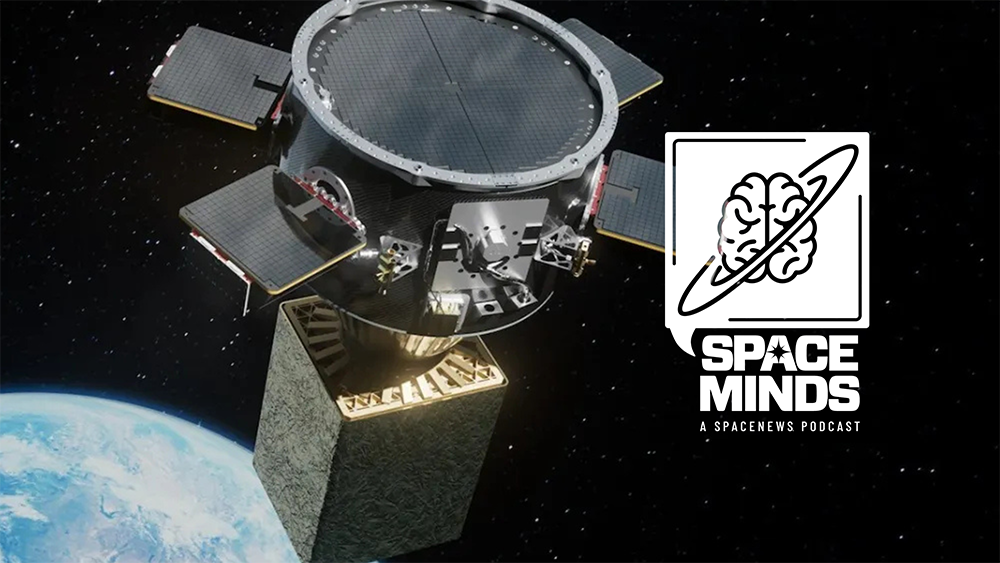 | | The evolution of multi-mission orbital vehicles: In this episode of Space Minds, catch SpaceNews' Jeff Foust panel discussion with Space Force and Firefly Aerospace leaders on what it takes to create agile, high-delta-V spacecraft capable of fulfilling multiple operational roles in orbit. Tune in for insights on the future of spacecraft modularity, propulsion innovations, and the real challenge: changing the mindset of space acquisition. | | | | | | | 🚀 🕑 🎧 Don't miss SpaceNews' FirstUp Audio
The day's most important space headlines delivered in less than 10 minutes every Monday-Friday. Listen on our website, YouTube, Apple Podcasts, Spotify or your favorite podcast app.
| | | | | | Sign up for our other newsletters -
Military Space: Veteran defense journalist Sandra Erwin delivers news and insights for the military space professional. Delivered Tuesday. -
China Report: Analysis of China's space activities and what it means as one of the United States' top competitors from correspondent Andrew Jones. Delivered every other Wednesday. -
SpaceNext AI: Exploring the intersection of space and artificial intelligence. Delivered Thursday.
-
SpaceNews This Week: A round-up of the week's top stories, including our conference coverage. Delivered Friday. -
Video & Audio: Upcoming live programs, scheduled guests, and recent Space Minds podcast episodes, webinars and other events. Delivered Friday. -
Marketing Minute: Covering PR, marketing, and advertising trends, upcoming SpaceNews opportunities, and editorial insights for communications and marketing leaders. Delivered monthly. | | | | |












No comments:
Post a Comment