Plus: How to talk about 'AI Fight Club'
| | | A SpaceNews daily newsletter | | 06/05/2025 | | | | | Jared Isaacman said his nomination to be NASA administrator was pulled because of people in the Trump administration with "axes to grind" with Elon Musk. Speaking on a podcast published Wednesday, Isaacman said he wasn't given an explanation for President Trump's decision last week to withdraw the nomination other than the president "decided to go in a different direction." However, he backed claims that the move was made by people within the White House who had been at odds with Musk and were taking advantage of Musk's formal departure from government work. "I think the direction people are going, or thinking on this, seems to check out to me," he said. Isaacman said that, had he been confirmed as administrator, he would have sought to focus NASA on "needle-mover" programs that only NASA could do, while working to cut bureaucracy. [SpaceNews]
American satellite imaging companies are witnessing a boom in demand from foreign governments. These companies are recasting themselves as global vendors of what they call "sovereign" space capabilities, striking high-value international deals that promise long-term revenue and access to new markets while still being closely tethered to U.S. government contracts. Industry officials say they are taking advantage of the fact that the remote-sensing industry, once dominated by classified government programs and limited to major powers, has evolved into an innovative and competitive commercial marketplace. Working with foreign governments also helps those companies diversify their customer base amid potential cuts in U.S. government spending. [SpaceNews]
A long-awaited European space law finally may be released this month. Europe is expected to publish a draft of the EU Space Act by the end of the month, a law intended to overhaul the regulation of space services. While details of the incoming law remain under wraps, legal experts anticipate a move away from voluntary guidance toward binding obligations in key areas such as space sustainability, safety, resilience and security. A central aim of the Space Act is to create a cohesive single market for space services in Europe, helping companies that today must deal with varying national regulations. [SpaceNews]
Lockheed Martin is creating a new initiative to allow companies to test artificial intelligence systems being developed for military applications. The "AI Fight Club" aims to create a digital proving ground for AI systems across air, land, sea and space operations, including head-to-head matchups between AI systems. Lockheed originally considered developing the platform to test its own algorithms but decided to expand access to smaller vendors who have promising technologies but lack the infrastructure to meet Pentagon-grade evaluation standards. [SpaceNews]
A space station research conference has been canceled and the future of a planetary science conference is in doubt as NASA pulls back support. CASIS, the organization that operates the ISS National Lab, said Wednesday it was canceling this year's ISS Research and Development Conference, planned for the end of July in Seattle, citing "the current regulatory and budgetary environment." NASA had reportedly withdrawn its support for the event, which the agency had used to promote ISS research and discuss station operations and future plans. Separately, NASA said Wednesday it would no longer pursue a partnership to continue the Lunar and Planetary Science Conference (LPSC). NASA, which had jointly run LPSC with the Lunar and Planetary Institute for years, had sought a new approach that would no longer require it to find the event, but now appears to be walking away from the event entirely. Scientists said it will be difficult to run LPSC in its current form without NASA support. [SpaceNews]
| | | | | SpaceX celebrated the 15th anniversary of the first Falcon 9 launch with another launch. A Falcon 9 lifted off from Vandenberg Space Force Base in California at 7:40 p.m. Eastern Wednesday and placed 27 Starlink satellites into orbit. The launch took place 15 years to the day after the first Falcon 9 launched a Dragon capsule on a brief test flight. SpaceX has now conducted 500 launches of rockets in the Falcon family, including the Falcon Heavy and the original Falcon 1. [Spaceflight Now]
Hanwha Systems plans to sell its stake in Eutelsat. The South Korean company said Thursday it would sell its 5.4 percent stake in the French satellite operator for $88.5 million so that it could focus on core business operations. Hanwha invested $300 million in OneWeb, the LEO satellite operator later acquired by Eutelsat, in 2021. Eutelsat said none of its other major shareholders have expressed an interest in selling their stakes in the company as Eutelsat seeks to raise funding for second-generation OneWeb satellites and its role in the IRIS² constellation. [Reuters]
SpaceX expects $15.5 billion in revenue this year. Elon Musk disclosed the projected revenue on social media this week, noting it includes $1.1 billion from NASA contracts. Privately held SpaceX has rarely disclosed revenues or other financial details, leading to widely varying estimates. Musk said he expected "commercial revenue" at SpaceX next year to exceed NASA's budget, but did not state if that was based on NASA's current $25 billion budget or the White House's request for fiscal year 2026 that would cut it to less than $19 billion. [Wall Street Journal]
The FCC will soon lack a quorum as two commissioners resign. Nathan Simington, a Republican who has been a commissioner since late 2020, announced Wednesday he would step down at the end of the week. Simington did not give a reason for his departure, which came as a surprise. A Democratic commissioner, Geoffrey Starks, said Wednesday he will also resign at the end of the week, confirming plans he announced last month. With one seat already vacant, the departures would leave the FCC with only two commissioners, depriving it of a quorum needed to take up any issues, including satellite regulations. [CNBC]
Marc Garneau, the first Canadian to go to space, has died. Garneau's family said Wednesday that he passed away after a short illness at the age of 76. Garneau was part of Canada's original class of six astronauts selected in 1983. He became the first Canadian in space as part of the STS-41G shuttle mission in 1984, and later flew on STS-77 in 1996 and STS-97 in 2000. He then served as president of the Canadian Space Agency before entering politics, winning a seat in the House of Commons and serving as transport minister and foreign affairs minister. He resigned from parliament in 2023. [CBC]
| Double-Digit Lives
| |
"New Horizons has been canceled so many times: during the proposal it was canceled, during development it was canceled, and in flight and in extended mission. We survived every one of those. I like to say that if New Horizons had been a cat it would have been dead long ago because cats only get nine lives."
– Alan Stern, principal investigator for the New Horizons mission, discussing at a meeting of the Outer Planets Assessment Group Wednesday the lack of funding for New Horizons in NASA's fiscal year 2026 budget proposal.
| | | | | | | | | What's New With SpaceNews? | | Don't forget to sign up for our next webinar! | 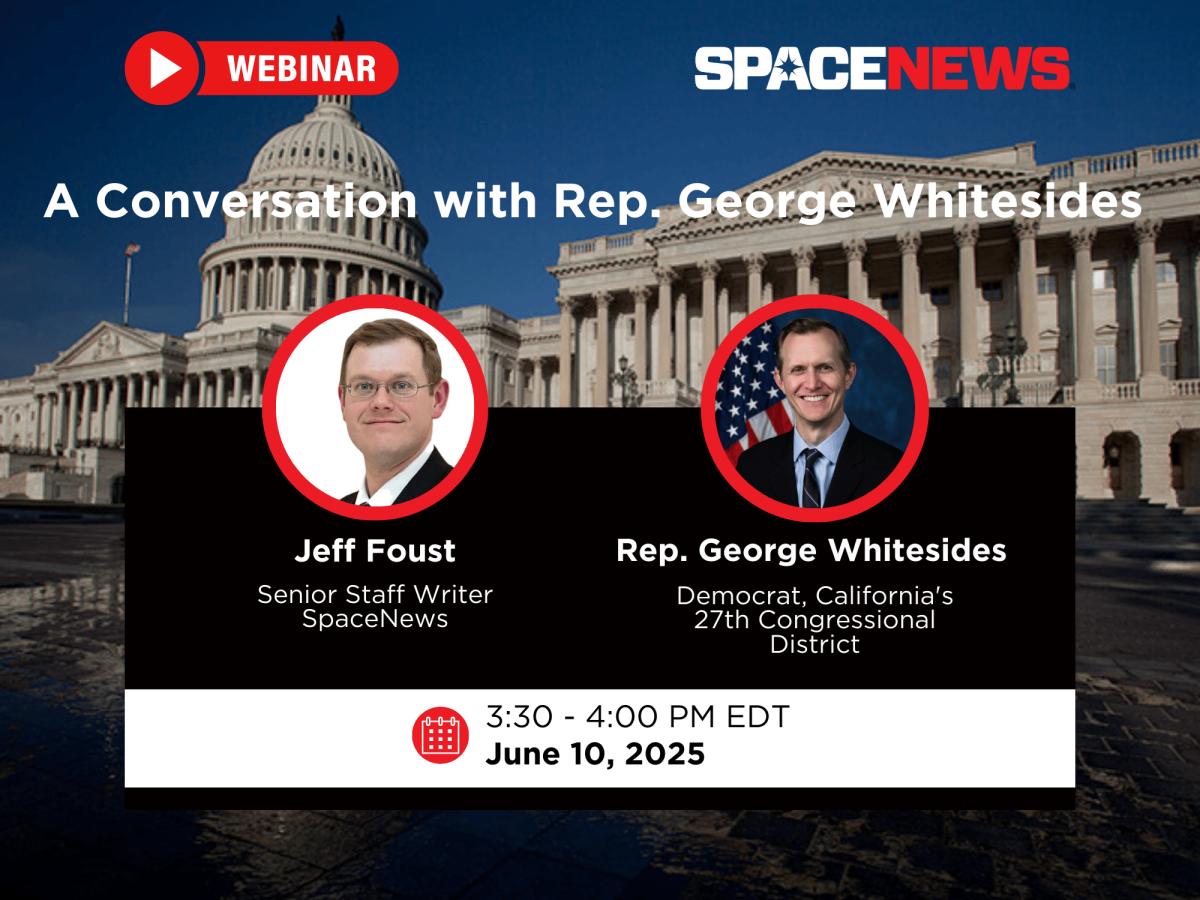 | | Join us June 10 for an exclusive one-on-one live interview with Rep. George Whitesides (D-CA), a freshman congressman representing California's 27th District. Whitesides brings years of experience to Capitol Hill, having previously served as NASA's chief of staff and as CEO of Virgin Galactic. | | | | |





No comments:
Post a Comment