Friday, May 9, 2025

Uncertainty clouds Artemis — but the work goes on

Plus: Details on Neutron's first flight
 ‌ ‌ ‌ ‌ ‌ ‌ ‌ ‌ ‌ ‌ ‌ ‌ ‌ ‌ ‌ ‌ ‌ ‌ ‌ ‌ ‌ ‌ ‌ ‌ ‌ ‌ ‌ ‌ ‌ ‌ ‌ ‌ ‌ ‌ ‌ ‌ ‌ ‌ ‌ ‌ ‌ ‌ ‌ ‌ ‌ ‌ ‌ ‌ ‌ ‌ ‌ ‌ ‌ ‌ ‌ ‌ ‌ ‌ ‌ ‌ ‌ ‌ ‌ ‌ ‌ ‌ ‌ ‌ ‌ ‌ ‌ ‌ ‌ ‌ ‌ ‌ ‌ ‌ ‌ ‌ ‌ ‌ ‌ ‌ ‌ ‌ ‌ ‌ ‌ ‌ ‌ ‌ ‌ ‌ ‌ ‌ ‌ ‌ ‌ ‌ ‌ ‌ ‌ ‌ ‌ ‌ ‌ ‌ ‌ ‌ ‌ ‌ ‌ ‌ ‌ ‌ ‌ ‌ ‌ ‌ ‌ ‌ ‌ ‌ ‌ ‌

View in Browser

A SpaceNews daily newsletter

05/09/2025

Top Stories

Space agencies involved in the Artemis lunar exploration effort say they're continuing work on their contributions amid NASA budget uncertainty. In sessions at the Global Conference on Space Exploration (GLEX) this week in India, officials with space agencies in Europe, Canada and the UAE said they are closely watching a NASA budget proposal released last week that would cancel the lunar Gateway and end SLS and Orion after Artemis 3. They said they are continuing work as normal on their contributions, while hoping that Congress will make significant changes to the budget. Some suggested, though, the need to consider alternative arrangements for international cooperation. NASA was not represented in those sessions at GLEX. [SpaceNews]


China is planning to launch additional modules for its Tiangong space station with an eye toward supporting international cooperation. Chinese officials recently said they plan to launch more modules to Tiangong using the Long March 5B rocket, but did not give a schedule for doing so. That expansion would likely start with a module that includes six docking ports, enabling additional modules to dock with it. Expanding Tiangong would enhance opportunities for science, payload hosting and international cooperation, particularly for crewed missions. [SpaceNews]


Rocket Lab won a Neutron launch contract for an Air Force "rocket cargo" program. The cargo test, slated for launch no earlier than 2026, would be a survivability experiment. Neutron is expected to carry a payload that will re-enter Earth's atmosphere, demonstrating the rocket's ability to safely transport and deploy cargo. Rocket Lab did not disclose the value of the contract but executives said in an earnings call Thursday that development of Neutron continues to be on schedule for a first flight later this year. [SpaceNews]


German defense contractor Rheinmetall plans to start building synthetic aperture radar (SAR) satellites next year with Finnish SAR constellation operator Iceye. The companies announced Thursday a joint venture that will set up a satellite production facility in Neuss, Germany, where Rheinmetall is anchoring its space expansion plans. Rheinmetall previously announced a deal to integrate Iceye's radar data into tactical battlefield systems and secured exclusive rights to market Iceye's SAR technology to military and government customers in Germany and Hungary. The deal is part of Europe's broader push to bolster military intelligence capabilities. [SpaceNews]


Solar cell developer mPower Technology has raised $21 million to expand production of its systems. The company announced the Series B round Thursday led by Razor's Edge Ventures with participation from Shield Capital. The funding will support increased production of mPower's DragonSCALES modules, which use commercial off-the-shelf silicon-based tools and processes for spacecraft solar power systems. Among the customers is Airbus, which plans to use mPower's DragonSCALES technology to power more than 200 LEO satellites that prime contractor MDA is building for Canada's Telesat. [SpaceNews]


Other News

American military leaders are speaking more openly than ever about fighting in space, not just defending it. Senior officials at last month's Space Symposium focused on "space superiority," a term rooted in military doctrine that means U.S. forces must be able to operate satellites in orbit without interference, and deny that advantage to enemies. The new rhetoric reflects a broader transformation in U.S. space strategy, one that increasingly views space as a dynamic, contested domain in which the ability to maneuver and, if needed, strike is essential. In a document last month, the Space Force outlined how U.S. forces might assert control of the orbital high ground through a range of offensive and defensive operations. [SpaceNews]


A push by the Pentagon to make more use of commercial technology in space systems creates opportunities for "mission integrators." These are engineering firms that specialize in making legacy technologies and newer commercial tech work together, critical for space networks where each company takes a different approach to their systems. SAIC recently won a contract to serve as a mission integrator for Tranche 3 of Space Development Agency's constellation, charged with making sure satellites ordered from several companies are able to work together. [SpaceNews]


The Space Force selected three companies for the next phase of a program for laser communications terminals. CACI, General Atomics and Viasat will move into Phase 2 of the Enterprise Space Terminal program, which seeks to establish standardized optical communications systems for military satellites, with a focus on commercial-off-the-shelf laser terminals adapted for government use.  The three companies participated in Phase 1 along with Blue Origin, which did not make the cut. [SpaceNews]


The National Science Foundation is radically changing its structure. The agency is eliminating its 37 existing divisions, such as one that funds research in astronomy, ahead of expected layoffs to NSF staff and termination of some grants that have already been awarded. The changes, yet to be publicly announced, are in reaction to the White House's 2026 budget proposal that would cut NSF's budget by 55%. The changes at NSF could be a model for those at other agencies, including NASA. [Science]


ESA's Proba-3 mission has demonstrated highly precise formation flying. The two spacecraft flew 150 meters apart from one another, maintaining their positions with millimeter precision, ESA said this week. The formation flying technology will be used later in the mission to allow one spacecraft to precisely block the sun as seen from the other, which will then image the solar corona. [ESA]


Keep looking up this weekend, just in case. Cosmos 482, a Soviet-era Venus mission that was stranded in Earth orbit after its launch in 1972, is forecast to reenter at 1:54 a.m. Eastern Saturday, plus or minus nine hours, according to a prediction from the Aerospace Corporation. Other predictions offer similar reentry times and margins of error, which are large enough to prevent pinpointing a reentry location. Cosmos 482 was designed to survive entry into the thick atmosphere of Venus, meaning much of it should survive terrestrial reentry, but the odds of someone being hit are very low: "any one individual on Earth is far likelier to be struck by lightning than to be injured by Cosmos 482," Aerospace noted. [Space.com]


Tough Crowds


"I go to speaking arrangements like this with our astronaut, Alper Gezeravcı, every once in a while. It's very depressing, because everybody's interested in him and nobody's interested in a scientist."


– Arif Karabeyoğlu, board member of the Turkish Space Agency, during a panel at the GLEX 2025 conference this week.


What's New With SpaceNews?

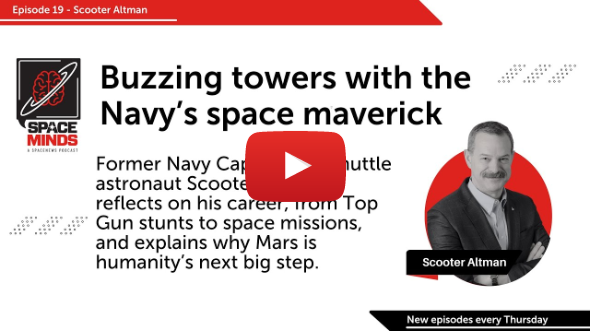
Buzzing Towers with the Navy's Space Maverick

Check out the latest episode of our new podcast, Space Minds. Join David Ariosto, Mike Gruss and journalists from the SpaceNews team for compelling interviews with scientists, founders and experts who love to talk about space, and their takes on the week's biggest news.


New episodes come out every Thursday on SpaceNews.com, YouTube and wherever you listen to your favorite podcasts.


Manage Preferences


No comments:

Post a Comment

Opinions: Keep the X-band open for climate change

Plus: An 'astrophysics nervous system' for NASA  ‌ ‌ ‌ ‌ ‌ ‌ ‌ ‌ ‌ ‌ ‌ ‌ ‌ ‌ ‌ ‌ ‌ ‌ ‌ ‌ ‌...