| By Sandra Erwin
Welcome to this week's edition of SpaceNews' Military Space, your source for the latest developments at the intersection of space and national security. In today's edition: The Space Force chief warns of funding gaps for space superiority missions, telling lawmakers there's a "disconnect between value and investment."
If someone forwarded you this edition, sign up to receive it directly in your inbox every Tuesday. And we're eager to hear your feedback and suggestions. You can hit reply to let me know directly.
|  | | | | Space Force chief makes case for more funding
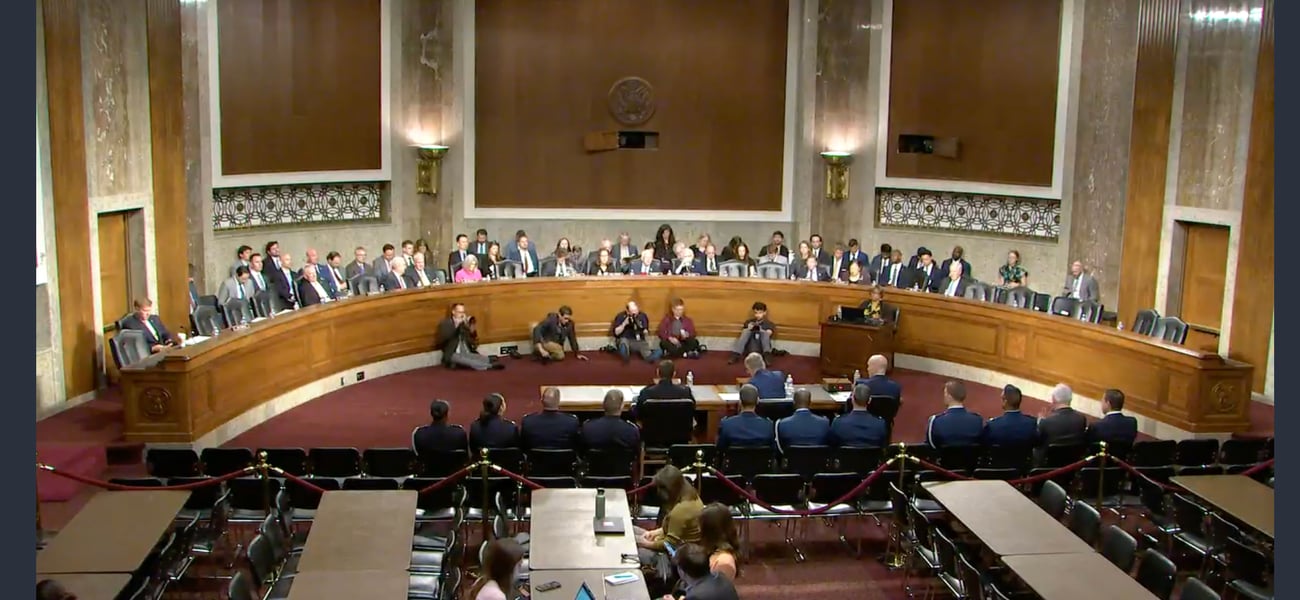
As the Trump administration prepares to unveil its fiscal 2026 defense budget in the coming weeks, Chief of Space Operations Gen. Chance Saltzman continues his months-long campaign to convince lawmakers that space capabilities critical to national security are under-funded.
The Space Force received $28.7 billion for fiscal 2025 — $800 million below what it requested and $300 million less than it received the previous year.
"Despite the dramatic rise in threats and increasing importance of space over the last few budget cycles, the Space Force has experienced shrinking resources," Saltzman told the Senate Armed Services Committee last week. "With about 3% of the DoD budget and less than 1% of the personnel, the Space Force is a great value proposition for the department."
What's driving the demand
The Space Force has been tasked with complex missions beyond its original satellite operations role these include: -
Developing technologies to operate satellites without interference from adversaries, -
Creating capabilities to deny space advantages to enemies, -
Building "protective measures for our satellites and networks, and to hold an adversary space assets at risk," as Saltzman put it, and -
Supporting the Golden Dome next-generation missile defense system, which received $25 billion in the administration's reconciliation funding bill. Saltzman described the budget situation as a "disconnect between value and investment," arguing that the service has been forced to make "tough choices between delayed readiness, reduced capacity and unaddressed vulnerabilities."
The threat picture
Russian and Chinese activities in space are driving much of the urgency. Saltzman highlighted Russian behavior, noting that Moscow has performed "some very aggressive on-orbit capabilities in terms of plane matching, getting very close to some of our most sensitive satellites in aggressive ways."
More concerning, he said, Russia "released what could be presumed to be kinetic kill vehicles that we've watched on orbit." China has also demonstrated anti-satellite technologies, adding to concerns about space becoming the next domain of military competition.
The analogy that explains it all
To illustrate why the Space Force needs more than repurposed legacy systems, Saltzman said, "I've often used the analogy that it's like transforming the merchant marine into the U.S. Navy or United Airlines into the U.S. Air Force. We can't just take what we had and presume that we can gain space superiority with that equipment. That new equipment requires new resources."
His message to Congress: "If we want a force that can secure our nation's interests in, from and to space, we must resource it accordingly." | | | | |  | | | Space acquisition expertise potentially at risk
The Space Force is feeling the pinch from the Trump administration's federal workforce reduction efforts. Saltzman told the Senate Armed Services Committee the service is losing nearly 14% of its civilian workforce amid Pentagon-wide cost-cutting measures.
The numbers: The Space Force is shedding about 700 civilian positions through buyouts, retirements, and a hiring freeze — a significant hit for the smallest military service, which relies heavily on civilian expertise to operate.
"We've certainly seen people leave through a combination of incentives, deferred retirement program, resignation program and others," Saltzman said at last week's SASC hearing. "We were in a hiring freeze for some time. We were in a period of managed growth, and so there was a deficit when we were trying to get to a larger civilian workforce, and we were asked to stop and then offer some to resign early."
Saltzman acknowledged the administration's goals but cautioned that there are risks: "We understand the desire to reduce the civilian workforce. But because of the small size of the Space Force, it's just having a little bit of an outsized impact."
The broader context: The Trump administration in March directed executive departments and agencies to streamline the federal workforce, leading the Pentagon to implement a civilian employee hiring freeze.
The hiring freeze isn't universal. DoD has exempted positions it considers "central to its core warfighting mission" including roles in immigration enforcement, national security, public safety, shipyards, depots, cyber fields and medical facilities.
Acquisition expertise: Unlike other military services, the Space Force depends heavily on civilian contractors and government employees for technical expertise "that we don't have in the active duty force," Saltzman explained. "They bring corporate continuity across all of our processes and procedures … And obviously we use a lot of our civilian workforce in the acquisition of our systems, which is a critical capability."
"I'm worried about replacing that level of expertise in the near term," he said.
| | | | | |  | | | Space Force, NGA strike deal to end intel turf wars
The U.S. Space Force and National Geospatial-Intelligence Agency last week signed a formal agreement to clarify their roles in delivering satellite-based intelligence to military users.
Saltzman and NGA Director Vice Adm. Frank Whitworth inked the memorandum of agreement at the GEOINT Symposium.
The agreement seeks to set boundaries and identify areas of collaboration between the Space Force's TacSRT program (Tactical Surveillance, Reconnaissance, and Tracking) and the intelligence community. TacSRT has emerged as a key tool for getting unclassified commercial imagery into commanders' hands quickly.
Saltzman described TacSRT as an "important capability that we've offered to the combatant commands. It fills a niche where you have unclassified capabilities that can get quickly into the planner's hands. It's intended to complement what the intelligence community, National Reconnaissance Office and NGA provide to combatant commanders writ large."
The goal is to better collaborate with the intelligence community "to make sure there's not overlap, there's not too much redundancy," said Saltzman. "We don't want to pay for imagery twice, for example."
The backstory
Historically, DoD and intelligence community agencies have engaged in bureaucratic infighting over roles and resources — a problem that has persisted across multiple administrations. The Space Force has built its own intelligence operations focused on space threats, creating new friction points with established intelligence agencies.
Saltzman acknowledged these growing pains, emphasizing that relationships with organizations like NRO and NGA remain "more of a work in progress, and we owe it to ourselves and others to clarify it, because ambiguity benefits no one."
What's different about TacSRT
TacSRT started as a pilot program but has evolved into an online marketplace where commercial vendors compete for contracts to deliver data-driven insights. The platform focuses on unclassified capabilities that can be rapidly deployed — a key distinction from traditional intelligence products that often require security clearances and lengthy processing times.
Saltzman cited disaster response after an earthquake in Turkey, where commercial imagery was quickly obtained and shared with NATO partners and civilian agencies to assess damage and plan relief efforts — exactly the kind of unclassified, shareable intelligence that fills gaps in traditional classified systems.
| | | | SpaceNews' latest national security coverage
| | | | Sign up for our other newsletters -
FirstUp: The latest civil, commercial and military space news, curated by veteran journalist Jeff Foust. Delivered Monday to Friday mornings. -
China Report: Analysis of China's space activities and what it means as one of the United States' top competitors from correspondent Andrew Jones. Delivered every other Wednesday. -
SpaceNext:AI: Exploring the intersection of space and artificial intelligence. Delivered Thursday. -
SpaceNews This Week: A round-up of the week's top stories, including our conference coverage. Delivered Friday. -
Video & Audio: Upcoming live programs, scheduled guests, and recent Space Minds podcast episodes, webinars and other events. Delivered Friday. -
Marketing Minute: Covering PR, marketing, and advertising trends, upcoming SpaceNews opportunities, and editorial insights for communications and marketing leaders. Delivered monthly. | | | | | | |









No comments:
Post a Comment