| By Sandra Erwin
Welcome to this week's edition of SpaceNews' Military Space, your source for the latest developments at the intersection of space and national security. In this week's edition: Space Force leaders roll out a documentary to shore up congressional backing and sharpen their public image.
If someone forwarded you this edition, sign up to receive it directly in your inbox every Tuesday. And we're eager to hear your feedback and suggestions. You can hit reply to let me know directly. | | | | Space Force goes to the Hill — with a film in tow
When your military branch sounds like science fiction to many Americans, sometimes a movie can explain you're the real deal.
A 20-minute documentary, "The U.S. Space Force – America's Invisible Front Line," produced by Air Force Television Pentagon, recently premiered for lawmakers on Capitol Hill.
The film's timing is no accident. With FY2026 budget talks still ongoing and some lawmakers still unsure what to make of the newest military service, Space Force leaders are using the documentary to shore up congressional backing and sharpen their public image.
It's also a recruitment and morale tool, crafted to help guardians — and would-be ones — understand the ethos of a service still defining itself. Since its 2019 launch, Space Force has struggled with perception problems, often conflated with NASA or lampooned thanks to pop culture parodies.
What's in the documentary? Viewers get an inside look at Space Force operations, locations and personnel, highlighting the service's responsibility for "organizing, training, and equipping guardians to conduct global space operations." The film breaks down three core missions: orbital warfare, electromagnetic warfare and cyberspace warfare.
Between the lines: Experts warn that the Space Force can't copy-paste other military branch structures — it needs an identity reflecting its unique national security space mission.
Beyond external PR, the documentary helps current and prospective guardians understand what Space Force service means.
| | | | | | Space Force leaders: Missions are growing, but money is not
Top Space Force officials warned Congress last week that the service is being asked to do more with less — and the gap is becoming a major concern.
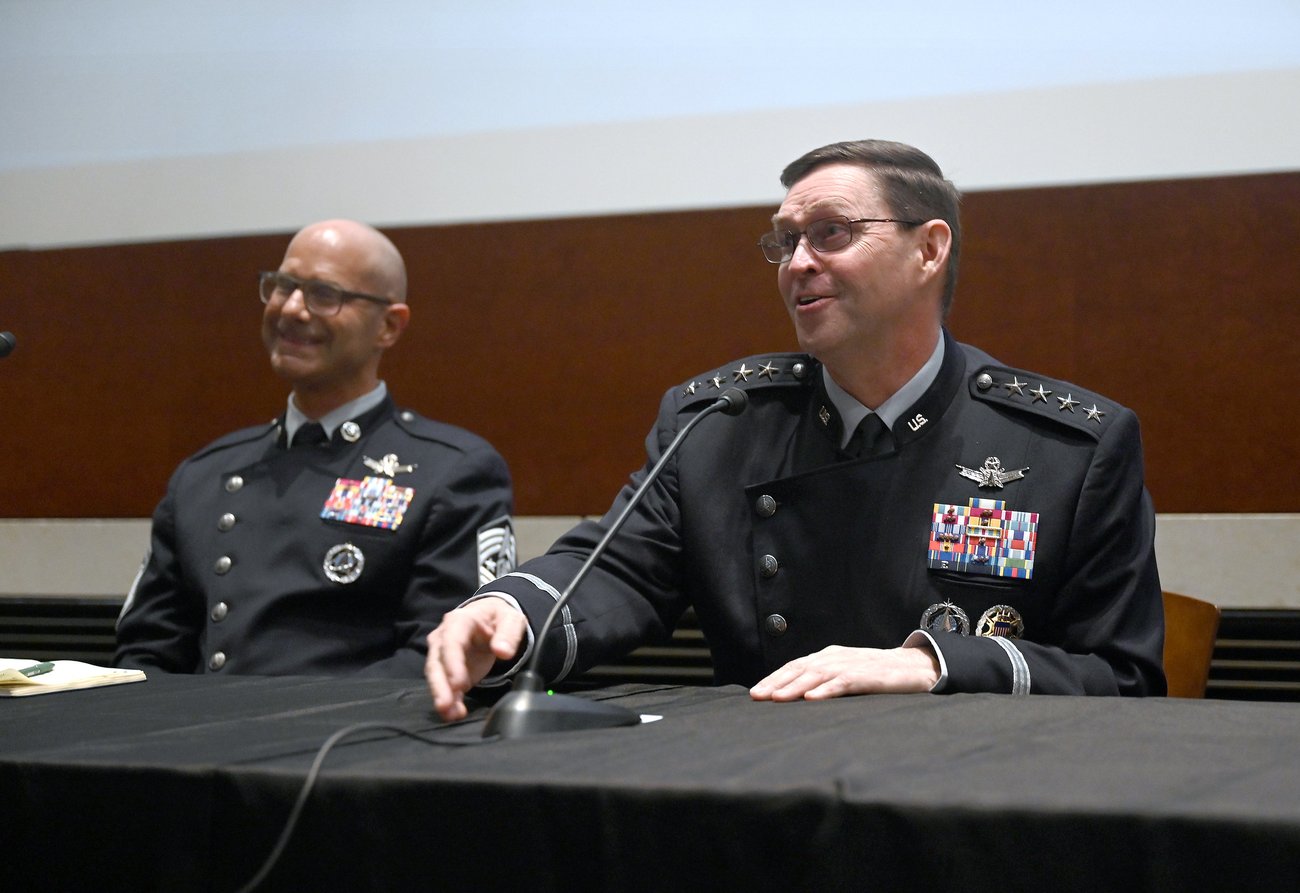
In back-to-back hearings last week, Chief of Space Operations Gen. Chance Saltzman and Vice Chief Gen. Michael Guetlein stressed to lawmakers that flat budgets and shrinking personnel are undermining the service's ability to meet fast-growing demands in an increasingly contested domain.
"We're being asked to accept new responsibilities and missions, forcing tough choices between delayed readiness, reduced capacity or unaddressed vulnerabilities," Saltzman told the House Appropriations defense subcommittee. -
The Space Force oversees satellite operations as well as new missions in target tracking, space control and support for a sharp rise in national security space launches. -
Guetlein, speaking separately to the House Armed Services readiness subcommittee, emphasized the Space Force accounts for 3% of the defense budget and 1% of the Pentagon's personnel — but its mission is expanding rapidly. "It is woefully under-resourced to meet the demands for space capabilities placed on it by our combatant commanders and by the nation," he said. "We must increase investments to deter the threat, and if necessary, to fight decisively." -
Guetlein said adversaries are jamming GPS, disrupting satellite communications, and developing anti-satellite weapons. "These unsafe and unprofessional behaviors have become the norm rather than the exception," he added. The Space Force received $28.7 billion for fiscal 2025 — $800 million below its request. The Trump administration's fiscal 2026 budget outline keeps defense funding flat unless Congress passes a separate $150 billion bill. Lawmakers in both parties have pushed back against that approach.
Losing civilians through buyouts, voluntary resignations
On the personnel side, Guetlein said the service is facing a 13.7% reduction in its civilian workforce — roughly 700 positions — due to buyouts, retirements, and a hiring freeze imposed by the Pentagon as part of broader cost-cutting initiatives. Civilians make up a third of the Space Force. -
Asked why so many civilians elected to leave the Space Force, Guetlein said some opted for early retirement and found employment opportunities in the private sector. Others, particularly civilians at the Los Angeles-based Space Systems Command, were required to return to work at the office and faced long commutes, "and they have chosen to take alternative career paths." -
Guetlein said the Space Force has taken steps to make sure the work is done with fewer people but the civilian cuts are harder to absorb in support services such as child care and base operations at Space Force installations. Both leaders stressed the need for targeted investment. Saltzman pointed to three key priorities: speeding up the launch of a new satellite constellation, expanding defensive and offensive space capabilities and improving training and testing infrastructure. He also highlighted the budget impact of new systems such as Golden Dome, a next-gen missile defense network that will depend on space-based assets.
"Space gives us an incredible strategic advantage, but any advantage can become a vulnerability when held at risk," Saltzman said. "If we want a Space Force that can secure our nation's interests in, from and to space, we must resource it accordingly.
| | | | The Space Force's future arsenal
The Space Force is increasingly looking to the commercial sector for dual-use technologies that could be repurposed for defense missions in orbit, as military leaders shift their rhetoric toward viewing space as a contested, warfighting domain.
After decades of treating space primarily as a support domain, U.S. strategy now increasingly views it as a dynamic arena where the ability to maneuver — and potentially strike — is essential.
Lt. Gen. Shawn Bratton, deputy chief of space operations for strategy, plans, programs and requirements, reaffirmed this shift: "We're moving past 'protect and defend' and yeah, we're going to talk about offensive capabilities in space," he told reporters.
China, Russia, driving shift to offensive ops
The pivot comes in response to provocative actions by China and Russia in orbit. China has used spacecraft equipped with robotic arms to tow satellites, a capability U.S. officials view as a potential counter-space weapon despite China's description of it as a debris mitigation system.
"We had 20 years of peace after the Cold War, where space was incredibly peaceful," said Col. Joe Roth, director of innovation and prototyping at Space Systems Command. "So we built constellations that weren't as resilient as they should be today."
Commercial tech offers faster path
The Space Force is eyeing several commercial technologies that could be adapted for defense missions: -
Starfish Space's "Otter" spacecraft received a $37.5 million defense contract last year to demonstrate satellite servicing in geostationary orbit. The Otter will dock with satellites and tow them to a "junk belt" for disposal—or potentially reposition active satellites. "It's a complex operation and one that should be proven out and make sure it works," Roth said. -
GITAI's "inchworm robot," developed by a Japanese space firm expanding in the U.S., could have defense applications. "I see some interesting possibilities with having that capability either grabbing another satellite, pulling it for docking and refueling, or replacing a component on the spacecraft," Roth noted. -
ThinkOrbital's electron-beam tool, originally designed for in-space manufacturing, has been adapted to see inside satellites from up to 10 kilometers away. "What we determined is we could also use those X-rays to look inside a spacecraft," said Justin Chandler, ThinkOrbital's vice president of government relations. "Whether it was anomaly resolution or something else." According to Lt. Gen. Philip Garrant, head of Space Systems Command, on-orbit space domain awareness — especially using systems that can maneuver — is becoming a top acquisition priority. Most surveillance comes from the ground, he explained. "To be effective, they need to be able to maneuver and to fly around and go look at things of interest." | | | | | | | FROM SPACENEWS |  | | Target the SpaceNews audience: Post your company's latest press release on Stellar Dispatch and immediately elevate your visibility. Connect your announcement directly with an engaged industry audience, and build a public record of consistent updates and progress. Amplify your message today at SpaceNews.com/stellar-dispatch. | | | | | | SpaceNews' latest national security coverage
| | | | Sign up for our other newsletters -
FirstUp: The latest civil, commercial and military space news, curated by veteran journalist Jeff Foust. Delivered Monday to Friday mornings. -
China Report: Analysis of China's space activities and what it means as one of the United States' top competitors from correspondent Andrew Jones. Delivered every other Wednesday. -
SpaceNext:AI: Exploring the intersection of space and artificial intelligence. Delivered Thursday. -
SpaceNews This Week: A round-up of the week's top stories, including our conference coverage. Delivered Friday. -
Video & Audio: Upcoming live programs, scheduled guests, and recent Space Minds podcast episodes, webinars and other events. Delivered Friday. -
Marketing Minute: Covering PR, marketing, and advertising trends, upcoming SpaceNews opportunities, and editorial insights for communications and marketing leaders. Delivered monthly. | | | | | | |







No comments:
Post a Comment