| 04/29/2025 | | National security insights for space professionals. Delivered Tuesdays. | | Welcome to this week's edition of SpaceNews Military Space, your source for the latest developments at the intersection of space and national security.
If this newsletter was forwarded to you, sign up for free here
|  | | | Space & defense brief 🛰️
| Report reveals escalating space threats
Interference with satellite signals is becoming a regular feature of modern conflict, not just a rare glitch.
According to a new report from the Center for Strategic and International Studies (CSIS), GPS jamming and spoofing are now routine across parts of the Middle East, Eastern Europe and Asia, posing growing risks for military and commercial space operators.
The report, released April 25, details how countries such as Russia and Israel have deployed GPS spoofing as part of their military operations in Ukraine and Gaza. Spoofing — sending fake GPS signals to confuse navigation systems — has shifted from a niche tactic to a standard tool of hybrid warfare, disrupting everything from civilian flights to military logistics.
Other key findings: -
Satellites are flexing: Chinese and Russian spacecraft continue to show off complex maneuvers in orbit, a sign of increasing technical skill with direct implications for surveillance and potential attacks. -
Blurred lines: Commercial companies supporting governments are increasingly being treated like military targets, especially as defense contracts grow in importance for private space firms. -
Cyber threats on the rise: Iran, China, and North Korea are ramping up cyberattacks on the space sector, though attribution remains tricky. CSIS summed it up bluntly: future conflicts are likely to extend into space, and the risks of escalation are rising fast.
| | |  | |
GOP defense spending bill adds billions for space systems
House and Senate Armed Services Committee leaders on Sunday unveiled legislation that would inject an additional $150 billion into Pentagon spending, with a significant portion dedicated to space-based defense systems.
The proposal would push total defense spending beyond the $1 trillion mark for fiscal year 2025.
Lawmakers recommended $25 billion for the Golden Dome initiative, established through a White House executive order to create a comprehensive shield protecting the United States against ballistic, hypersonic and advanced cruise missiles. Approximately $15 billion of this funding would support space-based assets, including satellites, sensors, interceptors, and launch infrastructure. -
The space-focused funding includes $2 billion for military satellites with air moving target indicators, $500 million for national security space launch infrastructure, and $7.2 billion to develop, procure, and integrate military space-based sensors. Additional allocations include $5.6 billion for space-based and boost-phase missile interceptors and $300 million for classified military space superiority programs. -
The funding package is advancing through a budget reconciliation bill to bypass potential Senate filibuster obstacles. The House Armed Services Committee is scheduled to begin markup today. -
Democrats are expected to push back on the reconciliation approach. Rep. Adam Smith (D., Wash.), ranking member on the House Armed Services Committee, criticized the legislative strategy as a "partisan budget reconciliation gimmick" that would require offsetting cuts to social safety net programs. | | | L3Harris passes key test in Golden Dome satellite program
L3Harris has gained a potential competitive edge in the race to secure contracts for the Trump administration's Golden Dome missile defense initiative after its satellite prototype successfully demonstrated the ability to track hypersonic missiles from space.
The Missile Defense Agency confirmed on Friday that L3Harris' Hypersonic and Ballistic Tracking Space Sensor (HBTSS) satellite met performance targets in recent tests, while a competing prototype from Northrop Grumman failed to satisfy program requirements. Both companies received contracts in January 2021 - $121 million for L3Harris and $155 million for Northrop Grumman - with the satellites launched in February 2024.
The HBTSS technology is considered crucial to the Golden Dome program, which was formalized through executive order to accelerate deployment of space-based sensors capable of tracking hypersonic weapons that maneuver unpredictably in the atmosphere.
|  | | |
| | Space Force "RIDE" program to revamp small launch contracting
The U.S. Space Force is modernizing its decade-old launch procurement vehicle with a new initiative called RIDE — Rocket Systems Launch Program (RSLP) Innovative Delivery of Effects.
The Space Systems Command issued a request for information April 25 seeking private sector input on this next generation of launch service contracts. -
RIDE will replace several existing programs including Orbital Services Program-4 (OSP-4), Small Rocket Program-Orbital (SRP-O) and Sounding Rocket Program-4 (SRP-4). The program will support launches using both commercial services and surplus ballistic missiles. -
"Given the variety of launch missions with varying degrees of complexity that RSLP anticipates supporting, the RIDE acquisition strategy may result in one or more contracts," the RFI stated. The government aims to better understand current commercial capabilities for suborbital and small satellite launches, acknowledging that "industry's capability and capacity have changed greatly over the last 10 years." The program is expected to draw significant interest from emerging small launch providers eager to secure government contracts amid uncertainty in the commercial small satellite launch market.
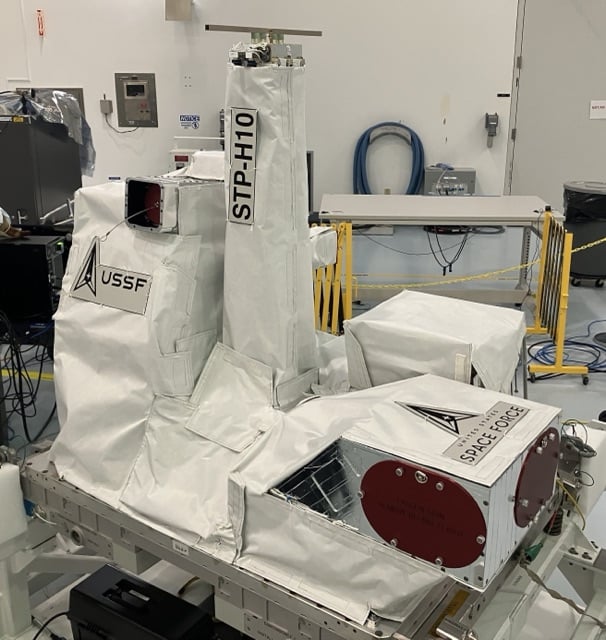
| | |  | | | In other news 🚀 | | The Space Force teamed with NASA for the launch of the Space Test Program-Houston 10 (STP-H10) mission, which delivered five DoD and one NASA experimental science payloads. These experiments were launched April 21 to the International Space Station (ISS) aboard SpaceX's Commercial Resupply Service (CRS)-32 mission. The experiments traveled inside a Cargo Dragon spacecraft.
The DoD Space Test Program seeks to advance space technology by providing experimental demonstration opportunities and rapid access to space for research and development projects.
|  | | |  | | | | The U.S. Space Force Weather System Follow-on - Microwave (WSF-M) satellite launched in April 2024 has completed an operational trial period and has been declared ready for initial use.
The data gathered by WSF-M, made by BAE Systems, will be provided to meteorologists for the generation of weather products used to conduct military mission planning and operations. "The performance of the first WSF-M satellite during on-orbit evaluations exceeded our expectations," said Col. Daniel Visosky, senior materiel leader at the Space Systems Command.
| | | | U.S. Space Force Col. Tim Trimailo is the new director of the Commercial Space Office at the Space Systems Command. The office, known as COMSO, is responsible for the acquisitions of commercial space services such as satellite communications and space domain awareness data.
Trimailo was previously at the Space Development Agency and at the Defense Advanced Research Projects Agency where he worked on satellite programs.
He replaces Col. Richard Kniseley, who has taken a new position in legislative affairs at the Department of the Air Force.
| | | | Thanks for reading! Please send comments, suggestions and tips to serwin@spacenews.com | | | | |



No comments:
Post a Comment