Plus: A new naming scheme for space weapons
SpaceNews journalists are reporting from the 2025 Spacepower Conference, held in Orlando, Florida. We'll bring highlights to your inbox — for full coverage, go to spacenews.com/spacepower-conference-2025/.
|
|
|
|
| By Sandra Erwin The Space Force Association, a nonprofit advocacy group, announced plans to create a virtual education and analysis hub aimed at improving how U.S. leaders understand space as a military domain.
The initiative, called the National Spacepower Center, is intended to use immersive and simulation technologies to explain the nature of space warfare, the role of space systems in national security, and the policies and strategies that underpin U.S. space power. The association said the effort is focused on education and concept development rather than operations.
SFA said the center is designed to help U.S. and allied policy makers better grasp how space capabilities support modern warfare, from missile warning and satellite communications to navigation and intelligence. While space systems are central to joint operations, many decision-makers have limited exposure to how those systems are threatened or employed in conflict.
| | |
|
|
|
| The U.S. Space Force is rolling out a new naming scheme for its satellites, cyber tools and other space-warfare systems, a move aimed at giving its arsenal the kind of recognizable nickname long used across the military, according to Chief of Space Operations Gen. Chance Saltzman.
U.S. Secretary of the Air Force Troy Meink cautioned that the United States should not assume China's accelerating progress in space and missile technology is simply the result of copying American systems, arguing Beijing is demonstrating significant independent innovation.
K2 Space said Dec. 11 it raised $250 million in new funding that values the satellite manufacturing startup at $3 billion. The Series C round was led by Redpoint, with additional backing from accounts advised by T. Rowe Price Associates, Hedosophia, Altimeter, Lightspeed and Alpine Space Ventures. | | |
|
|
|
| The Defense Advanced Research Projects Agency has awarded BAE Systems a $16 million contract to continue work on software that aims to keep "constant custody" of large numbers of ground targets by automatically retasking sensors across government and commercial satellite constellations.
Government and industry analysts have identified the refueling of satellites in geostationary orbit as one of the most practical and immediately valuable applications of on-orbit servicing, recommending focused investment, early demonstrations and coordinated policy work to bring the capability into routine use. |
|
|
|
| | FROM SPACENEWS | 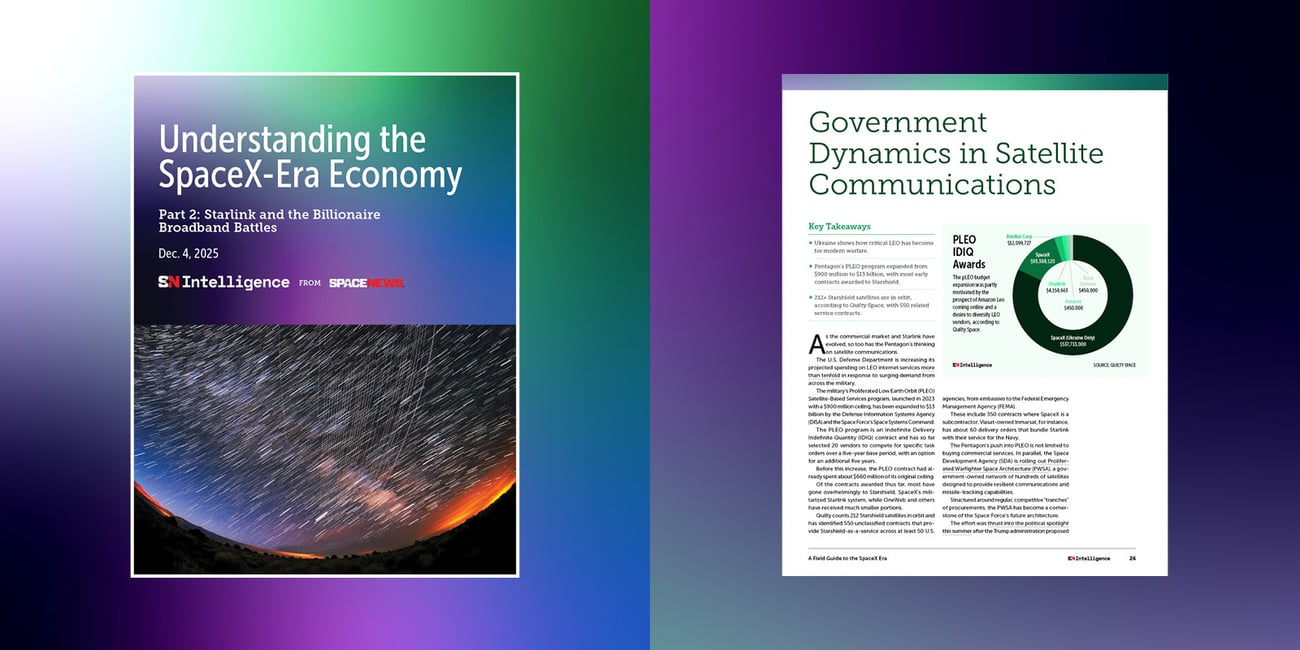 | As Starlink becomes embedded in military communications and government systems around the world, its unprecedented growth raises questions about sovereignty, supply-chain resilience and operational risk. Part 2 of our free Understanding the SpaceX-Era Economy series explores how the United States and its allies are recalibrating policy around proliferated LEO, while China and others accelerate their own strategic constellations. It's essential reading for defense and government professionals navigating an era where commercial space infrastructure is inseparable from national security. Download the report from SpaceNews Intelligence. |
|
|
|
|






No comments:
Post a Comment