Plus: The Space Force's AI challenge
| By Jeff Foust
In today's edition: the Space Force's AI challenge, a close approach between a Starlink satellite and one launched by China, EraDrive raises funding for autonomous spacecraft operations and more.
If someone forwarded you this edition, sign up to receive it in your inbox every weekday. Have thoughts or feedback? You can hit reply to let me know.
| | | | | | Top Stories
Problems with a NASA Mars orbiter that has been out of contact for 10 days may be more serious than first thought. NASA said Monday it has yet to restore contact with the MAVEN spacecraft, which did not resume communications after going behind Mars as seen from Earth on Dec. 6. In an update Monday, NASA said that a "brief fragment of tracking data" received as part of a radio science experiment the day contact was lost showed that the spacecraft appeared to be spinning and was not in its planned orbit. That has led to speculation that the spacecraft suffered an "energetic event" of some kind, like a burst tank or propellant line, that could spin the spacecraft and impart thrust. NASA said it is continuing efforts to restore contact, but that will be hampered by a solar conjunction in early January when Mars goes behind the sun as seen from Earth, disrupting communications. [SpaceNews]
The Space Force is using a competition to encourage new uses of AI within the service. An AI-powered onboarding assistant designed to help new Space Force members navigate the earliest stages of the service won the U.S. Space Force's annual AI Challenge, officials announced last week. The Space Force AI Challenge is an annual competition intended to accelerate the development and adoption of AI tools that address concrete problems facing the service, with 29 teams participating in this year's competition. Speaking at the Spacepower Conference last week, Air Force Secretary Troy Meink called on the service to build AI literacy inside the force, rather than relying primarily on contractors for AI-driven solutions. [SpaceNews]
A reported close approach between a SpaceX Starlink satellite and a payload from a Chinese launch highlighted the continued challenges of coordinating space operations. A SpaceX executive said late Friday that a satellite from a Kinetica-1 launch two days earlier passed within 200 meters of a Starlink satellite. CAS Space, the Chinese launch operator, said it would look into the incident but noted it took place long after the launch operations ended. Commercial space situational awareness firms did not publicly confirm the close approach. The incident comes after the Chinese government appeared to be more willing to coordinate satellite operations, including potential conjunctions, with NASA and Western satellite companies. [SpaceNews]
NASA intends to test the use of SpaceX's Starshield network to support the Deep Space Network. In a procurement filing last week, the company said it planned to buy several Starshield terminals and data subscriptions from SpaceX to "enhance the resiliency and diversity" of existing fiber-optic links between the three DSN sites in Australia, California and Spain. Starshield is an offshoot of SpaceX's Starlink constellation designed to provide communications, imaging and other services, primarily for national security customers. The limited information Starlink has disclosed about Starshield emphasized secure communications. NASA has not previously discussed using Starshield but is testing the use of commercial Starlink services to support data relay for satellites in Earth orbit. [SpaceNews]
GomSpace won a contract from a startup to provide a key subsystem for a planned data relay satellite. GomSpace will provide the radio-frequency subsystem for Interoperability Protocol over Satellite – Technology Demonstration Mission (IPoS-TDsM), a 3U cubesat being built by Apolink for launch next year. The cubesat will test how signals can be received from other low Earth orbit spacecraft and forwarded to the ground, and is a precursor of a constellation of larger spacecraft to provide data relay services. [SpaceNews]
EraDrive, a Stanford University spinoff developing software and hardware for satellite autonomy, raised $5.3 million. The seed round, announced Tuesday, was led by Hackstack Ventures with participation from several other investors. The investment will help EraDrive accelerate development of hardware, including cameras and optics for space situational awareness in low-Earth, geostationary orbit and beyond Earth orbit. EraDrive is developing a software-hardware module leveraging AI to make satellites autonomous and aware of their surroundings. [SpaceNews]
| | | | | | Other News
United Launch Alliance launched another set of satellites for Amazon's broadband constellation early Tuesday. An Atlas 5 lifted off from Cape Canaveral at 3:28 a.m. Eastern and put 27 Amazon Leo satellites into orbit. This was the fourth Atlas launch of operational satellites for Amazon Leo, the constellation formerly known as Project Kuiper. There are now 180 Amazon Leo satellites in orbit, just over 5% of the planned constellation of more than 3,200 satellites. [Space.com]
China launched a remote sensing satellite late Monday. A Long March 4B lifted off at 10:17 p.m. Eastern from the Taiyuan Satellite Launch Center. It placed into orbit Ziyuan-3 (04), a satellite part of a long-standing national civil space infrastructure program. It carries a stereo mapping camera, a multispectral camera and a laser altimeter for use in natural resource applications. [SpaceNews]
Rocket Lab announced, and then scrubbed, an Electron launch Monday. The company called off the Electron launch of the NEONSAT-1A spacecraft on an Electron from New Zealand after aborting the liftoff immediately after engine ignition. Rocket Lab said that "out of family" data from a sensor triggered the abort, and did not announce a new launch date. Rocket Lab announced the launch earlier in the day after calling off a first launch attempt last week. [Spaceflight Now]
A startup spun out of the University of California is finding space applications for its technology to damp vibrations. MetaSeismic uses AI to create materials to mitigate vibration and shock, initially to protect electronics from earthquakes. The company, though, found a new application for its material through testing with NASA, which found that it could damp launch vibrations on spacecraft components. The company tested the material at the Marshall Space Flight Center through a Space Act Agreement. [SpaceNews]
Vast is seeking research proposals for its first commercial space station. The company announced Monday a request for proposals for ground- and space-based research projects for the Haven-1 station, set to launch next year. The company says the lab on Haven-1 can support research in areas ranging from pharmaceutical development to plant growth and human health. The company recently hired as its principal scientist Meghan Everett, former NASA ISS deputy program scientist, to develop "a robust multi-disciplinary research portfolio" for Haven-1 and future stations. [Vast]
Virgin Galactic plans to work with Lawrence Livermore National Lab (LLNL) on additional uses of the company's aircraft. Virgin said Monday it will study how to incorporate LLNL sensors on its launch vehicles, the term the company uses for the aircraft that take its suborbital spaceplanes aloft. Virgin has previously said it is exploring other uses for such aircraft, noting their capabilities to take heavy payloads to high altitudes for potentially long-endurance flights. [Virgin Galactic]
| | | | | FROM SPACENEWS | 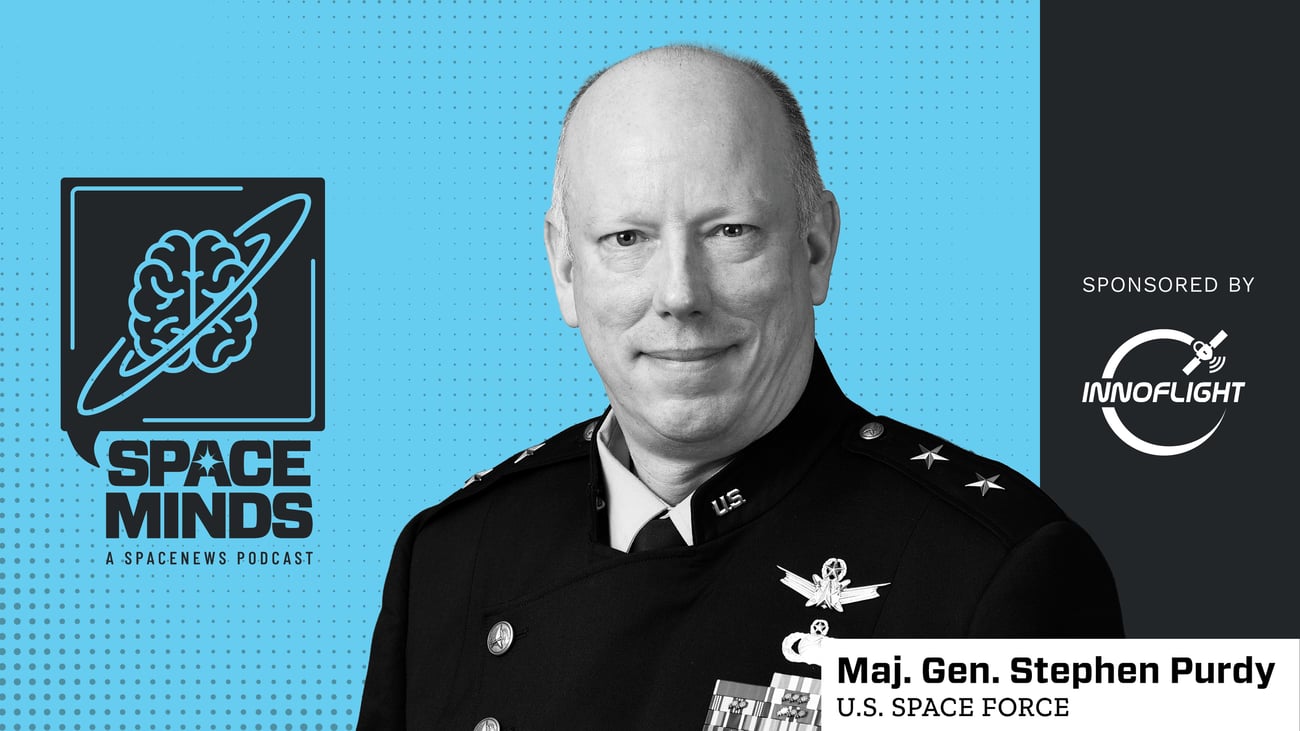 | | Why the Space Force says 2025 changed everything: In the first of our episodes recorded during the Spacepower Conference in Orlando, host Mike Gruss sits down with Maj. Gen. Stephen Purdy, one of the U.S. Space Force's most influential acquisition leaders and recipient of this year's SpaceNews Icon Award for Military Space Achievement. Purdy details how commercial space, venture-backed startups and emerging technologies — from space mining to in-space nuclear systems — are reshaping how the U.S. prepares for the future of space warfare. Watch or listen now. | | | | | | Problems for Breakfast
| "ESCAPADE is a team that eats problems for breakfast. I don't know what they eat for lunch."
| | – Joe Westlake, director of NASA's heliophysics division, mentioning the recently launched ESCAPADE mission to Mars during a town hall session at the AGU Annual Meeting on Monday.
| | | | | | |






No comments:
Post a Comment